Category Archives: Potential Risk of CVE

CVE-2024-21318 – SharePoint Enterprise Server 2016, 2019 and Subscription Edition design limitation (10th Jan 2024)

Preface: Under normal circumstances, CVEs are recorded sequentially every year. Microsoft announced CVE-2024-21318 on January 9, 2024. It’s the start of a new year, and this record let me speculated that whether there are plenty of design weakness found in 2023. But it is waiting to be verified. Due to the huge amount of data, it need to wait for the official CVE reference number. So, it carry forward to 2024. This brings the total to five figures.

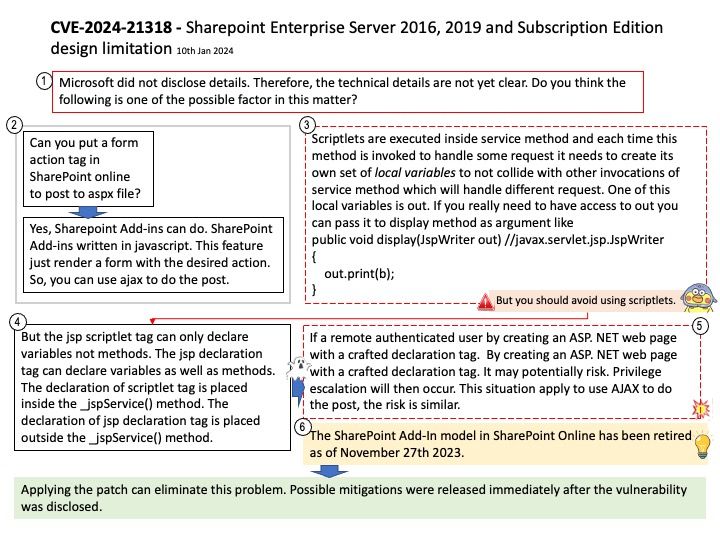
Background: Microsoft did not disclose details. Therefore, the technical details are not yet clear. Do you think SharePoint Add-in is one of the possible factor in this matter?

A SharePoint Add-in is a self-contained piece of functionality that extends the capabilities of SharePoint websites to solve a well-defined business problem. Add-ins don’t have custom code that runs on SharePoint servers. Instead, all custom logic moves “up” to the cloud, or “down” to client computers, or “over” to an on-premises server that is outside the SharePoint farm or SharePoint Online subscription. Keeping custom code off SharePoint servers provides reassurance to SharePoint administrators that the add-in can’t harm their servers or reduce the performance of their SharePoint Online websites.

Business logic in a SharePoint Add-in can access SharePoint data through one of the several client APIs included in SharePoint. Which API you use for your add-in depends on certain other design decisions you make.

Vulnerability details: Microsoft SharePoint Server Remote Code Execution Vulnerability. Technical details unknown.

Remedy: Applying the patch can eliminate this problem. Possible mitigations were released immediately after the vulnerability was disclosed.

Official announcement: Please refer to the link for details –

https://msrc.microsoft.com/update-guide/vulnerability/CVE-2024-21318
CVE-2023-34326: Potential risk allowing access to unindented memory regions (8th JAN 2024)

Preface: In fact, by the time the vulnerability was released to the public, the design limitations and/or flaws had already been fixed. You may ask, what is the discussion space for the discovered vulnerabilities? As you know, an increasing number of vendors remain compliant with CVE policies, but the technical details will not be disclosed. If your focus is understanding, even if the vendor doesn’t release any details. You can learn about specific techniques as you learn. The techniques you learn can expand your horizons.

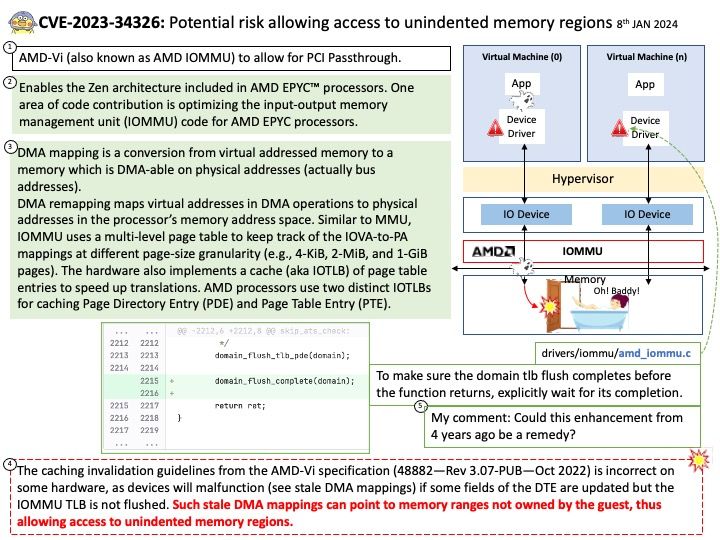
Background: AMD-Vi represents an I/O memory management unit (IOMMU) that is embedded in the chipset of the AMD Opteron 6000 Series platform. IOMMU is a key technology in extending the CPU’s virtual memory to GPUs to enable heterogeneous computing. AMD-Vi (also known as AMD IOMMU) to allow for PCI Passthrough.

DMA mapping is a conversion from virtual addressed memory to a memory which is DMA-able on physical addresses (actually bus addresses).

DMA remapping maps virtual addresses in DMA operations to physical addresses in the processor’s memory address space. Similar to MMU, IOMMU uses a multi-level page table to keep track of the IOVA-to-PA mappings at different page-size granularity (e.g., 4-KiB, 2-MiB, and 1-GiB pages). The hardware also implements a cache (aka IOTLB) of page table entries to speed up translations.

AMD processors use two distinct IOTLBs for caching Page Directory Entry (PDE) and Page Table Entry (PTE) (AMD, 2021; Kegel et al., 2016).

Ref: If your application scenario does not require virtualization, then disable AMD Virtualization Technology. With virtualization disabled, also, disable AMD IOMMU. It can cause differences in latency for memory access. Finally, also disable SR-IOV.

Vulnerability details: The caching invalidation guidelines from the AMD-Vi specification (48882—Rev 3.07-PUB—Oct 2022) is incorrect on some hardware, as devices will malfunction (see stale DMA mappings) if some fields of the DTE are updated but the IOMMU TLB is not flushed. Such stale DMA mappings can point to memory ranges not owned by the guest, thus allowing access to unindented memory regions.

Official announcement: Please refer to the link for details – https://nvd.nist.gov/vuln/detail/CVE-2023-34326

Android Security Bulletin – Released January 2024, covers a vulnerability in August 2023 (CVE-2023-21651) – 4th Jan 2024

Preface: According to the Android Security Bulletin, it releases a security bulletin once a month in the traditional way. However, if design limitations are related to other suppliers. The conclusion of the vulnerability details will be included the responses from relevant manufacturers. Therefore, Qualcomm also released its assessment of the severity of these problems.

I was not paying attention to this vulnerability in August 2023. Out of personal interest, maybe I’ll take this opportunity to dig into the details of this vulnerability. If you are interested, please become my guest.

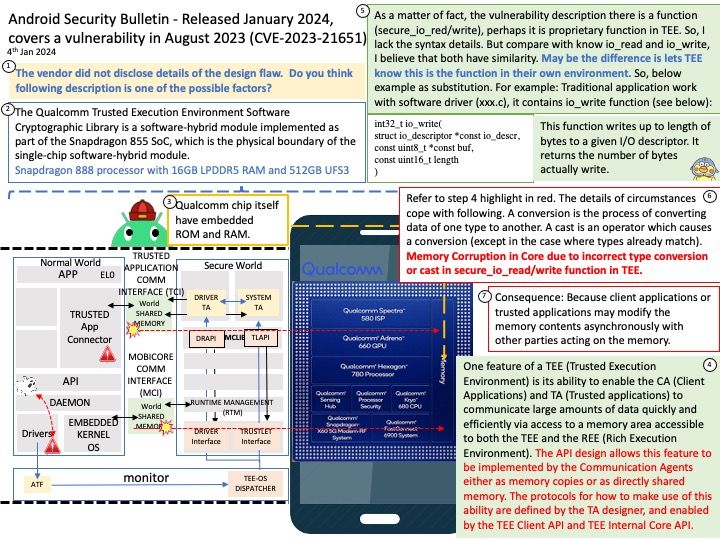
Background: The full name of TEE is trusted execution environment, which is an area on the CPU of mobile devices (smart phones, tablets, smart TVs). The role of this area is to provide a more secure space for data and code execution, and to ensure their confidentiality and integrity.

Other TEE operating systems are traditionally supplied as binary blobs by third-party vendors or developed internally. Developing internal TEE systems or licensing a TEE from a third-party can be costly to System-on-Chip (SoC) vendors and OEMs.

Trusty is a secure Operating System (OS) that provides a Trusted Execution Environment (TEE) for Android. A Trusty application is defined as a collection of binary files (executables and resource files), a binary manifest, and a cryptographic signature. At runtime, Trusty applications run as isolated processes in unprivileged mode under the Trusty kernel

The Qualcomm Trusted Execution Environment software cryptographic library is part of the implemented software hybrid module. As part of the Snapdragon SoC architecture. It is the physical boundary of a single-chip software hybrid module.

Vulnerability details: Memory Corruption in Core due to incorrect type conversion or cast in secure_io_read/write function in TEE.

Official announcement: Please refer to the link for details –

Android: https://source.android.com/docs/security/bulletin/2024-01-01

Qualcomm: https://docs.qualcomm.com/product/publicresources/securitybulletin/august-2023-bulletin.html

CVE-2023-43514 – Use After Free in DSP Services (3rd JAN 2024)

Preface: Is Qualcomm Snapdragon based on Arm? Based on its brand-new ARM CPU core ‘Oryon’, developed from its Nuvia acquisition, Qualcomm’s Snapdragon X Elite SoC is built on TSMC’s 4nm process node. The CPU uses ARM’s 8.7 instruction set and features 12 high-performance ‘Oryon’ cores clocked at 3.8GHz.

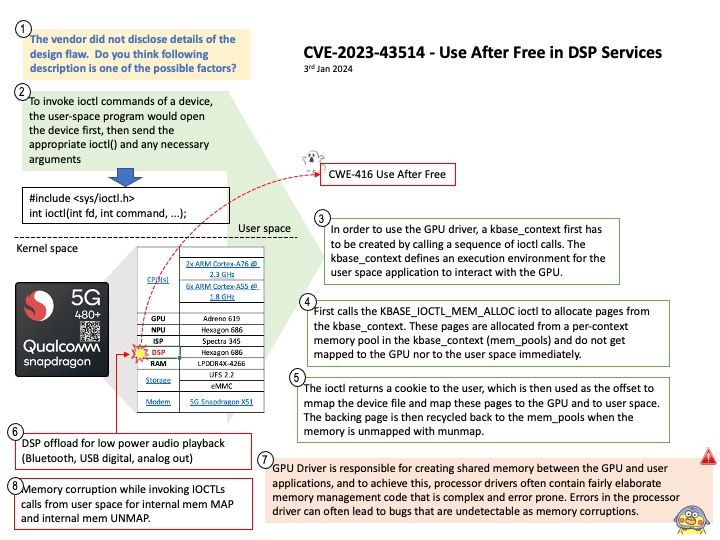
Background: How to call ioctl from user space? To invoke ioctl commands of a device, the user-space program would open the device first, then send the appropriate ioctl() and any necessary arguments. static int mydrvr_ioctl (struct inode *inode, struct file *filp, unsigned int cmd, unsigned long arg);

Ref: A kbase_context object is responsible for managing resources for each driver file that is opened and is unique for each file handle. In particular, the kbase_context manages different types of memory that are shared between the GPU devices and user space applications.

Ref: DSPs are optimized in two key areas compared to classic CPUs. They accelerate common DSP mathematical operations in hardware and boast specific memory architectures designed for real-time data streams. A DSP is designed for performing mathematical functions like “add”, “subtract”, “multiply” and “divide” very quickly.

Vulnerability details: Memory corruption while invoking IOCTLs calls from user space for internal mem MAP and internal mem UNMAP.

Consequence: Use After Free vulnerability in DSP Services

Official announcement: Please refer to the link for details – https://docs.qualcomm.com/product/publicresources/securitybulletin/january-2024-bulletin.html

CVE-2023-33025: Speculate what would cause a vulnerability to become a critical risk level (1st JAN 2024)

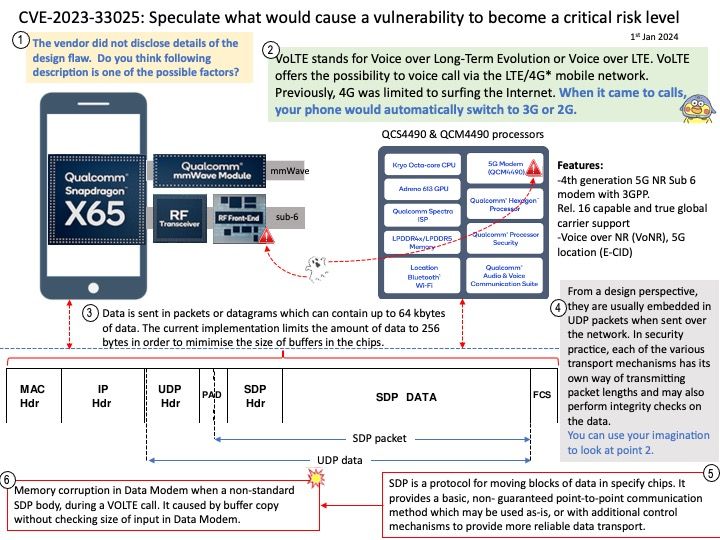
Preface: VoLTE stands for Voice over Long-Term Evolution or Voice over LTE. VoLTE offers the possibility to voice call via the LTE/4G* mobile network. Previously, 4G was limited to surfing the Internet. When it came to calls, your phone would automatically switch to 3G or 2G.

Background: A 5G modem-RF system is a combination of two different technologies that work together to enable 5G communication. The modem is the part of the system that processes the digital signals, including encoding and decoding data, and managing the connection to the network.

Voice over LTE, or VoLTE, is a digital packet technology that uses 4G LTE networks to route voice traffic and transmit data. From technical point of view, VoLTE uses “Internet data,” whereas traditional voice calls are circuit-switched.

Ref: For example: Qualcomm Snapdragon X55 5G Modem-RF System is a comprehensive modem-to-antenna solution designed to allow OEMs to build 5G multimode devices for a new era of connected experiences.

Vulnerability details:  Memory corruption in Data Modem when a non-standard SDP body, during a VOLTE call.

Vulnerability Type:  CWE-120 Buffer Copy Without Checking Size of Input (‘Classic Buffer Overflow’)

Official announcement: Please refer to the link for details – https://docs.qualcomm.com/product/publicresources/securitybulletin/january-2024-bulletin.html

CVE-2023-37188 Artificial Intelligence world versus tiny software components. Do not contempt a noncritical vulnerability! (27th December 2023)

Preface: Data science is an interdisciplinary field that combines statistical analysis, programming, and domain knowledge to extract valuable insights and make data-driven decisions.

Background: 2020 has been a year in which the Blosc program has received significant donations, totalling $55,000 to date. The most important tasks carried out between January 2020 and August 2020. Most of these tasks are related to the fastest projects under development: C-Blosc2 and Caterva (including its cat4py wrapper).

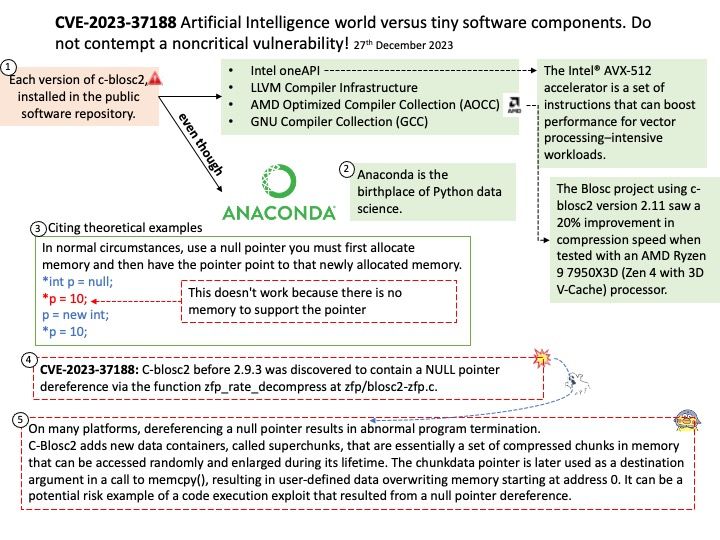
C-Blosc2 is the new major version of C-blosc, and it provides backward compatibility to both the C-Blosc1 API and its in-memory format.

C-Blosc2 adds new data containers, called superchunks, that are essentially a set of compressed chunks in memory that can be accessed randomly and enlarged during its lifetime.

Vulnerability details: C-blosc2 before 2.9.3 was discovered to contain a NULL pointer dereference via the function zfp_rate_decompress at zfp/blosc2-zfp[.]c.

My observation: On many platforms, dereferencing a null pointer results in abnormal program termination.

C-Blosc2 adds new data containers, called superchunks, that are essentially a set of compressed chunks in memory that can be accessed randomly and enlarged during its lifetime. The chunkdata pointer is later used as a destination argument in a call to memcpy(), resulting in user-defined data overwriting memory starting at address 0. It can be a potential risk example of a code execution exploit that resulted from a null pointer dereference.

Official announcement: Please refer to the link for details – https://nvd.nist.gov/vuln/detail/CVE-2023-37188

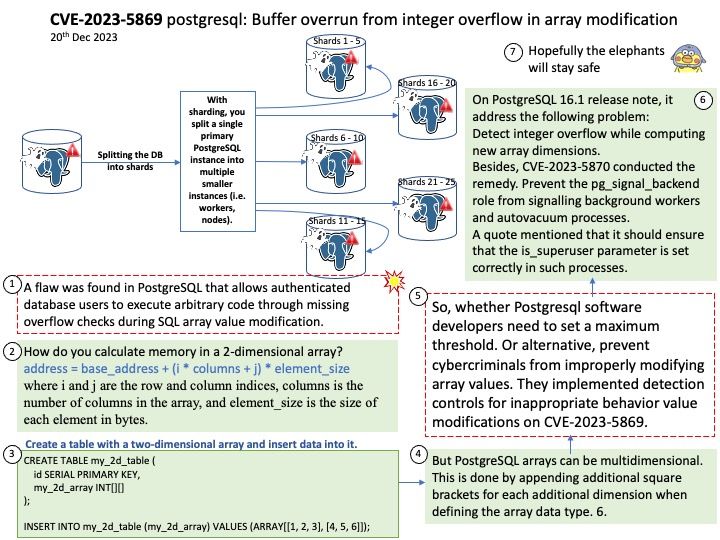
CVE-2023-5869 postgresql: Buffer overrun from integer overflow in array modification (20th Dec 2023)

Preface: PostgreSQL allocates memory from the work_mem pool when a query requires sorting or hashing. If there is not enough memory available in the work_mem pool, PostgreSQL will spill to disk. temp_buffers controls the amount of memory allocated for temporary tables.

Does Postgres write to disk? To guard against unforeseen failures, PostgreSQL periodically writes full page images to permanent storage before modifying the actual page on disk. By doing this, during crash recovery PostgreSQL can restore partially-written pages.

Background: Declaring an array in PostgreSQL is straightforward. An array data type is defined by appending square brackets [] to any valid data type. This could be an array of integers, text, boolean values, or even more complex data types like composite types or other arrays.
Many databases support array fields of a scalar type. SQL allows ARRAY column types. In PostgreSQL INTEGER[5] represents an array of 5 integers.

Vulnerability details: A flaw was found in PostgreSQL that allows authenticated database users to execute arbitrary code through missing overflow checks during SQL array value modification. This issue exists due to an integer overflow during array modification where a remote user can trigger the overflow by providing specially crafted data. This enables the execution of arbitrary code on the target system, allowing users to write arbitrary bytes to memory and extensively read the server’s memory.

Official announcement: Please refer to the link for details – https://nvd.nist.gov/vuln/detail/CVE-2023-5869

CVE-2023-28546: Buffer Copy Without Checking Size of Input in SPS Applications (19th Dec 2023)

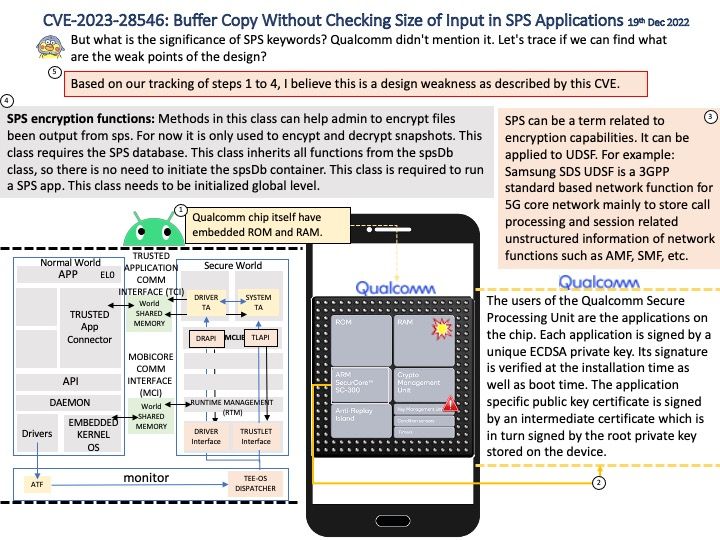
Preface: But what is the significance of SPS keywords? Qualcomm didn’t mention it. Let’s trace if we can find what are the weak points of the design?

Background: The Qualcomm Secure Processing Unit is an isolated hardware security core implemented in the Snapdragon 8cx Gen 3 Mobile Compute Platform SoC. As such, this security core incorporates standalone ROM, RAM, CPU, cryptographic acceleration units, countermeasure sensors, one-time programmable memory, etc. Key generation, signing and verification utilizing RSA and ECC cryptosystems across a range of modes.

Ref: SPS can be a term related to encryption capabilities. It can be applied to UDSF. For example: Samsung SDS UDSF is a 3GPP standard based network function for 5G core network mainly to store call processing and session related unstructured information of network functions such as AMF, SMF, etc.

SPS encryption functions: Methods in this class can help admin to encrypt files been output from sps. For now it is only used to encypt and decrypt snapshots. This class requires the SPS database. This class inherits all functions from the spsDb class, so there is no need to initiate the spsDb container. This class is required to run a SPS app. This class needs to be initialized global level.

Vulnerability details: Memory Corruption in SPS Application while exporting public key in sorter TA.

Official announcement: Please refer to the link for details –

https://nvd.nist.gov/vuln/detail/CVE-2023-28546

https://docs.qualcomm.com/product/publicresources/securitybulletin/december-2023-bulletin.html

CVE-2023-4622: It should patch by processor vendor or SUSE? (14th Dec 2023)

Preface: Unix domain sockets and network sockets have different security characteristics. In general, Unix domain sockets are considered to be more secure than network sockets, as they are not exposed to the network and are only accessible to processes on the same machine.

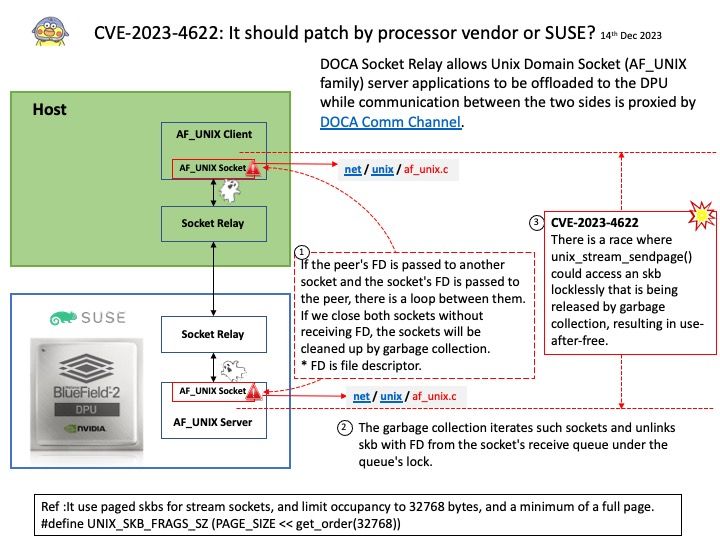
Background: A Unix domain socket aka UDS or IPC socket (inter-process communication socket) is a data communications endpoint for exchanging data between processes executing on the same host operating system. It is also referred to by its address family AF_UNIX .

DOCA Socket Relay allows Unix Domain Socket (AF_UNIX family) server applications to be offloaded to the DPU while communication between the two sides is proxied by DOCA Comm Channel.

Vulnerability details: A use-after-free vulnerability in the Linux kernel’s af_unix component can be exploited to achieve local privilege escalation. The unix_stream_sendpage() function tries to add data to the last skb in the peer’s recv queue without locking the queue. Thus there is a race where unix_stream_sendpage() could access an skb locklessly that is being released by garbage collection, resulting in use-after-free.

Official announcement: Please refer to the link for details – https://nvd.nist.gov/vuln/detail/CVE-2023-4622

About CVE-2023-40078: The OPUS a2dp on the Android platform has a design flaw that may lead paired device escalation of privilege (14th Dec 2023)

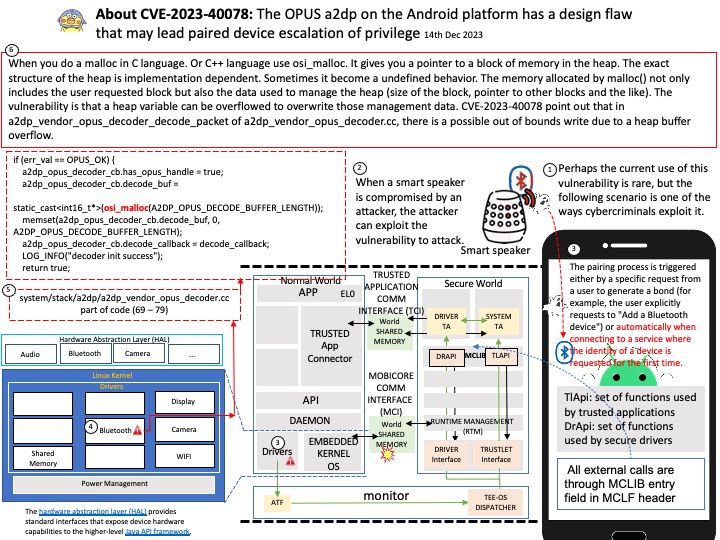
Preface: A2DP is a protocol supported on most Bluetooth Audio devices. Opus is open source , OPUS a2dp being introduced in Android 13.

Background: In Bluetooth, there is a possibility of code-execution due to a use after free. This could lead to paired device escalation of privilege in the privileged Bluetooth process with no additional execution privileges needed. User interaction is not needed for exploitation. Such design weakness published on 30th Oct, 2023. The CVE reference is CVE-2023-21361.

The advantages of using C++ for Android app development is its ability to create cross-platform apps. By writing platform-agnostic code in C++, you can reuse it for developing iOS apps using tools like Apple’s Xcode and Swift. This allows for efficient code sharing between Android and iOS platforms.

Official announcement: Please refer to the link for details – https://nvd.nist.gov/vuln/detail/CVE-2023-40078