Preface: It is common for application developers to use open source as a reference.
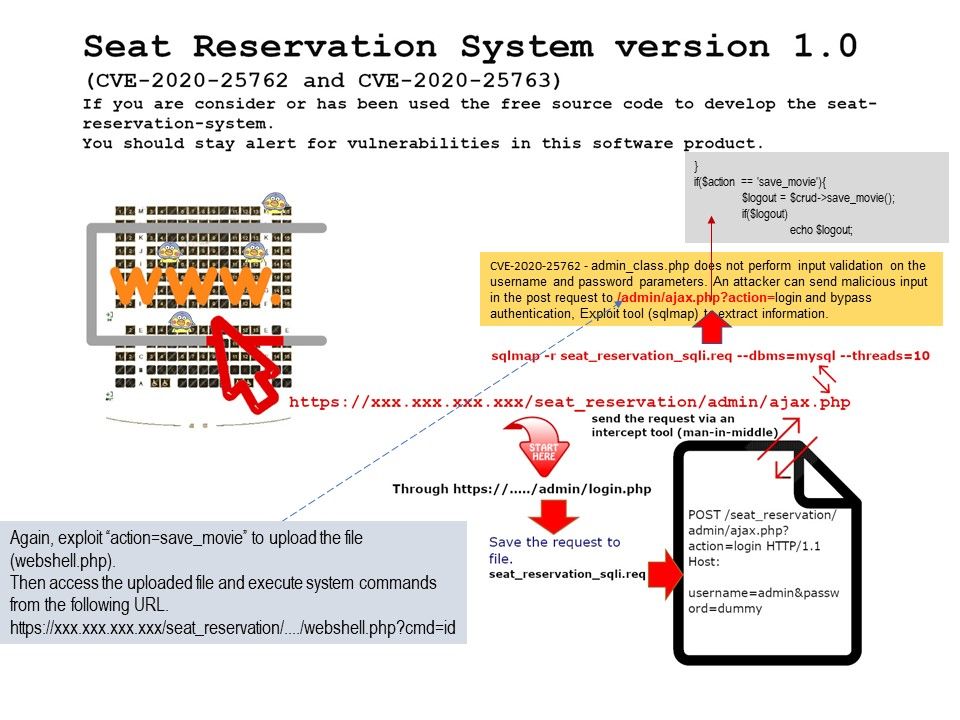
Synopsis: If you are consider or has been used the free source code to develop the seat-reservation-system. You should stay alert for vulnerabilities in this software product.
Vulnerability details:
Seat Reservation System 1.0 Unauthenticated SQL Injection (CVE-2020-25762) Seat Reservation System version 1.0 suffers from an unauthenticated file upload vulnerability that allows for remote code execution. (CVE-2020-25763)
Remedy: You can do a config on your firewall or Nginx to restrict the access of ajax.php and admin function pages.
Preface: The APT organization provides a hard-to-detect malware to attack other hostile campus.
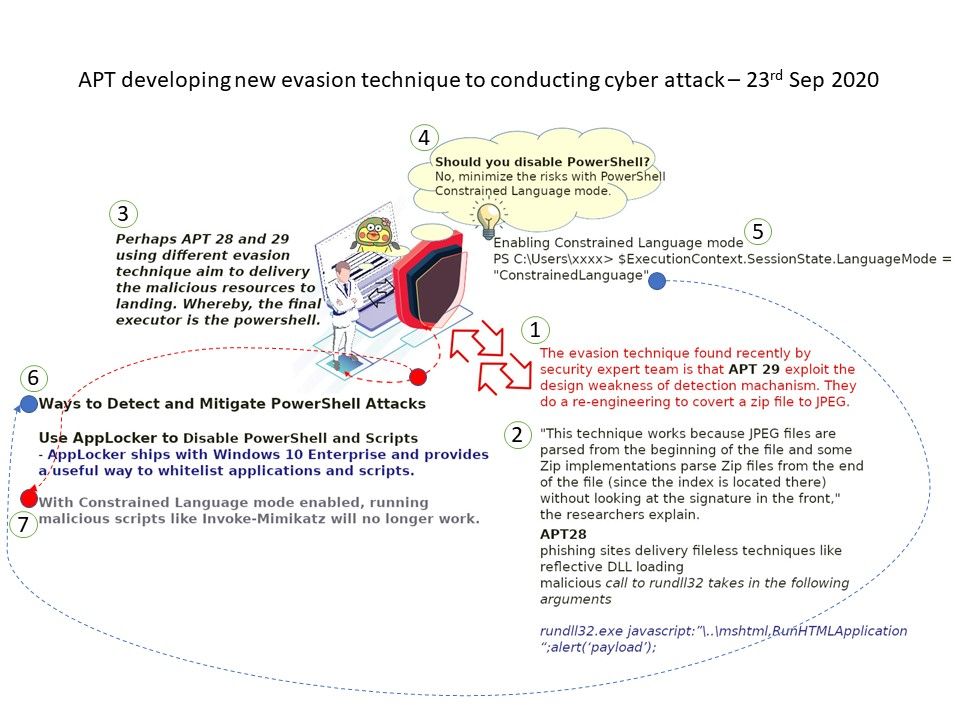
Synopsis: The evasion technique found recently by security expert team is that APT 29 exploit the design weakness of detection machanism. They do a re-engineering to covert a zip file to JPEG. “This technique works because JPEG files are parsed from the beginning of the file and some Zip implementations parse Zip files from the end of the file (since the index is located there) without looking at the signature in the front,” the researchers explain.
Perhaps APT 28 and 29 using different evasion technique aim to delivery the malicious resources to landing. Whereby, the final executor is the power shell.
So called Zebrocy. Its function is mainly Downloader. The evasion effect is better than the technique use by APT 29. After running, it will perform a persistence operation and pop up an error message box to confuse the user. When it is started with specific parameters, a screenshot will be taken. Through the timer callback function, send data to the remote server and wait for the subsequent payload to be downloaded.
Should you disable PowerShell? No, minimize the risks with PowerShell Constrained Language mode.
Enabling Constrained Language mode ^ PS C:\Users\xxxx> $ExecutionContext.SessionState.LanguageMode = “ConstrainedLanguage”
This could be configured in registry HKLM\System\CurrentControlSet\Control\SESSION MANAGER\Environment__PSLockdownPolicy .
Running PS as Admin you can simple remove this property Remove-ItemProperty -path “HKLM:\SYSTEM\CurrentControlSet\Control\Session Manager\Environment\” -name __PSLockdownPolicy
Recommended article: PSLockDownPolicy and PowerShell Constrained Language Mode – https://docs.microsoft.com/en-us/archive/blogs/kfalde/pslockdownpolicy-and-powershell-constrained-language-mode
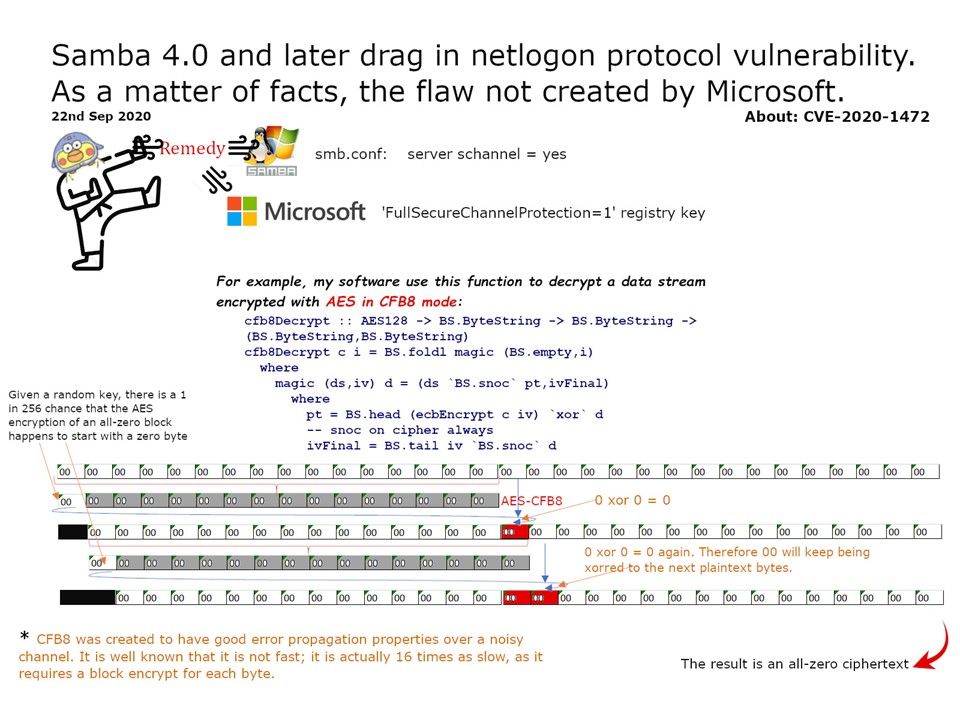
Preface: CFB8 was created to have good error propagation properties over a noisy channel. It is well known that it is not fast; it is actually 16 times as slow, as it requires a block encrypt for each byte.
Details: CVE-2020-1472, also known as “Zerologon,” was given a “critical” security rating from Microsoft. It has possibility let attacker gain fully control all identity services in the AD domain. As a result, any device under the domain will run malicious programs. But this headache will be expand to other 3rd party solution provider. The US government issued an emergency order requiring the Zerologon patch to be completed by next week.
My observation: If you have windows policy applied – accounts locked after invalid login attempts for 3 times. Perhaps it will avoid this attack.
Remediation on Samba server: In samba server config (smb.conf) modify ‘server schannel = yes
Preface: Companies large and small are using Rust in production all over the world, including Mozilla, Dropbox, npm, Postmates, Braintree and others.
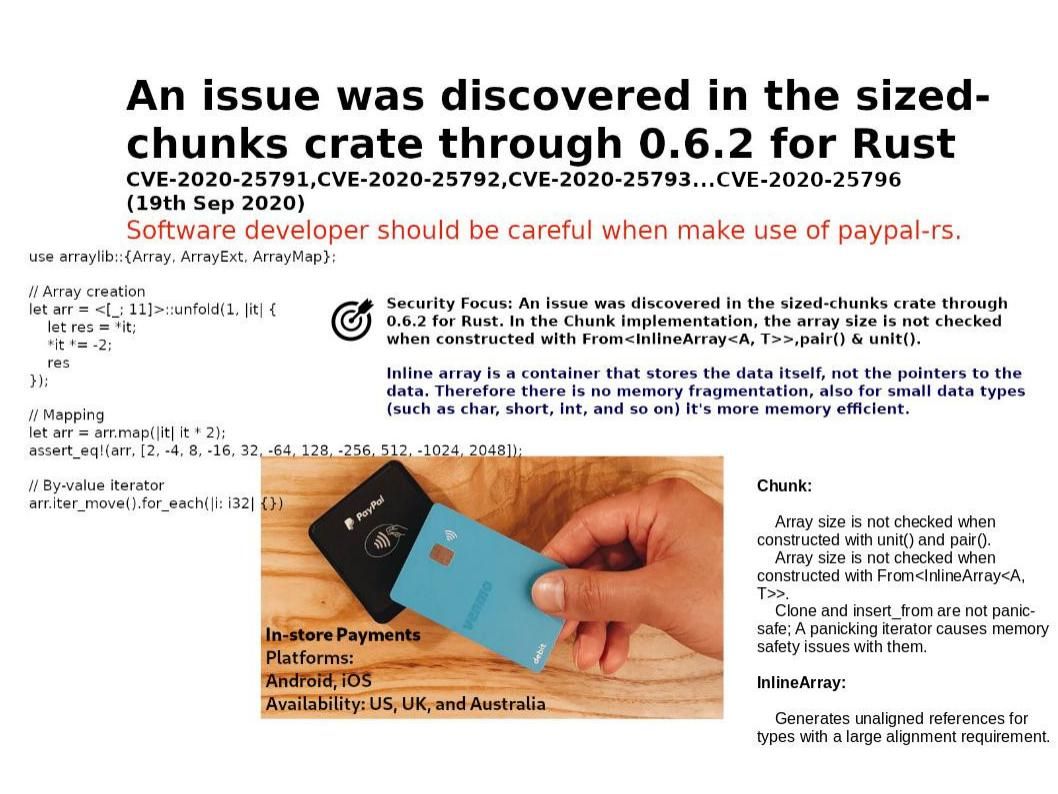
Vulnerability details: An issue was discovered in the sized-chucks crate through 0.6.2 for Rust CVE-2020-25791…CVE-2020-25796. Chunk: – Array size is not checked when constructed with unit() and pair() – Array size is not checked when constructed with From<InlineArray<A, T>>. – Clone and insert_from are not panic-safe (memory safety issues) InlineArray: – Generates unaligned references for types with a large alignment requirement.
Rust does not implement Default for all arrays because it does not have non-type polymorphism. Rust does not implement Default for all arrays because it does not have non-type polymorphism. If the design do not contain check array mechanism fo constructing structures (“structs”) by specify type. Perhaps there is no proof of concept to exploit this vulnerability in the moment. However it looks that it provides a way for attacker exploit this design limitation in future. In the moment, it require to waiting for the developer do the remediation.
Preface: The popularity of NFC mobile payments is owed to its ease of use and improved security options. Near-field communication (NFC) enables smartphones to exchange data and function as a payment device. It stores the customer’s credit card details and allows the user to pay at NFC POS terminals through smartphones.
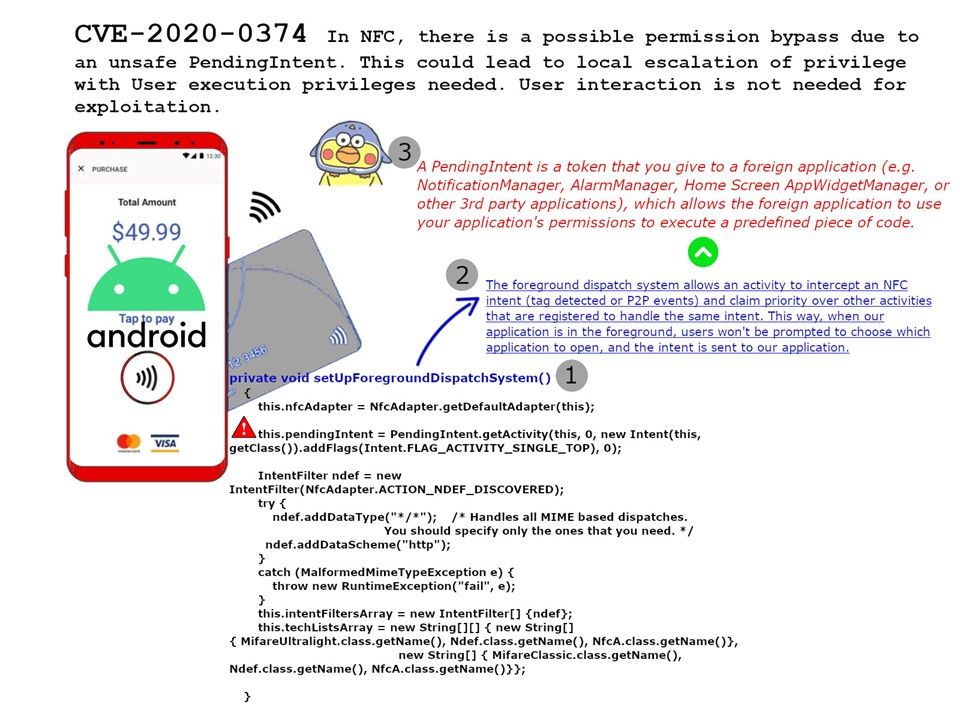
Vulnerability details: In NFC, there is a possible permission bypass due to an unsafe “PendingIntent”. This could lead to local escalation of privilege with User execution privileges needed. User interaction is not needed for exploitation.
By giving a “PendingIntent” to another application, you are granting it the right to perform the operation you have specified as if the other application was yourself (with the same permissions and identity). As such, you should be careful about how you build the “PendingIntent”: almost always, for example, the base Intent you supply should have the component name explicitly set to one of your own components, to ensure it is ultimately sent there and nowhere else.
Reference: A PendingIntent is a token that you give to a foreign application (e.g. NotificationManager, AlarmManager, Home Screen AppWidgetManager, or other 3rd party applications), which allows the foreign application to use your application’s permissions to execute a predefined piece of code.
Preface: The firewall does not display the Captive Portal web form to users until you Configure Authentication Policy rules that trigger authentication when users request services or applications.
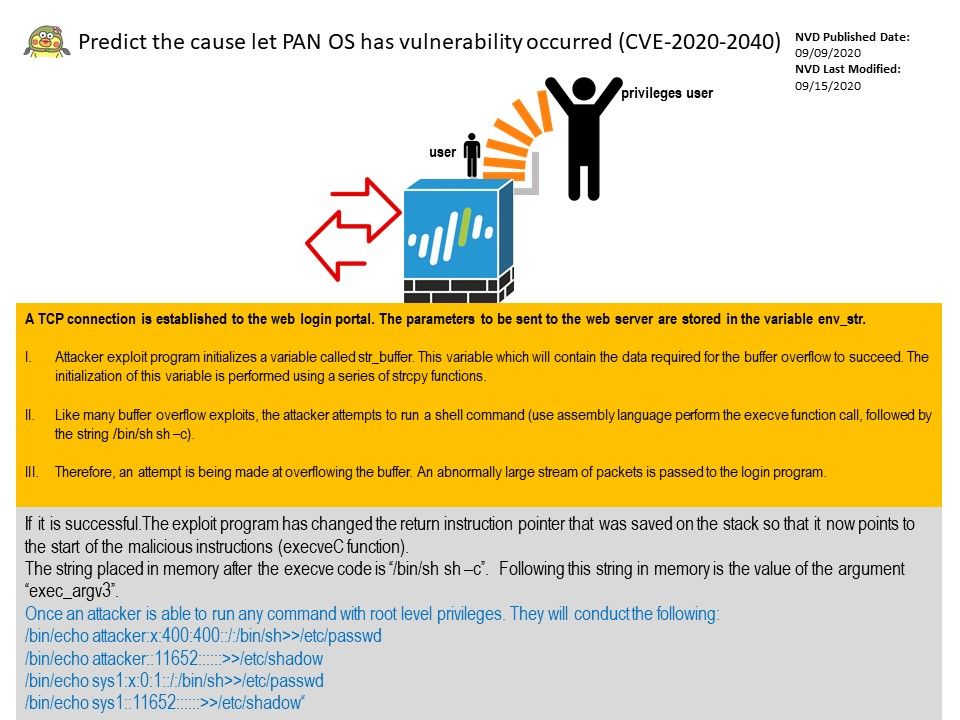
Vulnerability details: A buffer overflow vulnerability in PAN-OS allows an unauthenticated attacker to disrupt system processes and potentially execute arbitrary code with root privileges by sending a malicious request to the Captive Portal or Multi-Factor Authentication interface.
When a program (or subroutine) executes, it has a certain area of memory set aside called a stack (used for storing dynamically allocated variables). The stack also stores a return address to the program that invoked it. This allows a return to the code that was executing before the subroutine was called.
The goal of a buffer overflow attack is to overwrite the area of the stack where the return address is stored. The overwritten data will contain a new memory address pointing to the code that give a way for attacker to execute arbitrary code with privileges.
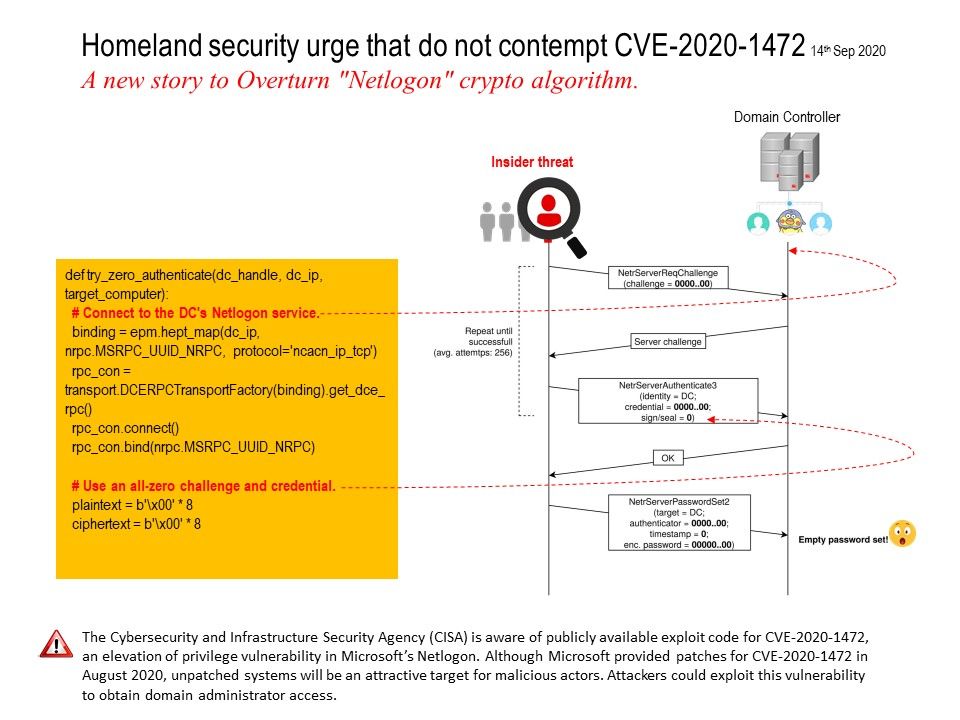
Security Focus: By sending a number of Netlogon messages in which various fields are filled with zeroes, an attacker can change the computer password of the domain controller that is stored in the AD (refer to Index 1). This can then be used to obtain domain admin credentials and then restore the original DC password.
Index 1: 0 xor 0 = 0 agian, all subsequent blocks fed to AES will be all-zero. And therefore 00 will keep being xorred to the next plaintext bytes.
Important notice by US Homeland Security: The Cybersecurity and Infrastructure Security Agency (CISA) is aware of publicly available exploit code for CVE-2020-1472, an elevation of privilege vulnerability in Microsoft’s Netlogon. Although Microsoft provided patches for CVE-2020-1472 in August 2020, unpatched systems will be an attractive target for malicious actors. Attackers could exploit this vulnerability to obtain domain administrator access.
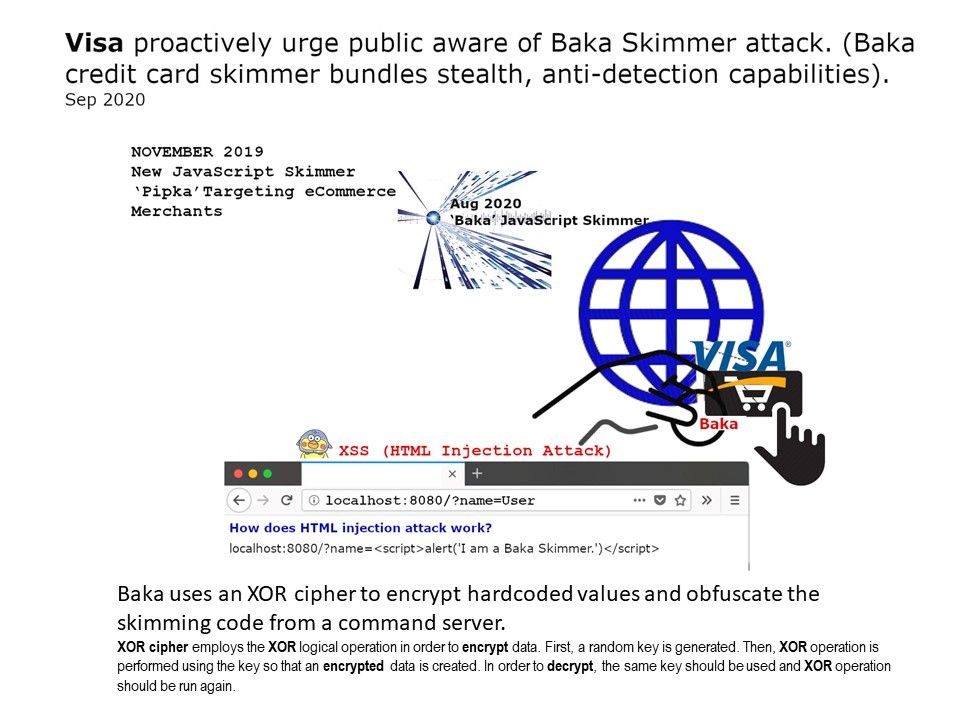
Preface: Visa identified a previously unknown eCommerce skimmer, and named the skimmer ‘Baka’.
Synopsis: The malicious JavaScript code aimed to avoid detection for modern defense system. Baka is stealth, anti-detection capabilities. According to an alert from Visa’s Payment Fraud Disruption (PFD) division, the skimmer also attempts to avoid detection and analysis by “removing itself from memory when it detects the possibility of dynamic analysis with Developer Tools or when data has been successfully exfiltrated”.
Additional: Briefly describe the concept of attack. The attacker sneaks some malicious JavaScript (usually via a <script> tag) into your html which is then executed.
How to protect against this attack? – Sanitizing at the url param layer – Sanitizing at the templating layer
Preface: Bluetooth Low Energy (BLE) is a low power wireless communication technology that can be used over a short distance to enable smart devices to communicate. … Today, the majority of Android and iOS devices on the market incorporate BLE for communication and interaction with other devices.
Ref I: CTKD pairing allows the devices to pair once using either transport method while generating both the BR/EDR and LE Long Term Keys (LTK) without needing to pair a second time. Ref II: Bonding: First, do Pairing to have a secure link, then exchange keys for the next time we meet, so that we don’t need to perform Pairing again to have a secure link.
Vulnerability details: Multiple devices supporting both Bluetooth BR/EDR and LE using Cross-Transport Key Derivation (CTKD) for pairing could allow a remote malicious user to conduct a man-in-the-middle attack.
Remedy:The affected devices include all products using Bluetooth 4.0 to 5.0. Bluetooth after version 5.1 will not be affected due to the addition of restrictions on CTKD.
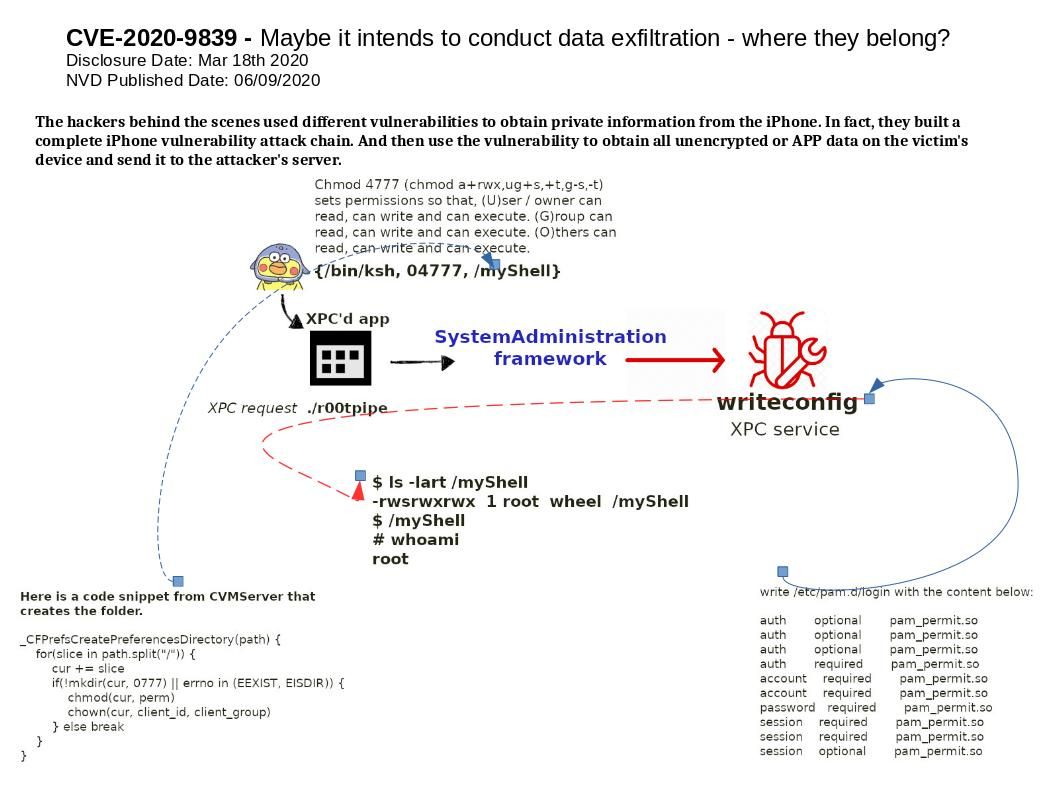
Synopsis: The hackers behind the scenes used different vulnerabilities to obtain private information from the iPhone. In fact, they built a complete iPhone vulnerability attack chain. And then use the vulnerability to obtain all unencrypted or APP data on the victim’s device and send it to the attacker’s server.
Technical details: According to below design definition. XPCService – You can connect to an XPCService strictly through a name Mach Service – You can also connect to a Mach Service strictly through a name NSXPCEndpoint – Communicate between two application processes. The design concept of “com[.]apple[.]cfprefsd[.]daemon” is an XPC service hosted by the cfprefsd daemon.
Vulnerability details: An application may be able to gain elevated privileges. The CFPreferencesSetAppValue function, which is reachable from most unsandboxed processes, can be exploited with a race condition in order to overwrite an arbitrary file as root.
_vul_1.jpg?width=1920&height=1080&fit=bounds)