Category Archives: Potential Risk of CVE

CVE-2023-0240 LINUX KERNEL until 5.10.160 IO_URING (IO_PREP_ASYNC_WORK) memory corruption  (30th Jan 2023)

Preface: The basic idea behind AIO is to allow a process to initiate a number of I/O operations without having to block or wait for any to complete.

Background: System calls are how a program enters the kernel to perform some task. Programs use system calls to perform a variety of operations such as: creating processes, doing network , file IO,…etc.
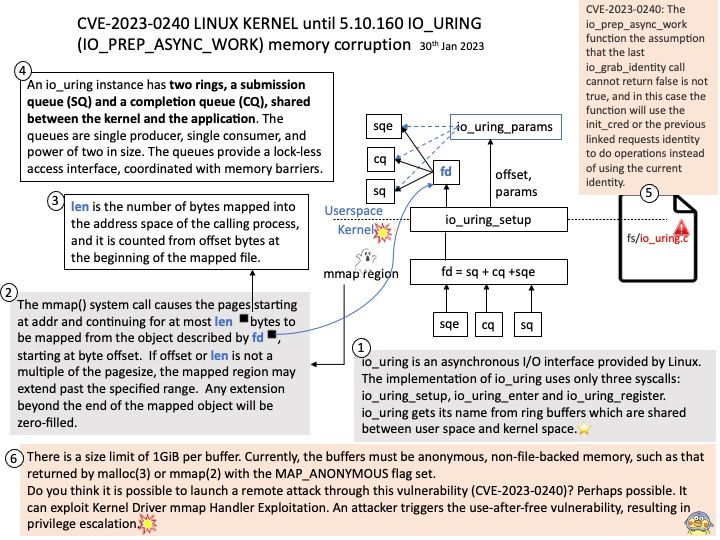
io_uring is an asynchronous I/O interface provided by Linux. The implementation of io_uring uses only three syscalls: io_uring_setup, io_uring_enter and io_uring_register.
io_uring gets its name from ring buffers which are shared between user space and kernel space.

There is a size limit of 1GiB per buffer. Currently, the buffers must be anonymous, non-file-backed memory, such as that returned by malloc(3) or mmap(2) with the MAP_ANONYMOUS flag set.
Do you think it is possible to launch a remote attack through this vulnerability (CVE-2023-0240)? Perhaps possible. It can exploit Kernel Driver mmap Handler Exploitation.

Ref: The use-after-free vulnerability exploits a mistake made by the original author of a software and can result in devastating effects that range from remote code execution to the leaking of sensitive data.

Vulnerability details: There is a logic error in io_uring’s implementation which can be used to trigger a use-after-free vulnerability leading to privilege escalation. In the io_prep_async_work function the assumption that the last io_grab_identity call cannot return false is not true, and in this case the function will use the init_cred or the previous linked requests identity to do operations instead of using the current identity. This can lead to reference counting issues causing use-after-free. We recommend upgrading past version 5.10.161.

Official announcement: For details, please refer to the URL – https://nvd.nist.gov/vuln/detail/CVE-2023-0240
About CVE-2023-0394 (30th Jan 2023)

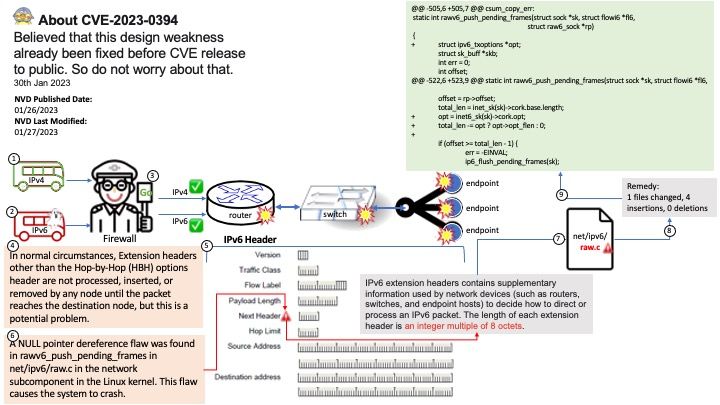
Preface: Believed that this design weakness already been fixed before CVE release to public. So do not worry about that.
To become secure, since a known Potential issues of IPv6 extension headers. Therefore , both stateful and stateless firewalls should do a deep inspection. Otherwise, it can do the evasion silently.

Background: From an early deployment aspect, IPv6 is seen as mandatory for specific 5G traffic flows, such as the 5G Control Plane (CP) and the 5G User Plane (UP). For the Management Plane (MP) and IPSec, IPv6 deployment in the early phase is not seen as mandatory but optional if available. But time will tell, IPv6 will have a major role to play in 5G, as IPv4 addresses, which are already in short supply, could never suffice the ever-growing connection demand further down the road.
IPv6 extension headers contains supplementary information used by network devices (such as routers, switches, and endpoint hosts) to decide how to direct or process an IPv6 packet. The length of each extension header is an integer multiple of 8 octets.

Vulnerability Details: A NULL pointer dereference flaw was found in rawv6_push_pending_frames in net/ipv6/raw.c in the network subcomponent in the Linux kernel. This flaw causes the system to crash.

Ref:In normal circumstances, Extension headers other than the Hop-by-Hop (HBH) options header are not processed, inserted, or removed by any node until the packet reaches the destination node, but this is a potential problem.

For the official announcement, please refer to the following URL: https://nvd.nist.gov/vuln/detail/CVE-2023-0394

Speculation – Cause of Microsoft Edge (Chromium-based) Vulnerabilities (25th Jan 2023)

Preface: Edge was initially built with Microsoft’s own proprietary browser engine, EdgeHTML, and their Chakra JavaScript engine. In late 2018, it was announced that Edge would be completely rebuilt as a Chromium-based browser with Blink and V8 engines.

The new Microsoft Edge is based on Chromium and was released on January 15, 2020. It is compatible with all supported versions of Windows, and macOS.

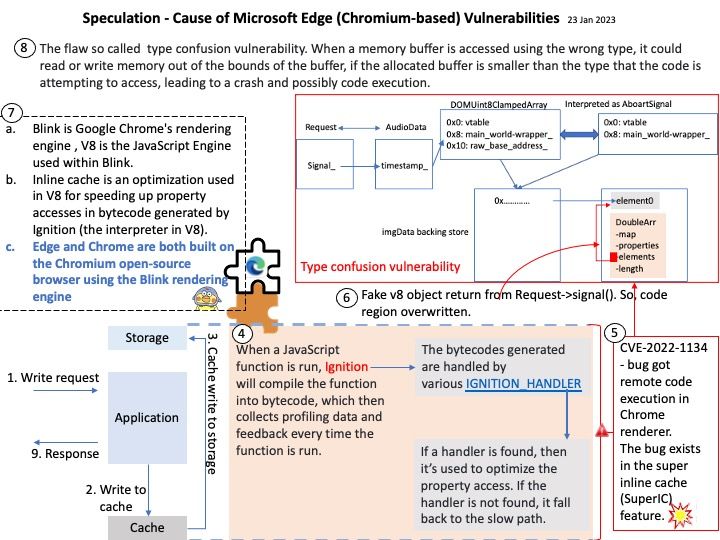
Background: In Chromium, a renderer doesn’t run in the main browser’s process. Different sites will run in different renderers who have different processes. Last year it found flaw occurred. CVE-2022-1134 – bug got remote code execution in Chrome renderer. The bug exists in the super inline cache (SuperIC) feature.

Blink is Google Chrome’s rendering engine , V8 is the JavaScript Engine used within Blink. Inline cache is an optimization used in V8 for speeding up property accesses in bytecode generated by Ignition (the interpreter in V8). 

Edge and Chrome are both built on the Chromium open-source browser using the Blink rendering engine

Vulnerability details:

CVE-2023-21796: Microsoft Edge (Chromium-based) Elevation of Privilege Vulnerability. This CVE ID is unique from CVE-2023-21795.

CVE-2023-21795: Microsoft Edge (Chromium-based) Elevation of Privilege Vulnerability. This CVE ID is unique from CVE-2023-21796.

CVE-2023-21775: Microsoft Edge (Chromium-based) Remote Code Execution Vulnerability

CVE-2023-21719: Microsoft Edge (Chromium-based) Security Feature Bypass Vulnerability

Official announcement: See URL for details – https://learn.microsoft.com/en-us/DeployEdge/microsoft-edge-relnotes-security

Observation: Refer to CVE-2022-1134. A JavaScript object has its map as its first field. In V8, this field is used for determining the type of an object, so by putting the map of a double Array in our fake object, V8 will interpret it as a double array. So, code region overwritten.

Since no details release by vendor. But think it over, in Chromium, a renderer doesn’t run in the main browser’s process. Different sites will run in different renderers who have different processes. However if there is Remote Code Execution Vulnerability happened (similar CVE-2022-1134). Then the impact will be different.

The flaw display in diagram so called  type confusion vulnerability. When a memory buffer is accessed using the wrong type, it could read or write memory out of the bounds of the buffer, if the allocated buffer is smaller than the type that the code is attempting to access, leading to a crash and possibly code execution. Then Exploiting this flaw to get a Privileged Shell.

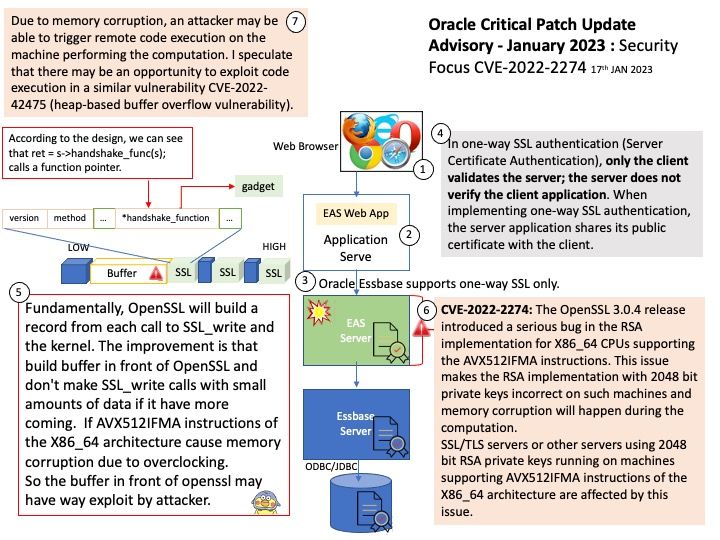
Oracle Critical Patch Update Advisory – January 2023 : Security Focus CVE-2022-2274 (17th JAN 2023)

Preface: Due to the threat posed by a successful attack, Oracle strongly recommends that customers apply Critical Patch Update security patches as soon possible.

Background: AVX-512 debuted in 2016 on Intel’s Xeon Phi x200 (codenamed Knights Landing). However, the instruction set has since found its way into other products from the chipmaker, such as Skylake-SP, Skylake-X, Cannon Lake, and Cascade Lake.
Furthermore, Intel’s support for AVX-512 instructions with its Alder Lake processors.
But an information disclosed by vendor to downstream manufacture that AVX-512 support on Alder Lake much like overclocking.
Remark: Overclocking is the action of increasing a component’s clock rate, running it at a higher speed than it was designed to run.

Oracle Essbase is a business analytics solution that uses a proven, flexible, best-in-class architecture for analysis, reporting, and collaboration. Oracle Essbase can be accessed on an intuitive web interface, or using Microsoft Office, for all of your analytic and business modeling needs, from multi-dimensional analysis to complex procedural business logic applied to your data.

Vulnerability details: The OpenSSL 3.0.4 release introduced a serious bug in the RSA implementation for X86_64 CPUs supporting the AVX512IFMA instructions. This issue makes the RSA implementation with 2048 bit private keys incorrect on such machines and memory corruption will happen during the computation. As a consequence of the memory corruption an attacker may be able to trigger a remote code execution on the machine performing the computation. SSL/TLS servers or other servers using 2048 bit RSA private keys running on machines supporting AVX512IFMA instructions of the X86_64 architecture are affected by this issue.

Observation: Fundamentally, OpenSSL will build a record from each call to SSL_write and the kernel. The improvement is that build buffer in front of OpenSSL and don’t make SSL_write calls with small amounts of data if it have more coming. If AVX512IFMA instructions of the X86_64 architecture cause memory corruption due to overclocking.
So the buffer in front of openssl may have way exploit by attacker.

Due to memory corruption, an attacker may be able to trigger remote code execution on the machine performing the computation. I speculate that there may be an opportunity to exploit code execution in a similar vulnerability CVE-2022-42475 (heap-based buffer overflow vulnerability).

Workaround (RedHat) – Disabling the AVX512IFMA instruction set extension can effectively mitigate this flaw:
export OPENSSL_ia32cap=:~0x200000

Official announcement (Oracle):  For  details please refer to link – https://www.oracle.com/security-alerts/cpujan2023.html

CVE-2022-47630 – See whether your android can skip this vulnerability? Perhaps it can. (16th Jan 2023)

Preface: Why configure Secure Boot? This type of hardware restriction protects the operating system from rootkits and other attacks that may not be detected by antivirus software.

Background: Secure Boot is the process where the operating system boot images and code are authenticated against the hardware before they are authorized to be used in the boot process. The hardware is pre-configured to authenticate code using trusted security credentials. ARM architectures are the most common electronic design in the world, even though x86 is more common in the server market. ARM architectures are used in almost all smartphone designs, as well as in other small mobile devices and laptops.

Arm is the CPU architecture used by all modern smartphones in the Android and Apple ecosystems.

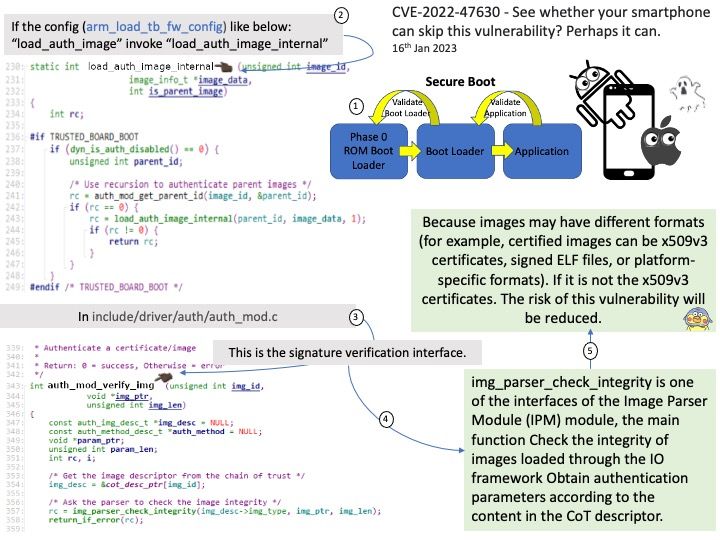
Vulnerability details: Trusted Firmware-A through 2.8 has an out-of-bounds read in the X.509 parser for parsing boot certificates. This affects downstream use of get_ext and auth_nvctr. Attackers might be able to trigger dangerous read side effects or obtain sensitive information about microarchitectural state.

Additional Details – One of its designs is not affected by this vulnerability:

If the config like below:

“load_auth_image” invoke “load_auth_image_internal” – See the attached picture for details

If the platform uses a custom image parser instead of the certificate
parser, the bug in the certificate parser is obviously not relevant. The
bug in auth_nvctr() may be relevant, but only if the returned data is:

  • Taken from an untrusted source (meaning that it is read prior to
    authentication).
  • Not already checked to be a primitively-encoded ASN.1 tag.
    In particular, if the custom image parser implementation wraps a 32-bit integer in an ASN.1 INTEGER, it is not affected.

Official announcement : Official details, please refer to url – https://nvd.nist.gov/vuln/detail/CVE-2022-47630

Security Focus (CVE-2023-0022) – This CVE is included in SAP’s first 2023 security update. (15th JAN 2023)

Preface: OLAP is all about BI and Big Data. Online analytical processing (OLAP) is an approach to formulate and answer multidimensional queries to large datasets.

Background: SAP have released a new statement of direction for SAP BusinessObjectsthat introduces a new version of the SAP BusinessObjects BI suite code named SAP BusinessObjects BI 2024, available on-premises and through managed cloud. SAP will provide clear use case migration paths for the components that they plan to end support of after 2027.

https://www.sap.com/documents/2020/03/908ee705-8a7d-0010-87a3-c30de2ffd8ff.html

Vulnerability details: A code injection flaw in the BusinessObjects Business Intelligence platform (CVSS score of 9.9).

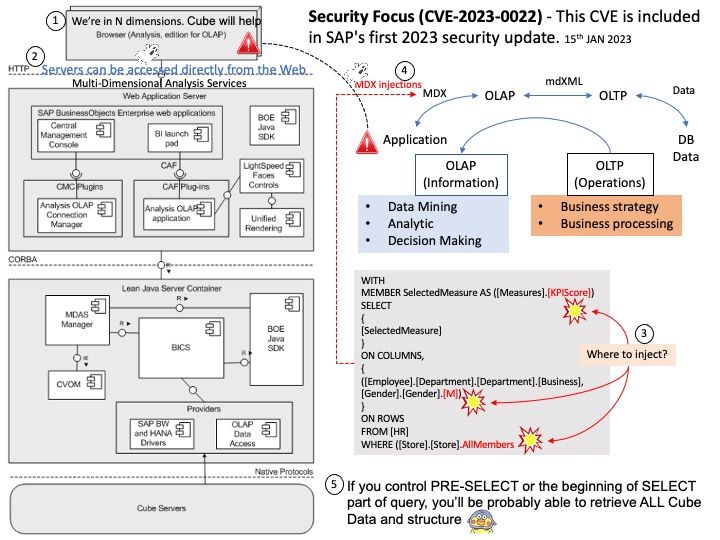
SAP BusinessObjects Business Intelligence Analysis edition for OLAP allows an authenticated attacker to inject malicious code that can be executed by the application over the network. On successful exploitation, an attacker can perform operations that may completely compromise the application causing a high impact on the confidentiality, integrity, and availability of the application.

What was that happen? In what way Does customer will trigger this vulnerability? As usual, vendor did not disclosed the details. But in case of similar design. Attacker will do the attack in this way. For details, please refer to diagram for reference.

Official Announcement: Please see the link for details of this official announcement

https://www.sap.com/documents/2022/02/fa865ea4-167e-0010-bca6-c68f7e60039b.html

Affected Products: SAP BusinessObjects Business Intelligence platform (Analysis edition for OLAP), Versions – 420, 430

CVE‑2022‑42271 Staying alert, Artificial intelligence world! (12th Jan 2023)

Preface: An “intelligent” computer uses AI to think like a human and perform tasks on its own. Machine learning is how a computer system develops its intelligence. One way to train a computer to mimic human reasoning is to use a neural network, which is a series of algorithms that are modeled after the human brain.

Quote: A GPU devotes more transistors to arithmetic logic than a CPU does to caching and flow control. As of 2022, the highest transistor count GPU is Nvidia’s H100, built on TSMC’s N4 process and totalling 80 billion MOSFETs.

Background: The Intelligent Platform Management Interface, or IPMI, is a standard for controlling intelligent devices that monitor a system. To use this, you need an interface to an IPMI controller in your system (called a Baseboard Management Controller – BMC) and management software that can use the IPMI system.

Under normal circumstance, you must pick ‘IPMI top-level message handler’ to use IPMI. The message handler does not provide any user-level interfaces. Kernel code (like the watchdog) can still use it. If you need access from userland, you need to select ‘Device interface for IPMI’ if you want access through a device driver.

The Linux IPMI driver is modular. This driver is for supporting a system that sits on an IPMB bus; it allows the interface to look like a normal IPMI interface. Sending system interface addressed messages to it will cause the message to go to the registered BMC on the system (default at IPMI address 0x20).

Vulnerability details: NVIDIA baseboard management controller (BMC) contains a vulnerability in the Intelligent Platform Management Interface (IPMI) handler, where an attacker with the required privileges can cause a buffer overflow, which may lead to denial of service or code execution.

Official announcement: For official details see the link – https://nvidia.custhelp.com/app/answers/detail/a_id/5435

NVIDIA recommends that customers follow best security practices for BMC management (IPMIport). These include, but are not limited to, such measures as:

  • Restricting the DGX A100 IPMI port to an isolated, dedicated management network.
  • Using a separate, firewalled subnet.
  • Configuring a separate VLAN for BMC traffic if a dedicated network is not available.

Intel security advisory (AV23-015) 10th JAN 2023

Preface: OpenMP (Open Multi-Processing) is an application programming interface (API) that supports multi-platform shared-memory multiprocessing programming in C, C++, and Fortran, on many platforms, instruction-set architectures and operating systems, including Solaris, AIX, FreeBSD, HP-UX, Linux, macOS, and Windows.

Background: A LEGO brick is a small plastic part, but it can build a big robot. Similar concept, CPU manufacturers provide main components, guidelines as upstream product suppliers. Let computer hardware manufacturers build their own powerful supercomputers. So they use their own design for load sharing, offloading resources to the GPU. That’s how the tech world works right now.

We often hear that computer hardware has backdoors. It usually happens during the design phase of the hardware. If you ask, who will bear this burden, the downstream hardware developer or the upstream CPU manufacturer? My comment is two-sided (see below).

  • If the hardware developer does not follow the best practices recommended by the CPU manufacturer. Risks will happen.
  • If CPU and development tool manufacturers have design flaws. The risk will be on this side.

Vulnerability details: CVE-2022-40196

Description: Improper access control in the Intel(R) oneAPI DPC++/C++ Compiler before version 2022.2.1 for some Intel(R) oneAPI Toolkits before version 2022.3.1 may allow an authenticated user to potentially enable escalation of privilege via local access.

For details, see the link – https://www.intel.com/content/www/us/en/security-center/advisory/intel-sa-00773.html

My observation: As usual, the vendor does not reveal the root cause. See whether it can dig out part of the possibility.

For example: Unified Shared Memory (USM): Device Kernels can access the data using pointers. Like this programming example. The memcpy operation will wait on events e1 and e2 and Transfers data back from device to host memory. As we know, the memcpy() and memmove() functions are a source of buffer overflow vulnerabilities. Will Intel oneAPI DPC++/C++ Compiler encounter a vulnerability in this place?

CVE-2022-25746: Possible cause of this vulnerability in Snapdragon (9th JAN 2023)

Preface: Qualcomm’s current Snapdragon chips for smartphones are also based on Arm technology. The Snapdragon’s central processing unit (CPU) uses the ARM architecture.

Some companies, like Apple, license the ISA from Arm, then design their own physical processor circuits to implement the ISA instructions. Other companies, like Qualcomm historically, also buy the rights to full core designs from Arm, marketed as Cortex. Arm reported $2.7 billion in sales from licensing and royalties in 2021, said CNBC.

For details, see the link – https://www.cnbc.com/2022/09/01/why-arms-lawsuit-against-qualcomm-is-a-big-deal.html

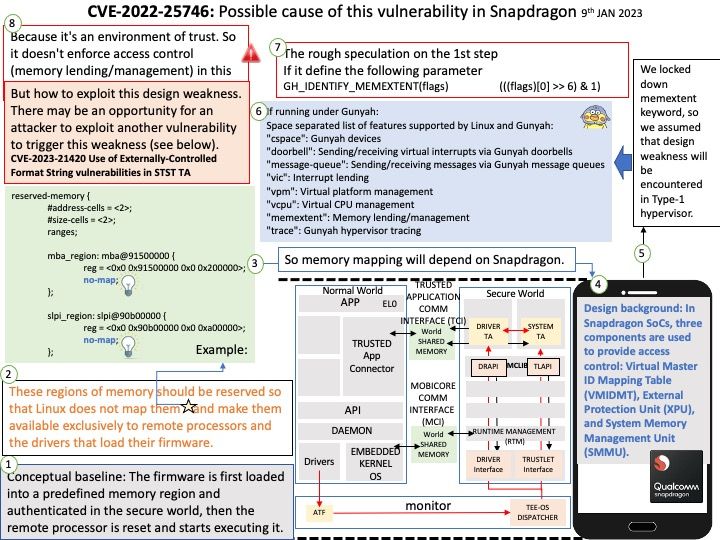
Conceptual baseline: The firmware is first loaded into a predefined memory region and authenticated in the secure world, then the remote processor is reset and starts executing it. These regions of memory should be reserved so that Linux does not map them and make them available exclusively to remote processors and the drivers that load their firmware.

Background: In Snapdragon SoCs, three components are used to provide access control: Virtual Master ID Mapping Table (VMIDMT), External Protection Unit (XPU), and System Memory Management Unit (SMMU). VMIDMT and XPU work together: VMIDMT applies security attributes corresponding to a security domain to transactions (e.g. read/write), while XPU enforces access control policies based on security domains. SMMU maps transactions to security domains and enforces corresponding access control policies.

Vulnerability details: Certain versions of Snapdragon from Qualcomm Inc. contain the following vulnerability:

Memory corruption in kernel due to missing checks when updating the access rights of a memextent mapping. For more information on this design weakness, see the link – https://www.qualcomm.com/company/product-security/bulletins/january-2023-bulletin

My observation: We locked down memextent keyword, so we assumed that design weakness will be ecountered in Type-1 hypervisor (Refer to attached diagram (point 6)).

Reference: Gunyah is a Type-1 hypervisor independent of any
high-level OS kernel, and runs in a higher CPU privilege level. It does
not depend on any lower-privileged OS kernel/code for its core
functionality. This increases its security and can support a much smaller trusted computing base than a Type-2 hypervisor.

But how to exploit this design weakness. There may be an opportunity for an attacker to exploit another vulnerability to trigger this weakness (see below).

CVE-2023-21420 Use of Externally-Controlled Format String vulnerabilities in STST TA

CVE-2023-21420 Use of Externally-Controlled Format String vulnerabilities in STST TA (8th JAN 2023)

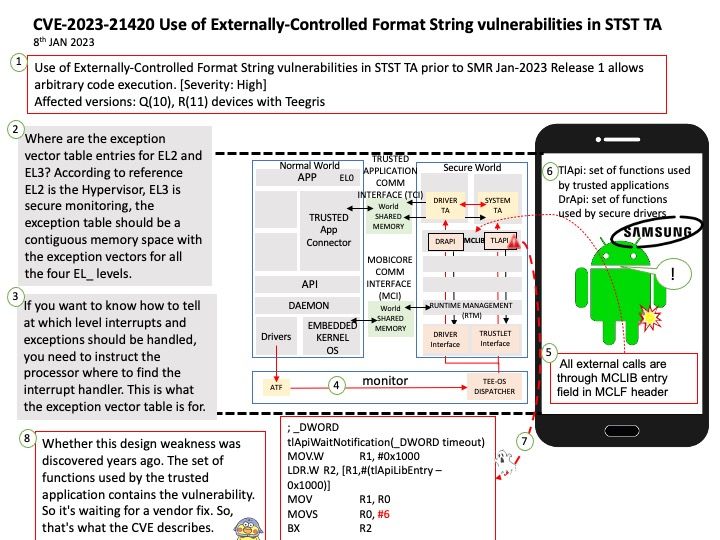
Preface: What is Samsung TEEGRIS? Samsung TEEGRIS is a system-wide security solution that allows you to run applications in a trusted execution environment based on TrustZone. We present the TEEGRIS architecture for external developers to enable their trusted applications and services.

Background: TEEGRIS is a relatively recent TEE OS, introduced by Samsung on the Galaxy S10. Most of the newer (starting from 2019) Samsung phones that have Exynos chipsets will also have TEEGRIS running in the TEE.

AArch64 or ARM64 is the 64-bit extension of the ARM architecture family. It was first introduced with the Armv8-A architecture. ARMv8-A CPUs support four privilege levels for each “world”, also known as exception levels:

  • (S-)EL0 – user mode/app
  • (S-)EL1 – kernel
  • EL2 – hypervisor
  • EL3 – Secure Monitor – EL3 is the level above which is called Monitor Mode. This extra level is used to run security applications (Trustzone).

Where are the exception vector table entries for EL2 and EL3? According to reference EL2 is the Hypervisor, EL3 is secure monitoring, the exception table should be a contiguous memory space with the exception vectors for all the four EL_ levels.

Remark: If you want to know how to tell at which level interrupts and exceptions should be handled, you need to instruct the processor where to find the interrupt handler. This is what the exception vector table is for.

  • TlApi: set of functions used by trusted applications
  • DrApi: set of functions used by secure drivers

Whether this design weakness was discovered years ago. The set of functions used by the trusted application contains the vulnerability. So it’s waiting for a vendor fix. So, that’s what the CVE describes.

Vulnerability details:

Severity: High
Affected versions: Q(10), R(11) devices with Teegris
Reported on: June 3, 2022
Disclosure status: Privately disclosed
Use of Externally-Controlled Format String vulnerabilities in ([ST] Samsung TEEgris Security Target, STST TA prior to SMR Jan-2023 Release 1 allows arbitrary code execution.
The patch restricts the triggering for the print of externally controlled format string code.

Official announcement: SMR-JAN-2023 – Samsung Mobile is releasing a maintenance release for major flagship models as part of monthly Security Maintenance Release (SMR) process. This SMR package includes patches from Google and Samsung.

For more information on this design weakness, see the link – https://security.samsungmobile.com/securityUpdate.smsb