All posts by admin

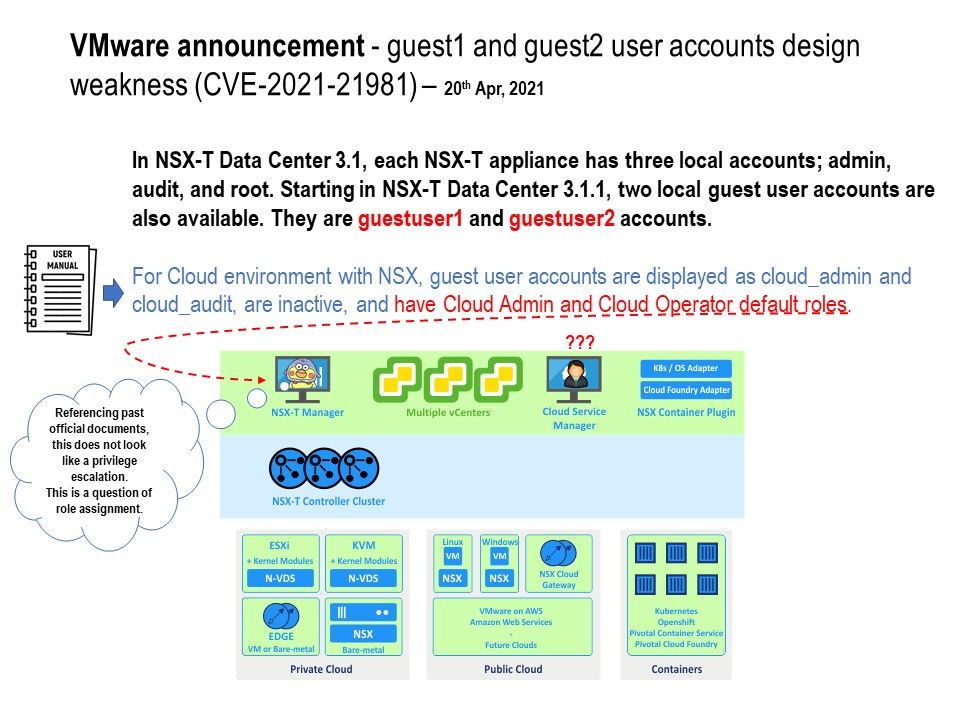
VMware announcement – guest1 and guest2 user accounts design weakness (CVE-2021-21981) – 20th Apr, 2021

Preface: From a security perspective, what is the difference between configuration errors and vulnerabilities? Perhaps the potential impact are the same if it is involves privileges control function.

Product background: NSX-T Data Center supports cloud-native applications, bare metal workloads, multi-hypervisor environments, public clouds, and multiple clouds. NSX-T aim to protect applications with workload-level micro-segmentation and sophisticated security. Regardless of the physical network topology within and between the data center and the native public cloud, the network and security principles can be managed in a consistent manner.

Vulnerability details: Official announcement said that a privilege escalation vulnerability in VMware NSX-T was privately reported to VMware. However when you read the old version of document. The document written down that For Cloud environment with NSX, guest user accounts are displayed as cloud_admin and cloud_audit, are inactive, and have Cloud Admin and Cloud Operator default roles. This is correct. Or is that right?

The official details link is here https://www.vmware.com/security/advisories/VMSA-2021-0006.html
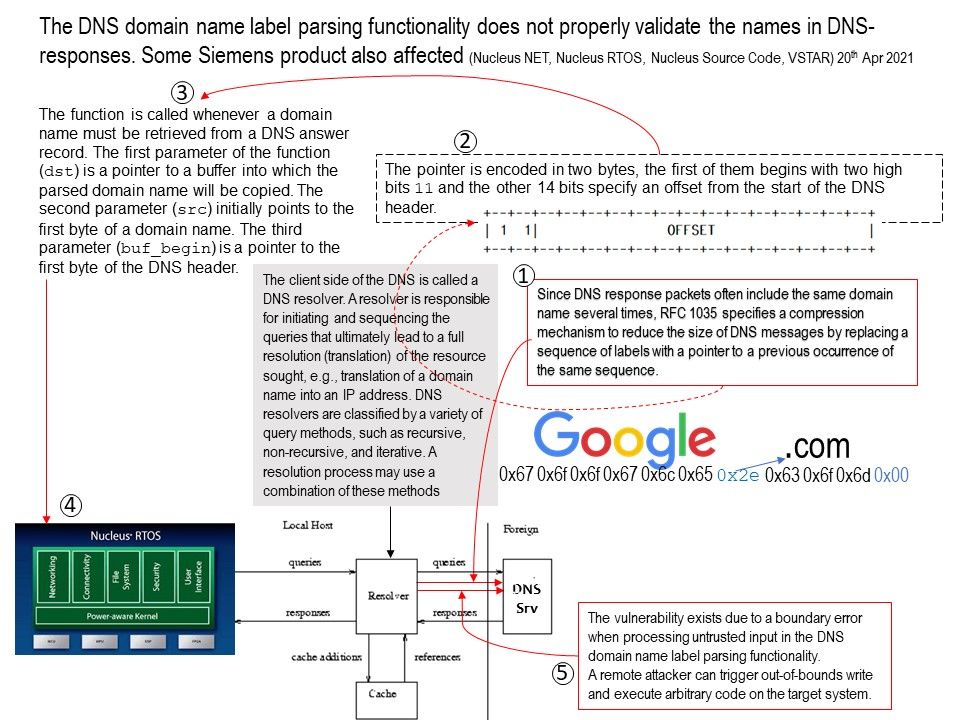
The design weakness of DNS module causes Siemens Nucleus Products involves WRECK loophole – 19th April, 2021.

Preface: The DNS Client is capable of resolving the IP address of a host from the host’s name. It does this by sending DNS requests to a DNS Server. The IP address of a DNS Server is specified in the network interface configuration file or can be obtained from the DHCP Server for the Local Area Network.

Product background: Nucleus RTOS is a proven, reliable, and fully optimized RTOS. Nucleus has been used successfully deployed in highly demanding markets with rigorous safety and security requirements such as industrial systems, medical devices, airborne systems, automotive and more.

Vulnerability details: The DNS domain name label parsing functionality does not properly validate the names in DNS-responses. When DNS packet compression offset such that src jumps back to the same compression pointer, the TCP/IP stack will reach a Denial-of-Service condition. For more details, please refer to official announcement – https://cert-portal.siemens.com/productcert/pdf/ssa-705111.pdf

Workarounds: Avoid using DNS client of affected versions. When remote access is required, use secure methods, such as Virtual Private Networks (VPNs)

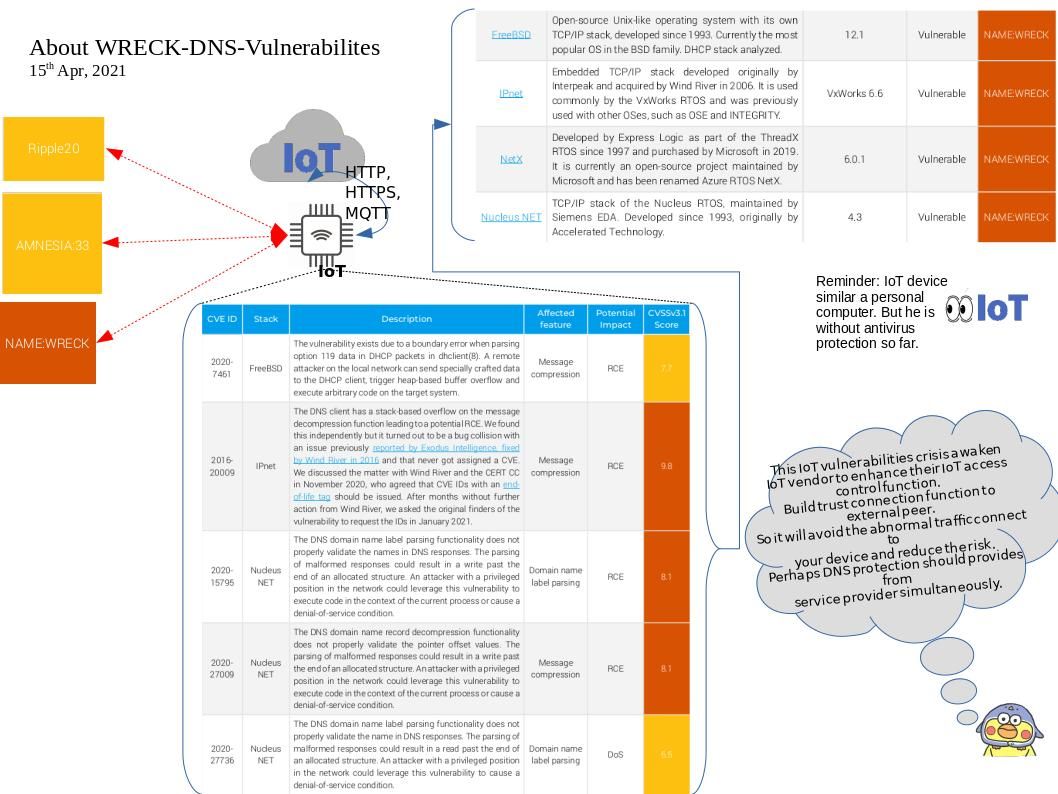
About WRECK DNS vulnerabilities – 15th Apr 2021

Background: DNS security awareness awaken by expert conduct a simple DNSsteal to do a demonstration show how to exploit unknown function feature on DNS function in few years ago.
On April 2021, cyber security product vendor with security experts announce that a unknown TCP/IP Stack weakness in IoT.
The difference in between DNS misuse function (DNSsteal) and techincal problem announced by vendor this month was that this time it is a design weakness of IoT TCP/IP stack.

Vulnerability details: So called WRECK, it affects at least four common TCP/IP stacks—FreeBSD, IPNet, NetX, and Nucleus NET—that are used in Internet of Things (IoT). The specify flaws could be abused to perform denial of service (DoS) attacks, to execute code remotely and or take victim devices offline. For details, please refer to link – https://www.forescout.com/company/resources/namewreck-breaking-and-fixing-dns-implementations/

My Comment: This IoT vulnerabilities crisis awaken IoT vendor to enhance their IoT access control function. Build trust connection function to external peer. So it will avoid the abnormalis traffic connect to your device and reduce the risk. Perhaps DNS protection should provides from service provider simultaneously.

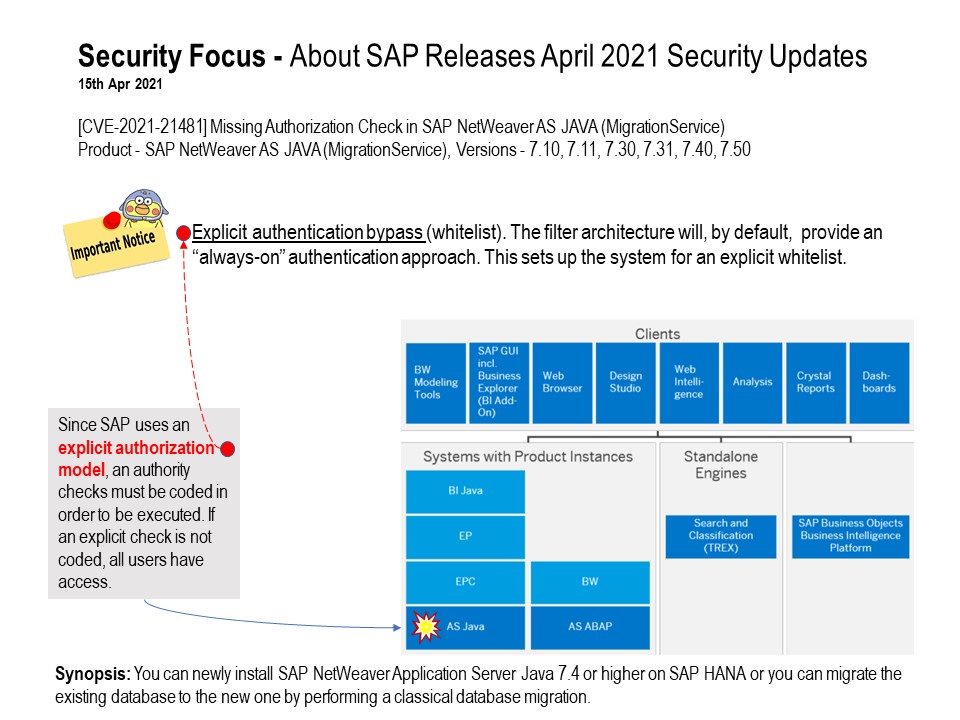
Security Focus – About SAP Releases April 2021 Security Updates – 15th Apr 2021

As usual, because of vendor decision, vendor not going to release the details of design weakness. From my opinion that understand the details will be enhanced your system and infrastructure defense mechanism. Below is my personal comment according to this specifics vulnerability.

Vulnerability details: CVE-2021-21481 – The MigrationService, which is part of SAP NetWeaver, does not perform an authorization check allowing an unauthorized attacker to access configuration objects, including such that grant administrative privileges.

Since SAP uses an explicit authorization model, an authority checks must be coded in order to be executed. If an explicit check is not coded, all users have access.

Reference: Explicit authentication bypass (whitelist). The filter architecture will, by default, provide an “always-on” authentication approach. This sets up the system for an explicit whitelist.

Impact: Since the failure is related to incorrect authorization, the risk will depend on the environment.

Official announcement: Please refer to link – https://wiki.scn.sap.com/wiki/pages/viewpage.action?pageId=573801649

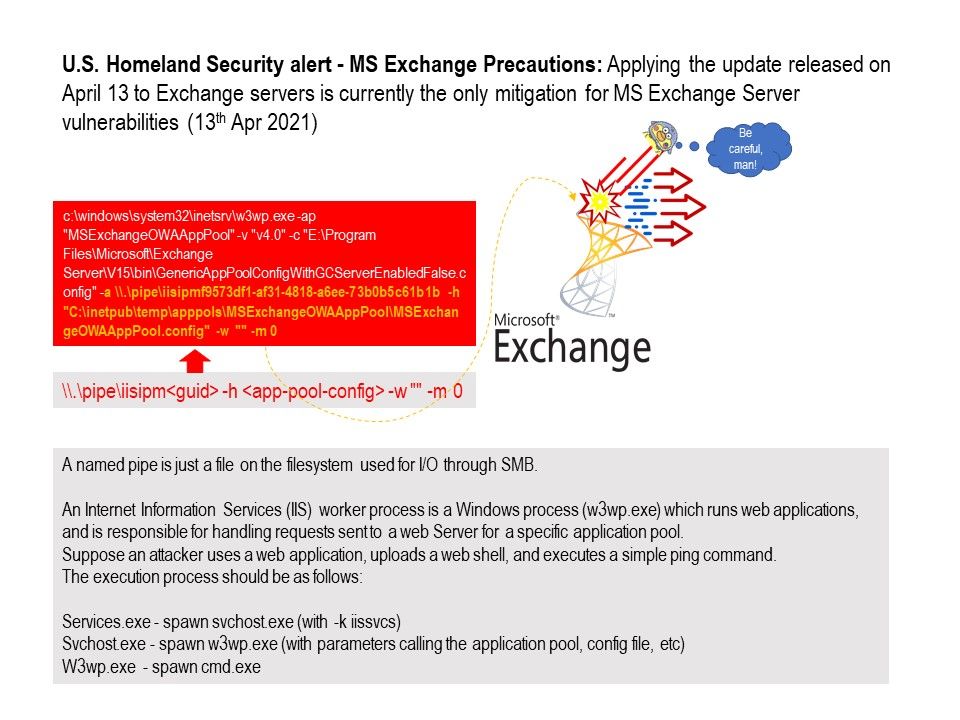
MS exchange Precautions – (13th Apr 2021)

Preface: A named pipe is just a file on the filesystem used for I/O through SMB.

Background: Outlook Web App is hosted on the Client Access Server role for Exchange Server and integrated with IIS. An Internet Information Services (IIS) worker process is a Windows process (w3wp.exe) which runs web applications, and is responsible for handling requests sent to a web Server for a specific application pool. Suppose an attacker uses a web application, uploads a web shell, and executes a simple ping command.
– The execution process should be as follows:
– Services.exe – spawn svchost.exe (with -k iissvcs)
– Svchost.exe – spawn w3wp.exe (with parameters calling the application pool, config file, etc)
– W3wp.exe – spawn cmd.exe

Direction v2 – Remediation of MS exchange vulnerabilities:
On April 13, 2021, Microsoft released a software update to mitigate significant vulnerabilities that affect on-premises Exchange Servers 2013, 2016, and 2019. These vulnerabilities are different from the ones disclosed and fixed in March 2021 – the security updates released in March 2021 will not remediate against these vulnerabilities. So you should pay attention of Microsoft announcement. When patch release, it is recommend to do this patching.

Official details: https://cyber.dhs.gov/ed/21-02/#supplemental-direction-v2

Status update: Released: April 2021 Exchange Server Security Updates – https://techcommunity.microsoft.com/t5/exchange-team-blog/released-april-2021-exchange-server-security-updates/ba-p/2254617

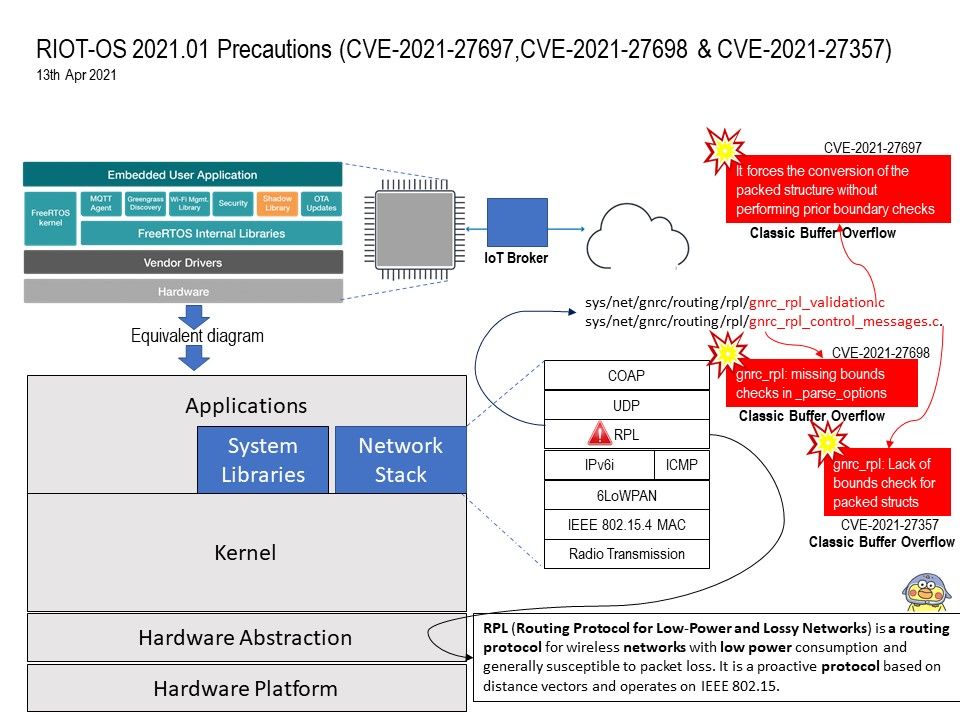
RIOT-OS 2021.01 Precautions (CVE-2021-27697,CVE-2021-27698 & CVE-2021-27357) – 13th Apr 2021

Preface: RIOT is a low-memory operating system suitable for IoT devices. It is an open source software released under LGPLv2.

Background: RPL (Routing Protocol for Low-Power and Lossy Networks) is a routing protocol for wireless networks with low power consumption and generally susceptible to packet loss. It is a proactive protocol based on distance vectors and operates on IEEE 802.15.

Vulnerability details: RPL is a distance vector routing protocol based on the construction of a directed acyclic graph (DAG). Existing Routing Protocols for Low Power and Lossy Networks (RPL) are considered lightweight and secure routing protocols for IoT devices, which offer a slight safeguard against innumerable forms of RPL routing attacks. Unfortunately of design weakness. There are total of 3 potential risk of vulnerabilities was found in RPL function. All the vulnerability will be trigger buffer overflow. For more details, please refer to the link below:

CVE-2021-27697 RIOT-OS 2021.01 contains a buffer overflow vulnerability in sys/net/gnrc/routing/rpl/gnrc_rpl_validation.c
through the gnrc_rpl_validation_options() function. – https://nvd.nist.gov/vuln/detail/CVE-2021-27697

CVE-2021-27698 RIOT-OS 2021.01 contains a buffer overflow vulnerability in /sys/net/gnrc/routing/rpl/gnrc_rpl_control_messages.c
through the _parse_options() function – https://nvd.nist.gov/vuln/detail/CVE-2021-27698

CVE-2020-27357 RIOT-OS 2020.01 contains a buffer overflow vulnerability in /sys/net/gnrc/routing/rpl/gnrc_rpl_control_messages.c – https://nvd.nist.gov/vuln/detail/CVE-2021-27357

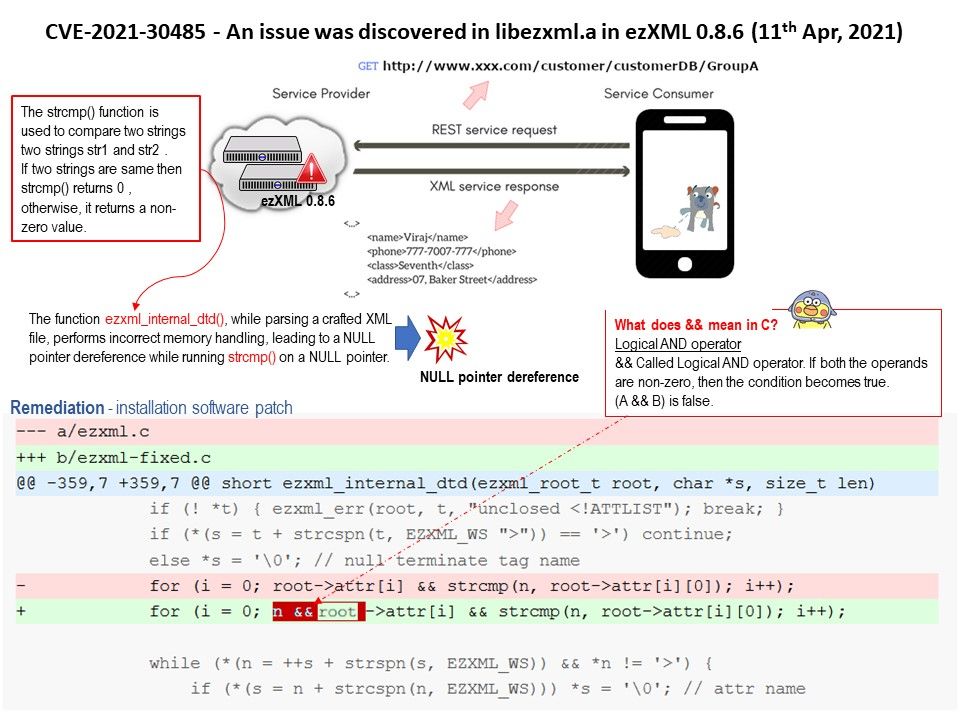
CVE-2021-30485 – A technical defect was found in ezxml 0.8.6 (11th Apr, 2021)

Preface: ezXML – XML Parsing C Library version 0.8.5 ezXML is a C library for parsing XML documents inspired by simpleXML for PHP.
According to the statistis by W3Techs, PHP is use by 79.2% of all websites primary server-side programming language.

Background: In an XML file, there are both tags and text. The tags provide the structure to the data. The text in the file that you wish to store is surrounded by these tags, which adhere to specific syntax guidelines. XML parser is a software library or a package that provides interface for client applications to work with XML documents. It checks for proper format of the XML document and may also validate the XML documents.

Vulnerability details: An issue was discovered in libezxml.a in ezXML 0.8.6. The function ezxml_internal_dtd(), while parsing a crafted XML file, performs incorrect memory handling, leading to a NULL pointer dereference while running strcmp() on a NULL pointer.

Consequences: Running a program that contains a NULL pointer dereference generates an immediate segmentation fault error. This defect may manifest itself as a program crash, or be transformed into a software exception that can be caught by program code.

For more details, please refer to link https://nvd.nist.gov/vuln/detail/CVE-2021-30485

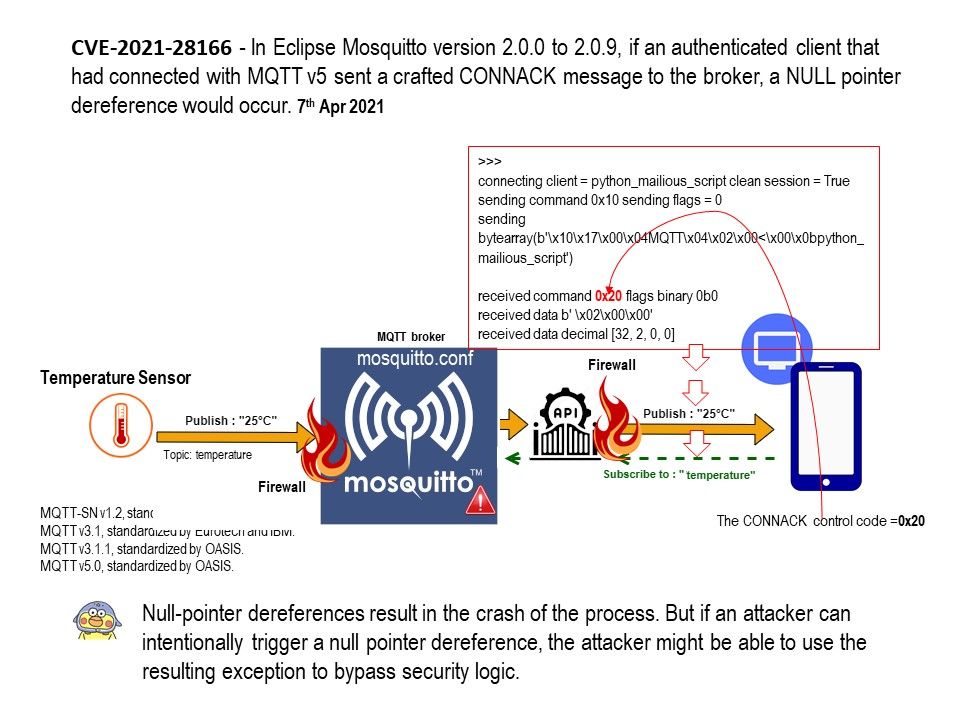
CVE-2021-28166 (Eclipse Mosquitto) – When a small hole appears in the dam. You should fix it immediately. 7-Apr-2021

Preface: The two main changes to the CONNACK message between MQTTv3.1.1 and MQTTv5 are the enhanced reason codes and the properties field.

Background: MQTT is an OASIS standard messaging protocol for the Internet of Things (IoT). It is designed as an extremely lightweight publish/subscribe messaging transport that is ideal for connecting remote devices with a small code footprint and minimal network bandwidth. Furthermore, the MQTT CONNECT and response messages (CONNACK) have been greatly enhanced in MQTTv5 with the addition of the properties field. The properties field allows for a large increase in the information that can be exchanged between client and server on connection establishment compared to MQTT v3.1.1.

Vulnerability details: In Eclipse Mosquitto version 2.0.0 to 2.0.9, if an authenticated client that had connected with MQTT v5 sent a crafted CONNACK message to the broker, a NULL pointer dereference would occur. Null-pointer dereferences result in the crash of the process. But if an attacker can intentionally trigger a null pointer dereference, the attacker might be able to use the resulting exception to bypass security logic.

Official announcement: Please refer to link – https://bugs.eclipse.org/bugs/show_bug.cgi?id=572608

If you currently use of SOAP Microservices & Apache CXF, you should be staying alert! 7th APr 2021

Preface: Many industry standards still rely on XML to describe and exchange data between business partners in a way that guarantee interoperability even with legacy systems running on mainframes. SOAP enable developers to create and use APIs based on XML payloads.

Background: Apache CXF™ is an open source services framework. CXF helps you build and develop services using frontend programming APIs, like JAX-WS and JAX-RS. These services can speak a variety of protocols such as SOAP, XML/HTTP, RESTful HTTP, or CORBA and work over a variety of transports such as HTTP, JMS or JBI.

Vulnerability Details: A set of malicious client can launch a DoS attack to the authorization server by pointing the “request_uri” to a URI that returns extremely large content or extremely slow to respond. Under such an attack, the server may use up its resource and start failing. Official details shown in follow link – https://lists.apache.org/thread.html/r6445001cc5f9a2bb1e6316993753306e054bdd1d702656b7cbe59045@%3Cannounce.apache.org%3E

Workaround: To prevent such attack to succeed, the server should:

(a) check that the value of “request_uri” parameter does not point to an unexpected location.
(b) check the content type of the response is “application/oauth-authz-req+jwt”.
(c) implement a time-out for obtaining the content of “request_uri”.
(d) not perform recursive GET on the “request_uri”.

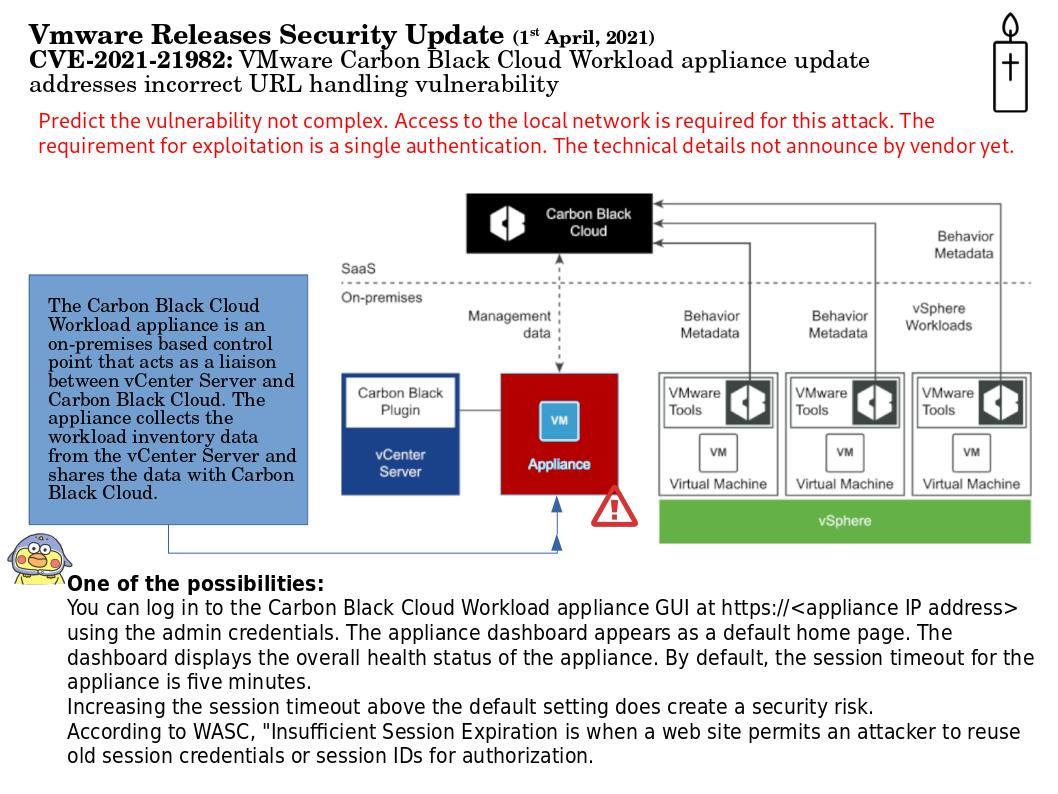
VMware Releases Security Update (CVE-2021-21982) – 2021-04-01

Preface: From developing anti-virus till today. The trend is Analyse attackers’ behaviour patterns to detect and conducting defence.

Product background: Carbon Black Cloud Workload is a data center security product that protects your workloads running in a virtualized environment. Carbon Black Cloud Workload ensures that security is intrinsic to the virtualization environment by providing a built-in protection for virtual machines.

Vulnerability details: For more details, please refer to link – https://www.vmware.com/security/advisories/VMSA-2021-0005.html

Supplement: The technical details not announce by vendor yet.
Maybe the attached picture will provide you with hints. Apart from that when you finish the software patching or workaround. I would recommend that conduct a review of alert logging in your VMware carbon black environment. But what is the coverage (period). The way is do a review on the monthly virus detection log, find out the victim workstation which have connectivity to carbon black network segment. But the next step all depends on what you find out in the 1st step. This audit check should covered 3 month log activities.