Category Archives: Potential Risk of CVE

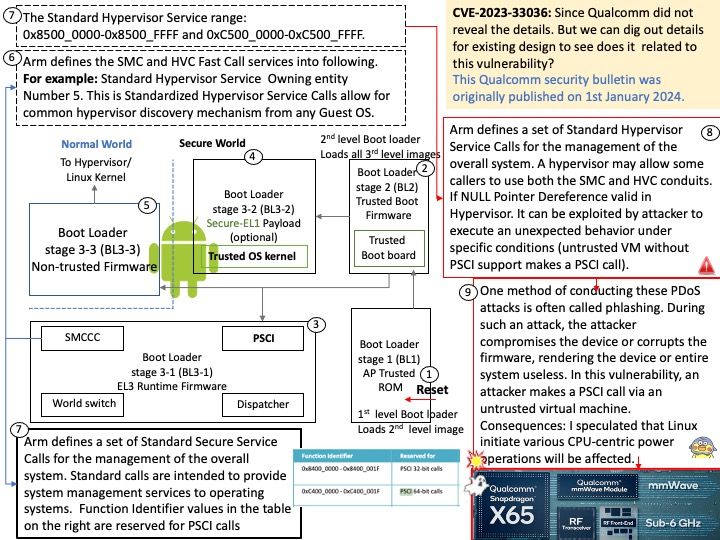
CVE-2023-33036: NULL Pointer Dereference in Hypervisor (26th Jan 2024)

This Qualcomm security bulletin was originally published on 1st January 2024.

Preface: One method of conducting these PDoS attacks is commonly referred to as phlashing. During such an attack, an attacker bricks a device or destroys firmware, rendering the device or an entire system useless. This is one method to exploit vulnerabilities and replace a device’s basic software with a corrupt firmware image.

Background: The ARM Trusted Firmware implements a subset of the Trusted Board Boot Requirements (TBBR) Platform Design Document (PDD) for ARM reference platforms. The TBB sequence starts when the platform is powered on and runs up to the stage where it hands-off control to firmware running in the normal world in DRAM. This is the cold boot path.

The ARM Trusted Firmware also implements the Power State Coordination Interface (PSCI) PDD as a runtime service. PSCI is the interface from normal world software to firmware implementing power management use-cases (for example, secondary CPU boot, hotplug and idle). Normal world software can access ARM Trusted Firmware runtime services via the ARM SMC (Secure Monitor Call) instruction.

Vulnerability details: Permanent DOS in Hypervisor while untrusted VM without PSCI support makes a PSCI call.

Vulnerability Type : CWE-476 NULL Pointer Dereference

My observation: I speculated that Linux initiate various CPU-centric power operations will be affected.

Official announcement: Please refer to the link for details – https://docs.qualcomm.com/product/publicresources/securitybulletin/january-2024-bulletin.html
CVE-2024-23212: Apple Neural Engine design has weakness in memory handling. (25th January 2024)

This announcement was originally published on January 22nd 2024

Preface: Neural networks, also known as artificial neural networks (ANNs) or simulated neural networks (SNNs), are a subset of machine learning and are at the heart of deep learning algorithms.

Recent advances in artificial intelligence systems, such as voice or facial recognition programs, have benefited from neural networks, densely interconnected meshes of simple information processors that learn to perform tasks by analyzing large amounts of training data.

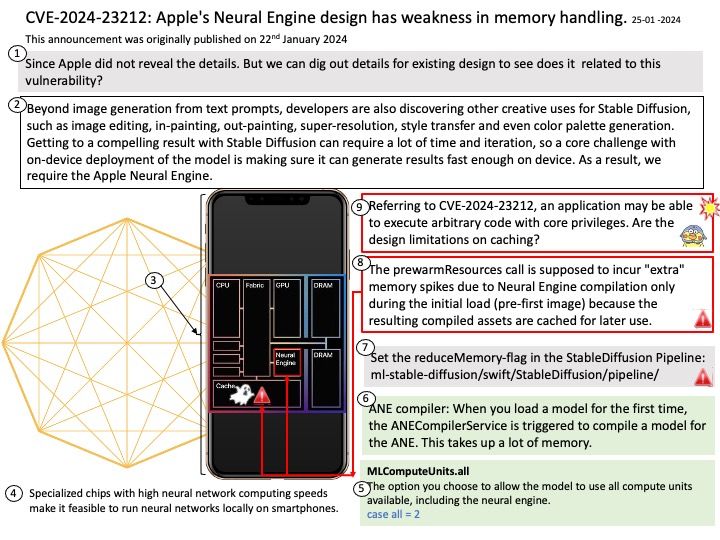
Background: The Apple Neural Engine (or ANE) is a type of NPU, which stands for Neural Processing Unit. It’s like a GPU, but instead of accelerating graphics an NPU accelerates neural network operations such as convolutions and matrix multiplies.

Beyond image generation from text prompts, developers are also discovering other creative uses for Stable Diffusion, such as image editing, in-painting, out-painting, super-resolution, style transfer and even color palette generation.  Getting to a compelling result with Stable Diffusion can require a lot of time and iteration, so a core challenge with on-device deployment of the model is making sure it can generate results fast enough on device. As a result, we require the Apple Neural Engine.

Vulnerability details: Apple security advisory shown that the vulnerability belongs to Apple Neural Engine.

Impact: An app may be able to execute arbitrary code with kernel privileges

Description: The issue was addressed with improved memory handling.

Official announcement: Please refer to the link for details – https://support.apple.com/en-us/HT214059

CVE‑2023‑31037: Design weakness on NVIDIA Bluefield 2 and Bluefield 3 DPU BMC (Updated 01/22/2024)

Preface: Virtio-net device emulation enables users to create VirtIO-net emulated PCIe devices in the system where the NVIDIA® BlueField® DPU is connected.

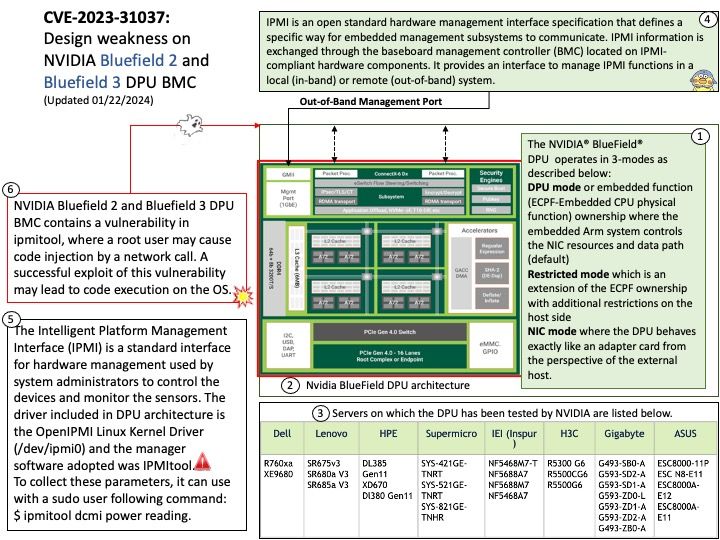
Background: The Intelligent Platform Management Interface (IPMI) is a standard interface for hardware management used by system administrators to control the devices and monitor the sensors. For these, it is necessary the IPMI Controller called Baseboard Management Controller (BMC) and a manager software (for example, IPMItool). It provides an interface to manage IPMI functions in a local (in-band) or remote (out-of-band) system.

Ref: Developer can wrote their own tools to query the sensors, via the IPMItool

Vulnerability details: NVIDIA Bluefield 2 and Bluefield 3 DPU BMC contains a vulnerability in ipmitool, where a root user may cause code injection by a network call. A successful exploit of this vulnerability may lead to code execution on the OS.

Official announcement: Please refer to the link for details – https://nvidia.custhelp.com/app/answers/detail/a_id/5511

CVE-2023-34063: A vulnerability was discovered in VMware Aria Automation and Cloud Foundation that affects unknown components. (23rd Jan 2024)

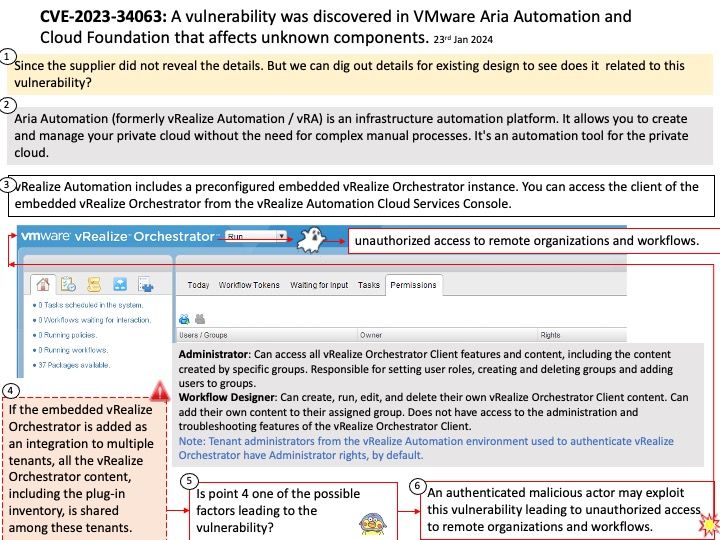
Preface: The missing function-level access control vulnerability refers to the flaws in the authorization logic. By exploiting it, an attacker, who could be an existing user of the application, is able to escalate privileges and access restricted functionalities.

Background: VMware Aria Automation Orchestrator. (formerly vRealize Orchestrator). VMware Aria is an intelligent multi-cloud management solution that enables you to consistently deploy and operate your apps, infrastructure, and platform services across private, hybrid, and multiple clouds from a single platform with a common data model.

Ref: vRealize Automation includes a preconfigured embedded vRealize Orchestrator instance. You can access the client of the embedded vRealize Orchestrator from the vRealize Automation Cloud Services Console.

Vulnerability details: An authenticated malicious actor may exploit this vulnerability leading to unauthorized access to remote organizations and workflows.

Resolution: To remediate CVE-2023-34063 apply the patches

Official announcement: Please refer to the link for details – https://www.vmware.com/security/advisories/VMSA-2024-0001.html

CVE-2023-6531: A use-after-free flaw was found in the Linux Kernel , fixed design weakness, attacker cannot relies on io_uring_get_socket() anymore (21st Jan 2024)

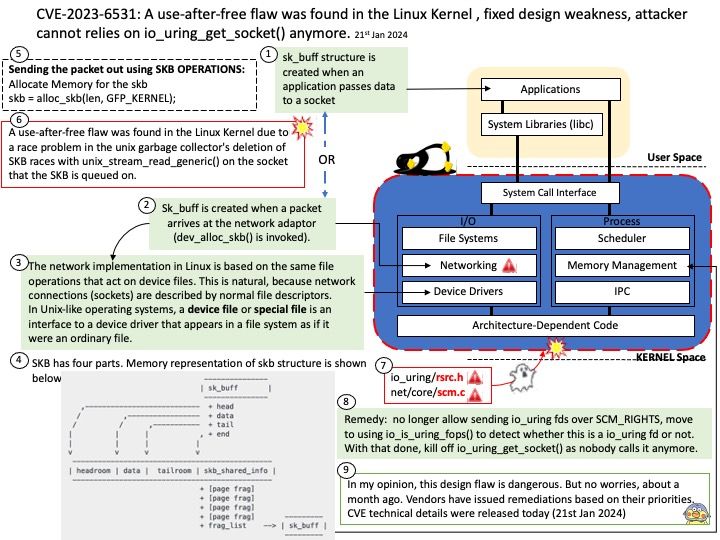
Preface: In my opinion, this design flaw is dangerous. But no worries, about a month ago. Vendors have issued remediations based on their priorities. CVE technical details were released today (21st Jan 2024).

Background: io_uring is applicable to most businesses and applications with a demand for asynchronous I/O. As of now, io_uring has been integrated into multiple mainstream open-source applications, such as RocksDB, Netty, QEMU, SPDK, PostgreSQL, MariaDB, etc.

What is io_uring? io_uring is an asynchronous I/O interface for the Linux kernel. An io_uring is a pair of ring buffers in shared memory that are used as queues between user space and the kernel:

Submission queue (SQ): A user space process uses the submission queue to send asynchronous I/O requests to the kernel.

Completion queue (CQ): The kernel uses the completion queue to send the results of asynchronous I/O operations back to user space.

Many io_uring features will soon be available in Red Hat Enterprise Linux 9.3, which ships with core version 5.14. Fedora 37 currently provides the latest io_uring functionality.

Vulnerability details: A use-after-free flaw was found in the Linux Kernel due to a race problem in the unix garbage collector’s deletion of SKB races with unix_stream_read_generic() on the socket that the SKB is queued on.

Official announcement: Please refer to the link for details – https://nvd.nist.gov/vuln/detail/CVE-2023-6531

CVE-2024-21735: SAP LT Replication Server design weakness (included – version S4CORE 103, S4CORE 104, S4CORE 105, S4CORE 106, S4CORE 107, S4CORE 108) 18th Jan 2024

Preface: The latest version of SAP Landscape Transformation Replication Server. It combines the latest SAP Landscape Transformation Replication Server functionality with the latest SAP Basis version for the best support of all uses cases involving SAP systems and databases. There are two options for using this version of SAP Landscape Transformation Replication Server (see also chapter Installation Options):

i.As a standalone system based on SAP S/4HANA Foundation 2020 (or higher) together with the DMIS 2020 addon.

ii.Embedded in SAP S/4HANA 2020 (or higher).

Background: (S_DMIS – Authority object for SAP SLO Data migration server)

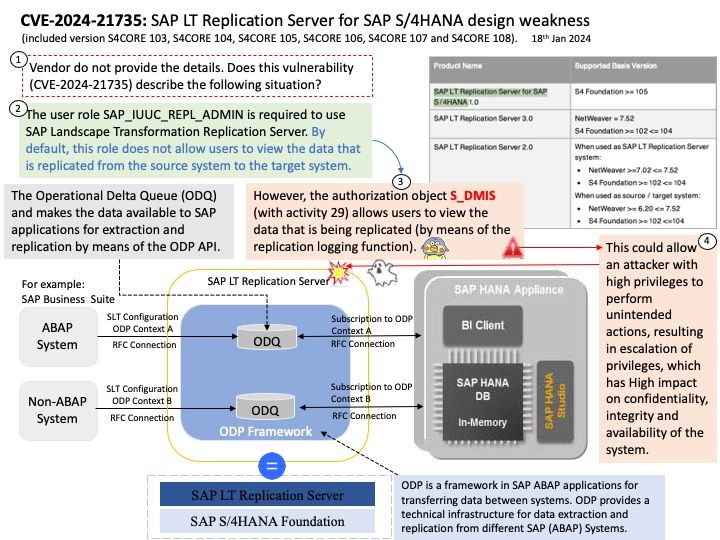
The user role SAP_IUUC_REPL_ADMIN is required to use SAP Landscape Transformation Replication Server. By default, this role does not allow users to view the data that is replicated from the source system to the target system. However, the authorization object S_DMIS (with activity 29) allows users to view the data that is being replicated (by means of the replication logging function).

SAP strongly recommend that you use the Read Access Logging (RAL) component to monitor and log read access to the relevant data.

Vulnerability Details: SAP LT Replication Server – version S4CORE 103, S4CORE 104, S4CORE 105, S4CORE 106, S4CORE 107, S4CORE 108, does not perform necessary authorization checks. This could allow an attacker with high privileges to perform unintended actions, resulting in escalation of privileges, which has High impact on confidentiality, integrity and availability of the system.

Official announcement: Please refer to the link for details – https://www.sap.com/documents/2022/02/fa865ea4-167e-0010-bca6-c68f7e60039b.html

Oracle’s January 2024 Critical Patch Update Bulletin to remediate the related CVE-2023-44487 vulnerability in its product family (17th Jan 2024)

Preface: HTTP/2 Rapid Reset, based on stream multiplexing. HTTP/2 Rapid Reset attacks mostly affect the large infrastructure providers. Software smaller providers use, such as NGINX, Apache Server, ….etc

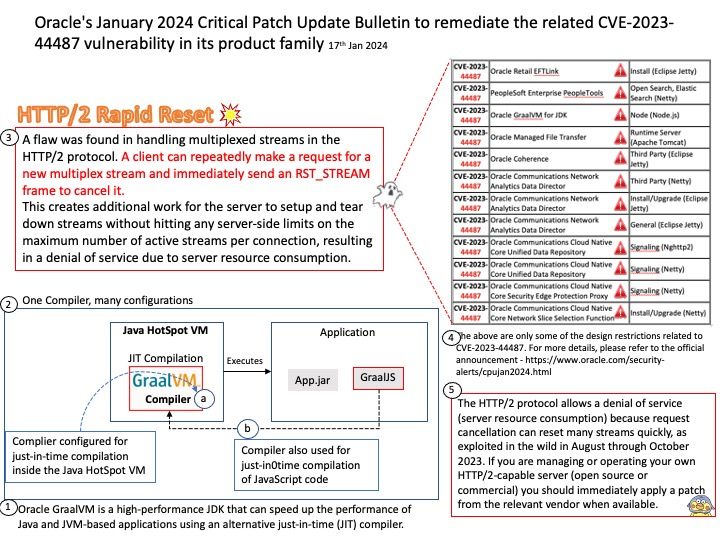
Background: Oracle GraalVM is a high-performance JDK that can speed up the performance of Java and JVM-based applications using an alternative just-in-time (JIT) compiler.

Vulnerability details: The HTTP/2 protocol allows a denial of service (server resource consumption) because request cancellation can reset many streams quickly, as exploited in the wild in August through October 2023.

If you are managing or operating your own HTTP/2-capable server (open source or commercial) you should immediately apply a patch from the relevant vendor when available.

Official announcement: Please refer to the link for details – https://www.oracle.com/security-alerts/cpujan2024.html

The patch for CVE-2023-44487 also addresses CVE-2023-36478, CVE-2023-40167, CVE-2023-42794, CVE-2023-42795, and CVE-2023-45648.

The patch for CVE-2023-44487 also addresses CVE-2023-45143.

The patch for CVE-2023-45648 also addresses CVE-2023-42794, CVE-2023-42795, and CVE-2023-44487.

The patch for CVE-2023-44487 also addresses CVE-2023-36478.

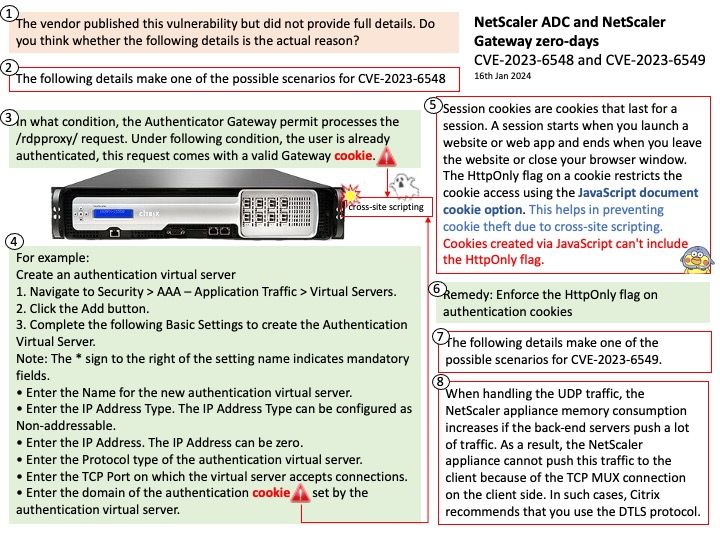
Netscaler zero-days – CVE-2023-6548 and CVE-2023-6549 (16th Jan 2024)

Preface: NetScaler was initially developed in 1997 by Michel K Susai and acquired by Citrix Systems in 2005. What is the difference between NetScaler ADC and NetScaler gateway? NetScaler ADC is an application delivery controller. NetScaler Gateway (formerly Citrix Gateway) is an access gateway with SSL VPN solution, providing single sign-on (SSO) and authentication for remote end users of network assets.

Background: A cross-site scripting (XSS) attack is a type of injection attack in which malicious script is injected into an otherwise benign and trusted website. The risk of XSS comes from the ability to execute arbitrary JS within the current user context.

UDP is common, but it has inherent vulnerabilities that make it prone to attacks, such as limited packet verification, IP spoofing and DoS attacks.

Ref:

#NSIP address – The management IP address for NetScaler Gateway that is used for all management‑related access to the appliance. NetScaler Gateway also uses the NSIP address for authentication

#Subnet IP (SNIP) address – The IP address that represents the user device by communicating with a server on a secondary network

#Cluster management IP (CLIP) address

Vulnerability details:

CVE-2023-6548 is a RCE vulnerability in the NetScaler ADC and Gateway appliances. An authenticated attacker with low level privileges could exploit this vulnerability if they are able to access NetScaler IP (NSIP), Subnet IP (SNIP), or cluster management IP (CLIP) with access to the appliance’s management interface.

CVE-2023-6549 is a denial of service (DoS) vulnerability in the NetScaler ADC and Gateway appliances. An attacker could exploit this vulnerability when a vulnerable appliance has been configured as a Gateway (e.g. VPN, ICA Proxy, CVPN, RDP Proxy) or as a AAA virtual server.

Official announcement: Please refer to the link for details – https://support.citrix.com/article/CTX584986/netscaler-adc-and-netscaler-gateway-security-bulletin-for-cve20236548-and-cve20236549

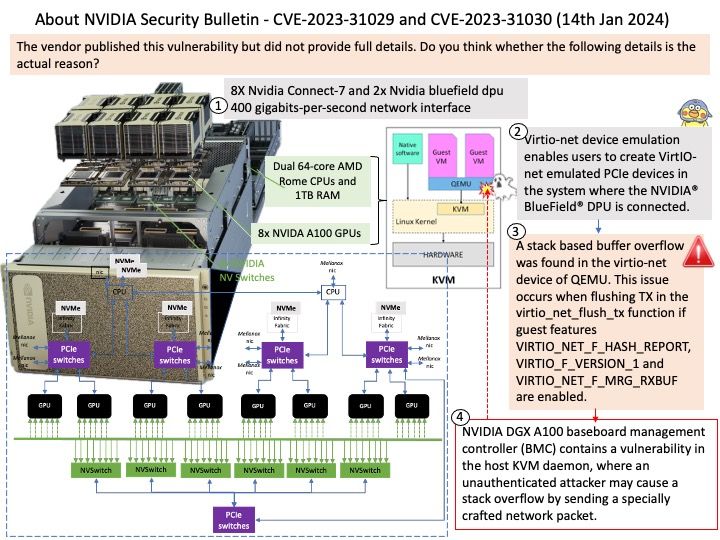
About NVIDIA Security Bulletin – CVE-2023-31029 and CVE-2023-31030 (14th Jan 2024)

Preface: Artificial intelligence performs better when humans are involved in data collection, annotation, and validation. But why is artificial intelligence ubiquitous in the human world? Can we limit the use of AI?

Background: The NVIDIA DGX A100 system comes with a baseboard management controller (BMC) for monitoring and controlling various hardware devices on the system. It monitors system sensors and other parameters. Kernel-based Virtual Machine (KVM) is an open source virtualization technology built into Linux. KVM lets you turn Linux into a hypervisor that allows a host machine to run multiple, isolated virtual environments called guests or virtual machines (VMs).

What is Virtio-net device? Virtio-net device emulation enables users to create VirtIO-net emulated PCIe devices in the system where the NVIDIA® BlueField® DPU is connected.

Vulnerability details:

CVE-2023-31029 – NVIDIA DGX A100 baseboard management controller (BMC) contains a vulnerability in the host KVM daemon, where an unauthenticated attacker may cause a stack overflow by sending a specially crafted network packet. A successful exploit of this vulnerability may lead to arbitrary code execution, denial of service, information disclosure, and data tampering.

CVE-2023-31030 – NVIDIA DGX A100 BMC contains a vulnerability in the host KVM daemon, where an unauthenticated attacker may cause a stack overflow by sending a specially crafted network packet. A successful exploit of this vulnerability may lead to arbitrary code execution, denial of service, information disclosure, and data tampering.

Official announcement: Please refer to the link for details – https://nvidia.custhelp.com/app/answers/detail/a_id/5510

My comment: The vendor published this vulnerability but did not provide full details. Do you think whether the details in attached diagram is the actual reason?

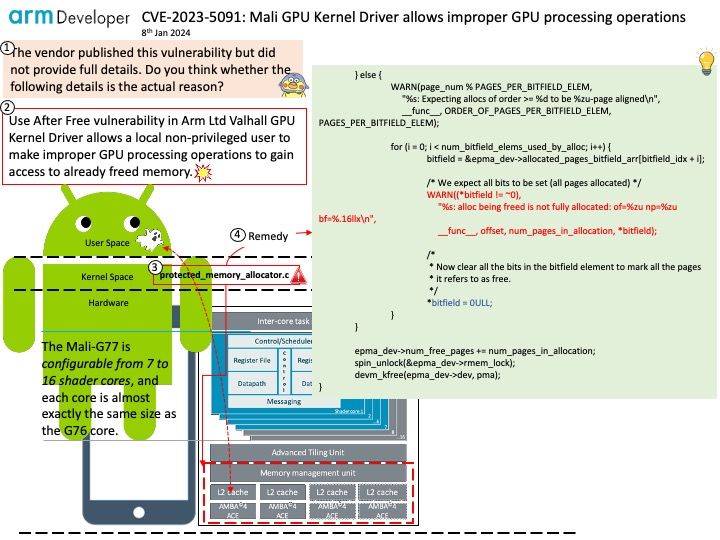
CVE-2023-5091: Mali GPU Kernel Driver allows improper GPU processing operations (8th Jan 2024)

Preface: According to news in October 2023, experts speculated that commercial spyware exploited a security vulnerability in the Arm Mali GPU driver to compromise some people’s devices. The vulnerability was claimed to be a local attack. But how do attacker plant malware on a smartphone without remote access? Hard to say! Phishing and social engineering techniques may be involved.

Background: About four years ago, the mainstream GPUs are PowerVr, Mali, and Adreno (Qualcomm). Apple used a customized version of PowerVr in the early days. However, as Apple develops its own GPU, PowerVr software design now owned by Canyon Bridge Capital Partners. Mali is the graphics acceleration IP of ARM. Mali is actually ARM’s Mali series IP core.

The first version of the Mali microarchitecture is called Utgard. Later there were versions called Midgard (second generation), Bifrost (third generation), and Valhall (fourth generation). Valhall was launched in the second quarter of 2019. The main series are Mali-G57 and Mali-G77.

However, commercial spyware has exploited a security hole in Arm’s Mali GPU drivers to compromise some people’s devices, according to news from Oct 2023.

ARM decided last September (2023) not to disclose any details of CVE-2023-5091 to the public. The official announcement published on January 8, 2024 finally.

Vulnerability details: Use After Free vulnerability in Arm Ltd Valhall GPU Kernel Driver allows a local non-privileged user to make improper GPU processing operations to gain access to already freed memory. This issue affects Valhall GPU Kernel Driver: from r37p0 through r40p0.

Official announcement: Please refer to the link for details – https://nvd.nist.gov/vuln/detail/CVE-2023-5091