Category Archives: Potential Risk of CVE

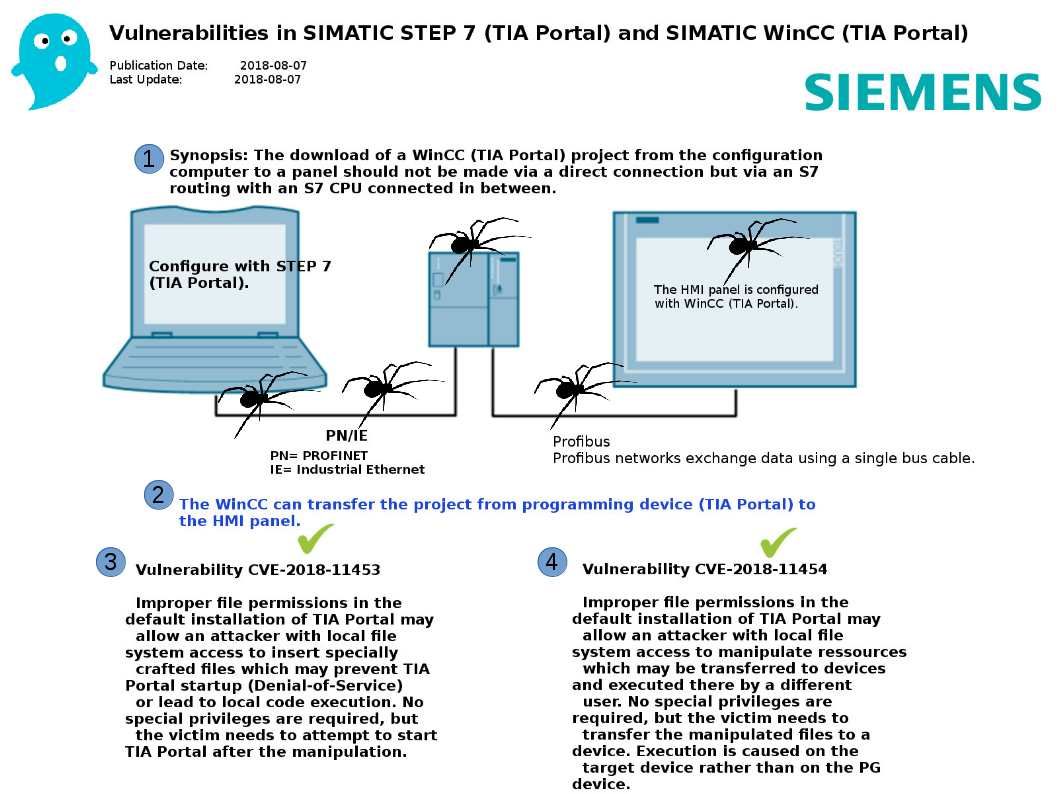
SIEMENS Vulnerabilities in SIMATIC STEP 7 (TIA Portal) and SIMATIC WinCC (TIA Portal) – Aug 2018

SIMATIC WinCC is a supervisory control and data acquisition (SCADA) and human-machine interface system from Siemens. Due to threats to actors’ interests, manufacturers have recently paid close attention to cybersecurity attacks. Hackers use Microsoft’s operating system entry point to become a channel for SCADA system facilities network attacks. Even Though Microsoft Office also pulled into SCADA security concerns! As far as we know, the new version of BLACKENERGY malware threat exploit an unpatched Office 2013 form the attack. From technical point of view, malware is hard to survival in 64 bit OS environment. However 32-bit operating system is common in SCADA related industries. So, it requires a longer time to do the design enhancement. The SCADA vendor found 2 items of Vulnerabilities in SIMATIC STEP 7 (TIA Portal) and SIMATIC WinCC (TIA Portal) on Aug 2018 (see below diagram). So, Tenable and Siemens partner to secure critical infrastructure & reduce cybersecurity risks. Please refer to the following URL:

https://www.windpowerengineering.com/business-news-projects/tenable-and-siemens-partner-to-secure-critical-infrastructure-reduce-cybersecurity-risks/

Are 64-bit OS malware proof?

Are 64-bit OS malware proof?

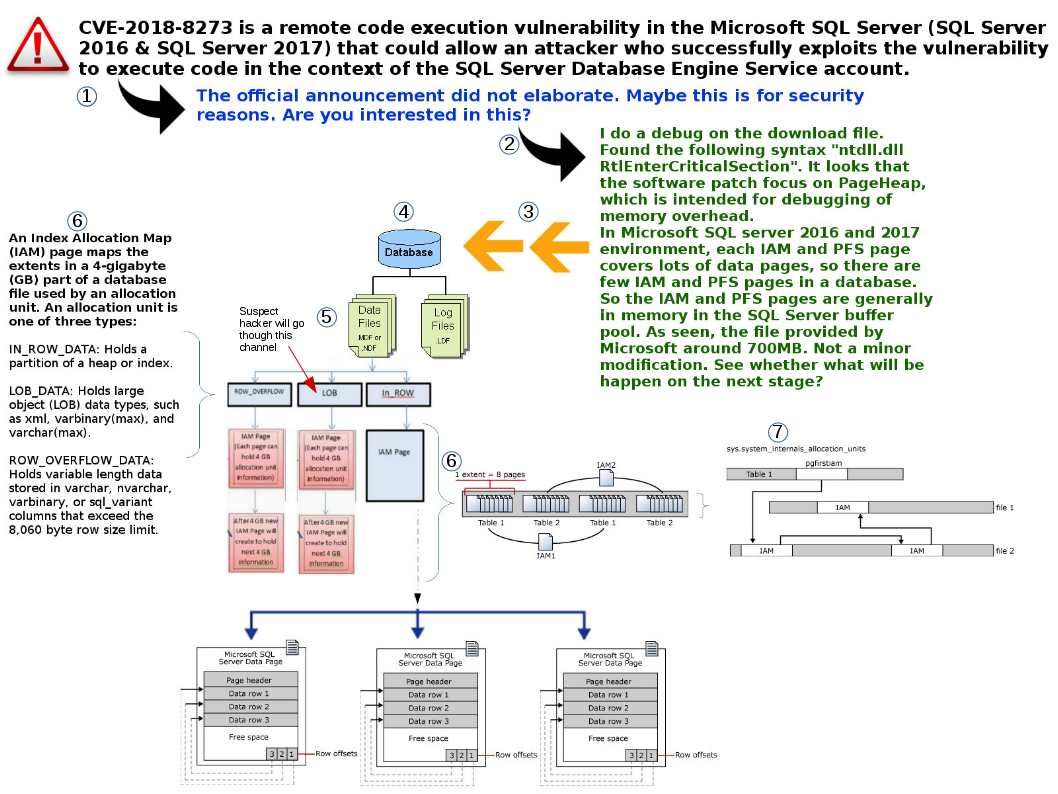
Aug 2018 – CVE-2018-8273 | Microsoft SQL Server Remote Code Execution Vulnerability

Above vulnerability looks complicated. It is only effect SQL server 2016 and 2017.

I do a debug on the download file.

Found the following syntax “ntdll.dll RtlEnterCriticalSection”. It looks that the software patch focus on PageHeap, which is intended for debugging of memory overhead.
In Microsoft SQL server 2016 and 2017 environment, each IAM and PFS page covers lots of data pages, so there are few IAM and PFS pages in a database. So the IAM and PFS pages are generally in memory in the SQL Server buffer pool. As seen, the file provided by Microsoft around 700MB. Not a minor modification. See whether what will be happen on the next stage?

Should you have interest, please reference below diagram.

Official announcement shown below:

https://portal.msrc.microsoft.com/en-US/security-guidance/advisory/CVE-2018-8273


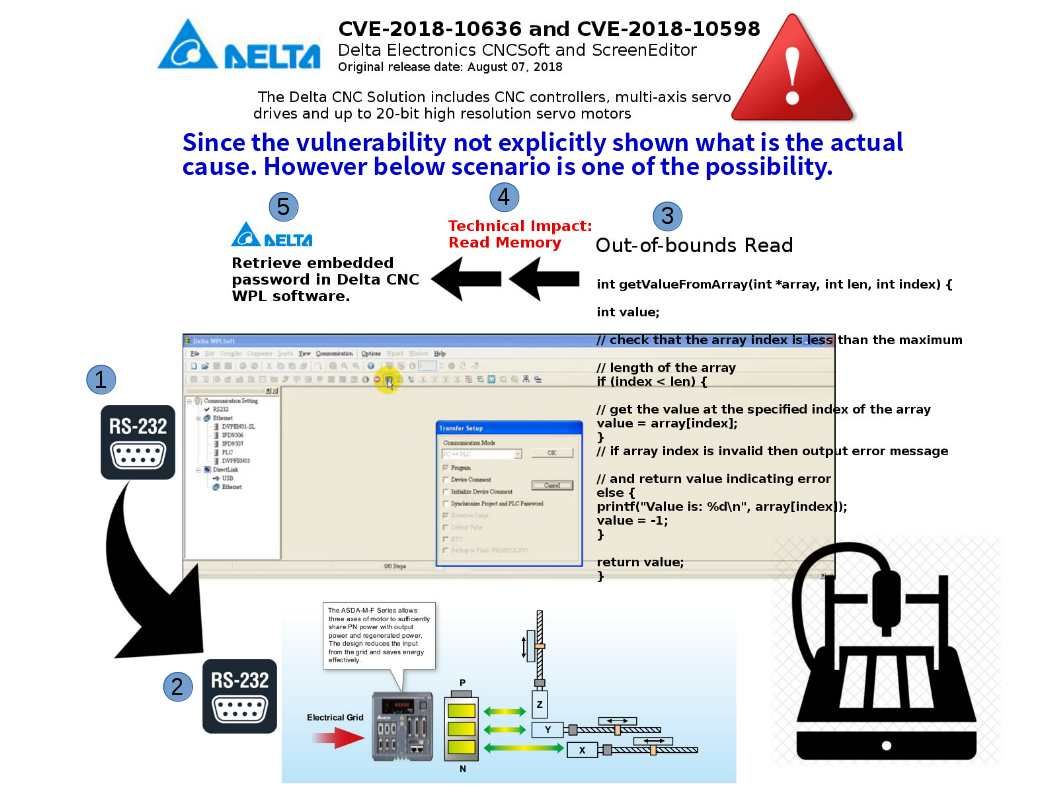
Aug 2018: Delta CNCsoft client alert – Suggest update to the latest version of CNCSoft v1.01.09


Computerized Numerical Control (CNC) Machining is a method used to perform a wide range of manufacturing tasks, which are all carried out by computerized devices. … The new CNC machines were able to be controlled by programming language to carry out a wider variety of tasks with greater accuracy. Delta, a world-class provider of industrial automation solutions includes CNC.

Found Delta CNCSoft Version 1.00.83 and prior with ScreenEditor Version 1.00.54 has two out-of-bounds read vulnerabilities and multiple stack-based buffer overflow problem. To my observation, CNCSoft application looks embedded with a password. May be there is another root cause.

Official recommendation:

Update to the latest version of CNCSoft, v1.01.09. The updated version can be found at: http://www.deltaww.com/Products/PluginWebUserControl/downloadCenterCounter.aspx?DID=84&DocPath=1&hl=en-US

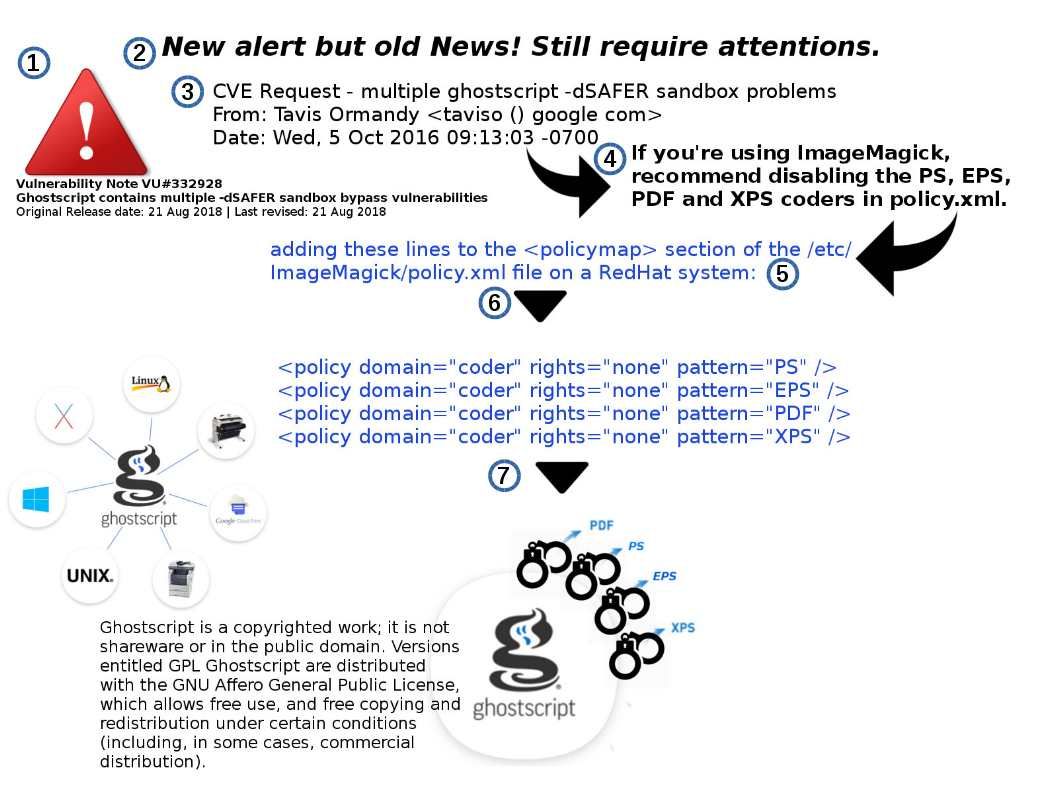
New alert but old News! Still require attentions (Ghostscript -dSAFER)!

The product name Ghostscript misleading people that it is a undergound hack tool. Actually Ghostscript is a suite of software based on an interpreter for Adobe Systems’ PostScript and Portable Document Format page description languages. And therefore it might install in your computer already. On Oct 2016, Google security expert infomed that we must stay alert for vulnerability found in ghostscript (multiple ghostscript -dSAFER sandbox problems).It looks this issue become serious. US-CERT prompt the alert again! Should you have interest, please refer below:

https://www.kb.cert.org/vuls/id/332928

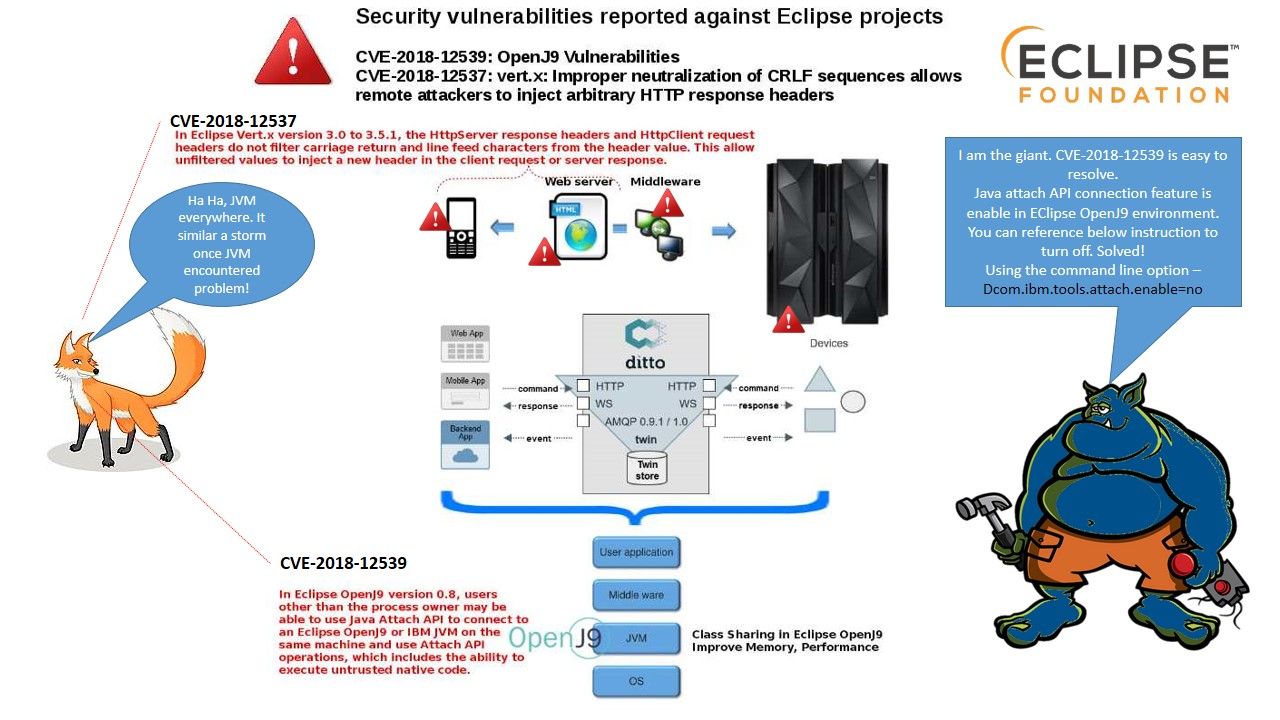
Aug 2018 – (CVE-2018-12539) – Eclipse OpenJ9 Vulnerabilities

The software expert keen to reduce memory footprint and improve their application performance.Java code can run on different systems, because it relies on the JVM, not on the operational system itself. This is the powerful function of Java plus JVM. Meanwhile, it let’s Java application developers and end users spreading around in the world. The virtual machine creates an independent platform on top of the operating system. Similar the situation of Docker in today’s cloud computing.The JVM is a “simulated machine” that can be installed on different systems.  Furthermore, if vulnerability occurs in JVM. It will jeopardizing the related system facilities since the application run on top of JVM.

CVE-2018-12539 – In Eclipse OpenJ9 version 0.8, users other than the process owner may be able to use Java Attach API to connect to an Eclipse OpenJ9 or IBM JVM on the same machine and use Attach API operations, which includes the ability to execute untrusted native code.

Remediation – Attach API is enabled by default on Windows, Linux and AIX JVMs and can be disabled using the command line option –Dcom.ibm.tools.attach.enable=no.

ABout the details CVE-2018-12539 : https://bugs.eclipse.org/bugs/show_bug.cgi?id=534589

Additional CVE-2018-12537: https://bugs.eclipse.org/bugs/show_bug.cgi?id=536038

Do not contempt CVE-2018-6973 (VMware workstation)-Out-of-bounds-write-14thAug2018

Since the popularity of VM machine. Software development team and IT operations team will do the testing on their own premises in the first. May be you would say, this is not compliance for best practice. But the fact is that this is one of the way. VMware alert to public last week (14th Aug 2018 -CVE-2018-6973). In high level point of view, this vulnerability only occurs in VMware Workstation and Fusion products. VMware workstation is a solution for running virtual machines on Windows and Linux, while Fusion is used for running virtual machines on macOS. So the popularity and volume of usage will be much high than VM server in public. But do not contempt this bug, if such vulnerabilities occurs in your local workstation. It will jeopardizes your infrastructure because you workstation will become vulnerable. Wishing that the attached pictures can tell you the story.

Official reference details shown as below:

https://www.vmware.com/security/advisories/VMSA-2018-0022.html

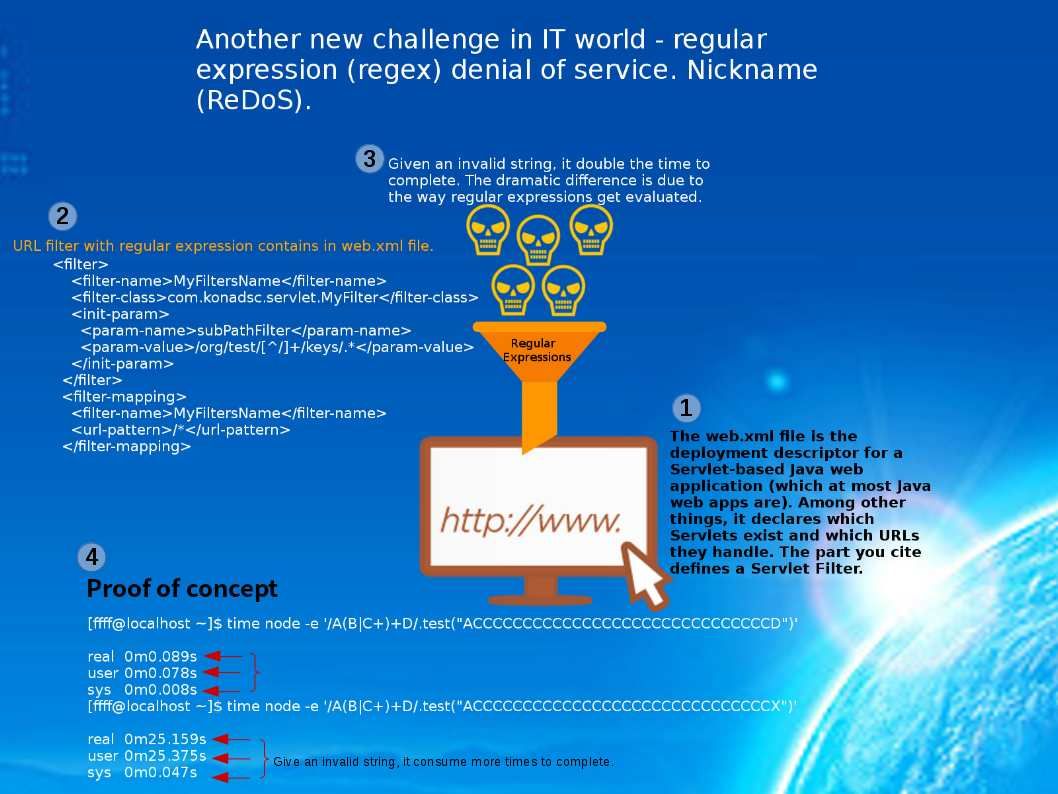
Another new challenge in IT world – Nickname (ReDoS) Aug 2018

A regular expression (regex or regexp for short) is a special text string for describing a search pattern. We can’t lack of this function in IT world. For example, your SIEM log parser and Web server input protection filter.

Eventhough if you want to represent a group of Strings according to a particular pattern then you should go for Regular Expression. Just heard that the regular expression function can be modify by attacker.Then conduct denial of service attack.

I download node.js package do the proof of concept. It looks that it is ture. For more details, please reference to attached diagram. Java is also known to be affected by ReDoS attacks.

Technical articles shown as below:

http://people.cs.vt.edu/dongyoon/papers/EUROSEC-17-EHP.pdf

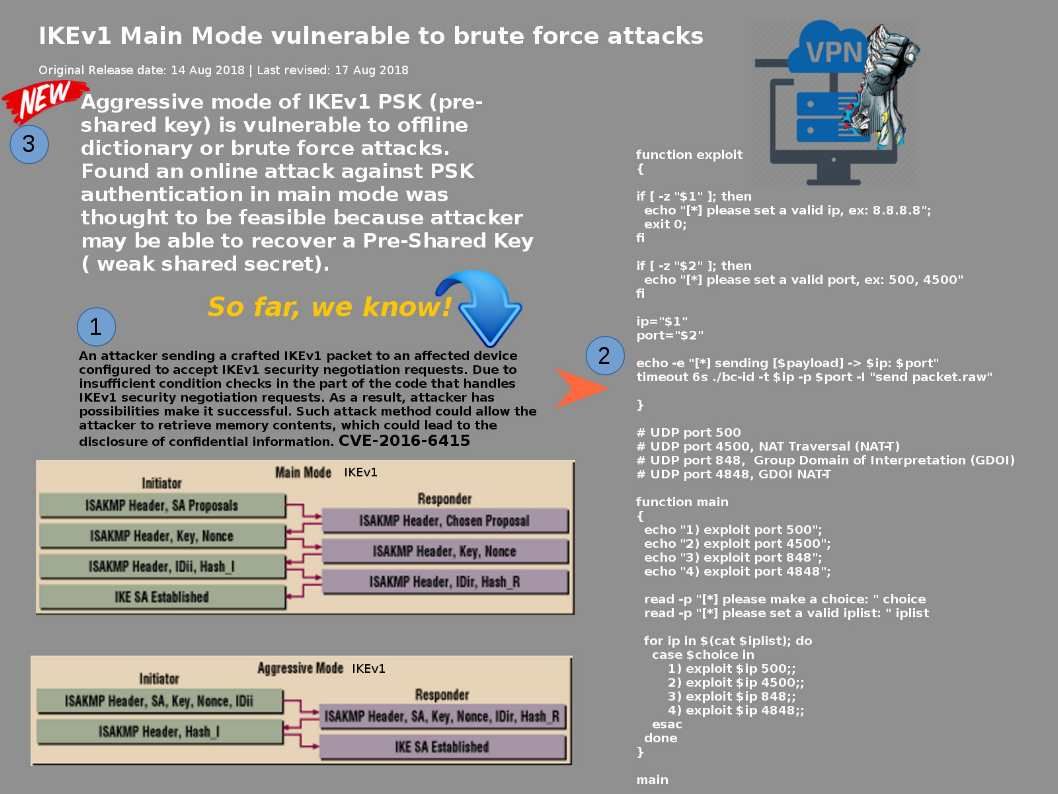
17th Aug 2018 – IKEv1 Main Mode vulnerable to brute force attacks

Sometimes the situation of the technology world similar a people stand in the cross road. For instance, you relies on remote access to do your work. We relies SSL/TLS so far. Now we know SSL TLS 1.0 not safe and advice to use TLS 1.1 and 1.2. VPN (virtual private network) like a mandatory interconnect of our life daily. We known already that VPN with IKEv1 aggressive mode not safe. How about IKEv1 main mode situation? The world tell the truth this week. IKEv1 Main Mode vulnerable to brute force attacks. The Internet Key Exchange v1 main mode is vulnerable to offline dictionary or brute force attacks. (CVE-2018-5389). The fact is that an attacker may be able to recover a weak Pre-Shared Key (weak shared secret).

Offical details shown below reference hyperlink.

https://www.kb.cert.org/vuls/id/857035

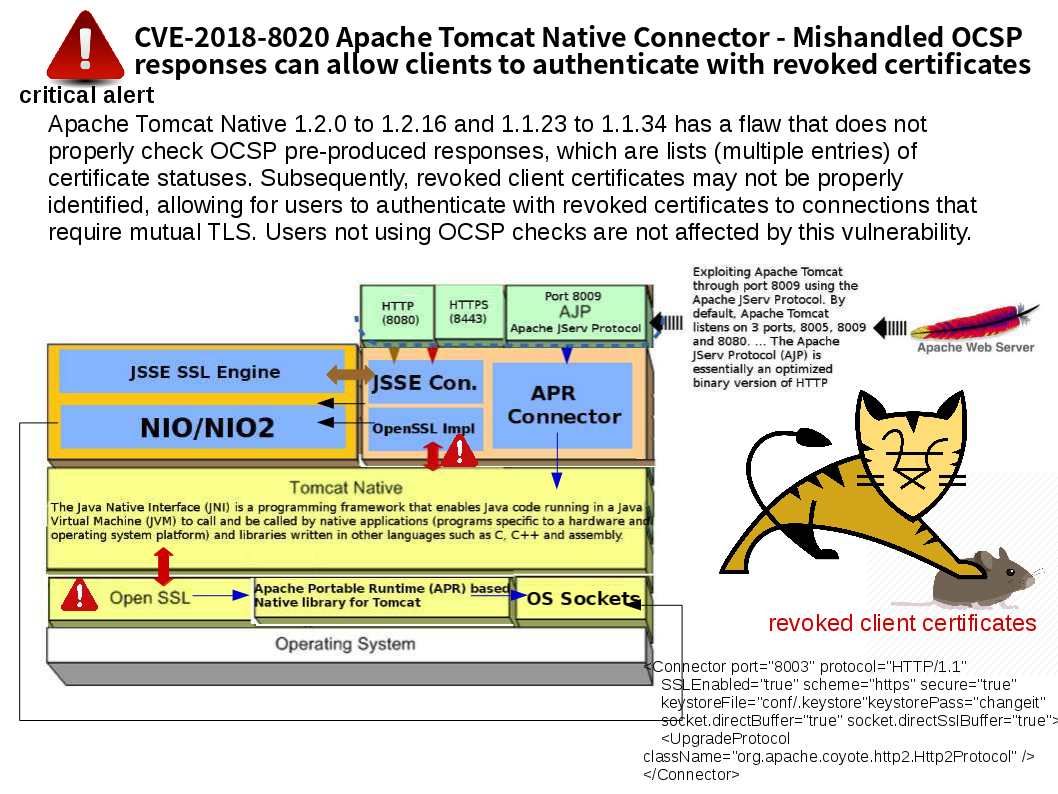
Staying alert on this vulnerability! (Apache Tomcat APR/native Connector vulnerabilities) – Aug 2018

Apache and Tomcat is a perfect match. Their relationship similar pianist and piano. We can’t lack of music in our life. On the other hand, IT world can’t without Apache and Tomcat. But Tomcat is sick today. Found the Apache Tomcat Native (1.2.0 to 1.2.16 and 1.1.23 to 1.1.34) has a flaw that does not properly check OCSP pre-produced responses, which are lists (multiple entries) of certificate statuses. As a result, revoked client certificates may not be properly identified. It allow suspects to authenticate with revoked certificates to connections that require mutual TLS. Native connector use OpenSSL for SSL/TLS function. Refer to attached diagram. If such vulnerability occurs, in the sense that the suspects can control the whole system. It is hard to imagine that how worst will be the IT shop using multiple vhost setup (see below specifications)!

Tomcat 8 supports
one TLS virtual host per connector
one certificate per virtual host

Tomcat 9 supports
multiple virtual hosts per connector (SNI)
multiple certificates per virtual host

For more details, please reference to official announcement.

http://tomcat.apache.org/security-native.html#Not_a_vulnerability_in_the_Apache_Tomcat_APR/native_Connector