Category Archives: Potential Risk of CVE

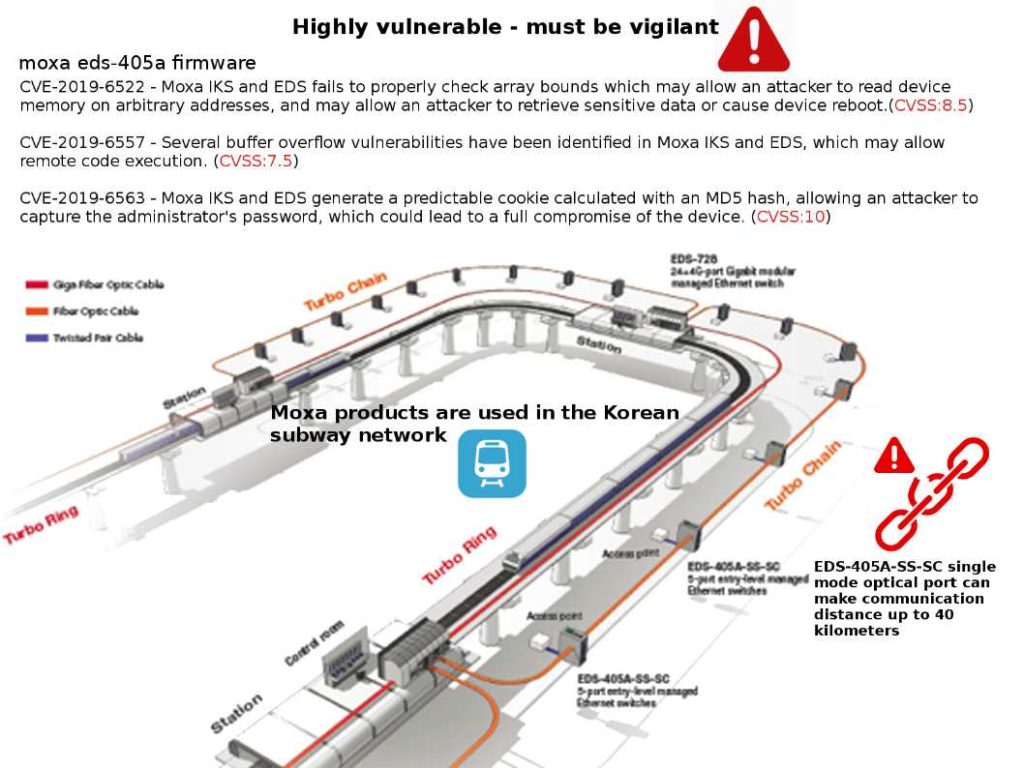
Highly vulnerable – Moxa customer must be vigilant!

Preface: The MoxaEDS405A/408A are entry-level 5 and 8-port managed Ethernet switches designed especially for industrial applications.

Technical background: Turbo Ring is a self-healing technology that enables fast fault recovery under 20 ms. Moxa’s Turbo Ring and Turbo Chain Ethernet technologies maximize railway network availability with ideal redundancy technology.

Security focus: CVE-2019-6563 (CVSS:10) – Moxa IKS and EDS generate a predictable cookie calculated with an MD5 hash, allowing an attacker to capture the administrator’s password, which could lead to a full compromise of the device.

What is Predictable cookie ? For example: Cookie: JSESSIONID=USER1. A predictable cookie calculated with an MD5 hash bring our attention because MD5 produces a 128-bit hash as an output; only 3 bytes of the hash value are used in the cookie value.

Observation: Moxa products are used in the Korean subway network on 2010. Not sure whether it is still remain usage. But believe that a remedy solution has been taken if it is still in used. Otherwise it will create a cyber security risk in the operations.

Vulnerabilities details please refer to url: https://ics-cert.us-cert.gov/advisories/ICSA-19-057-01
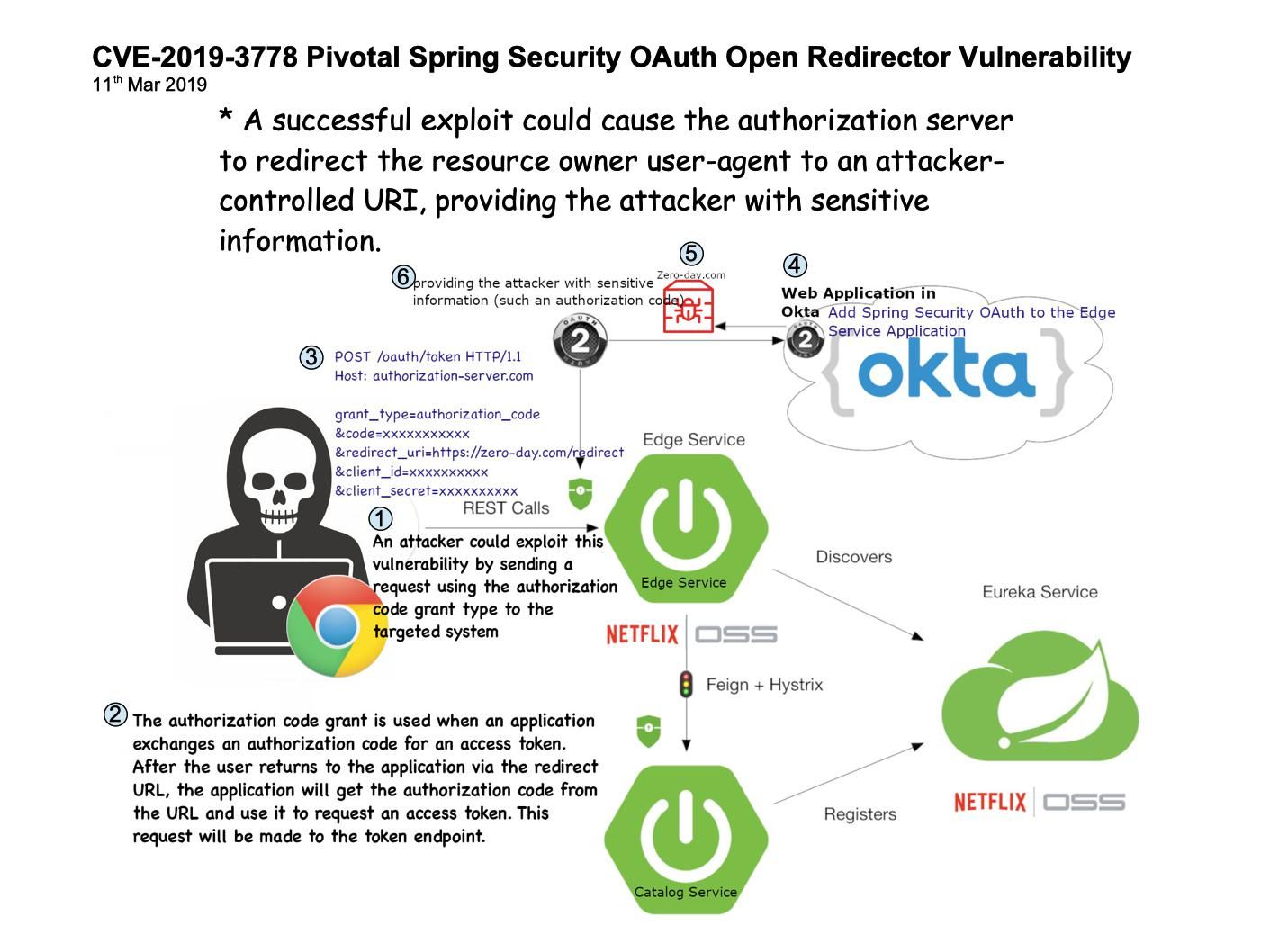
CVE-2019-3778 Pivotal Spring Security OAuth Open Redirector Vulnerability (critical)

Preface: OAuth has become a standard for third-party applications to communicate with the APIs of popular web sites, such as Facebook, Twitter, and Foursquare, to name a few.

Technical background: Currently, the two major versions of OAuth are 1.0(a) and 2.0. With Spring Security and its OAuth 2.0 support, the OAuth (Open Authorisation) is a standard for authorisation of resources. You can set it up to automatically propagate your access tokens from one app to the other, ensuring that everything stays secure and encrypted along the way.

Vulnerability detail: A vulnerability in Pivotal Spring Security OAuth could allow an unauthenticated, remote attacker to conduct an open redirect attack on a targeted system. A successful exploit could cause the authorization server to redirect the resource owner user-agent to an attacker-controlled URI, providing the attacker with sensitive information.

Official announcement: https://pivotal.io/security/cve-2019-3778

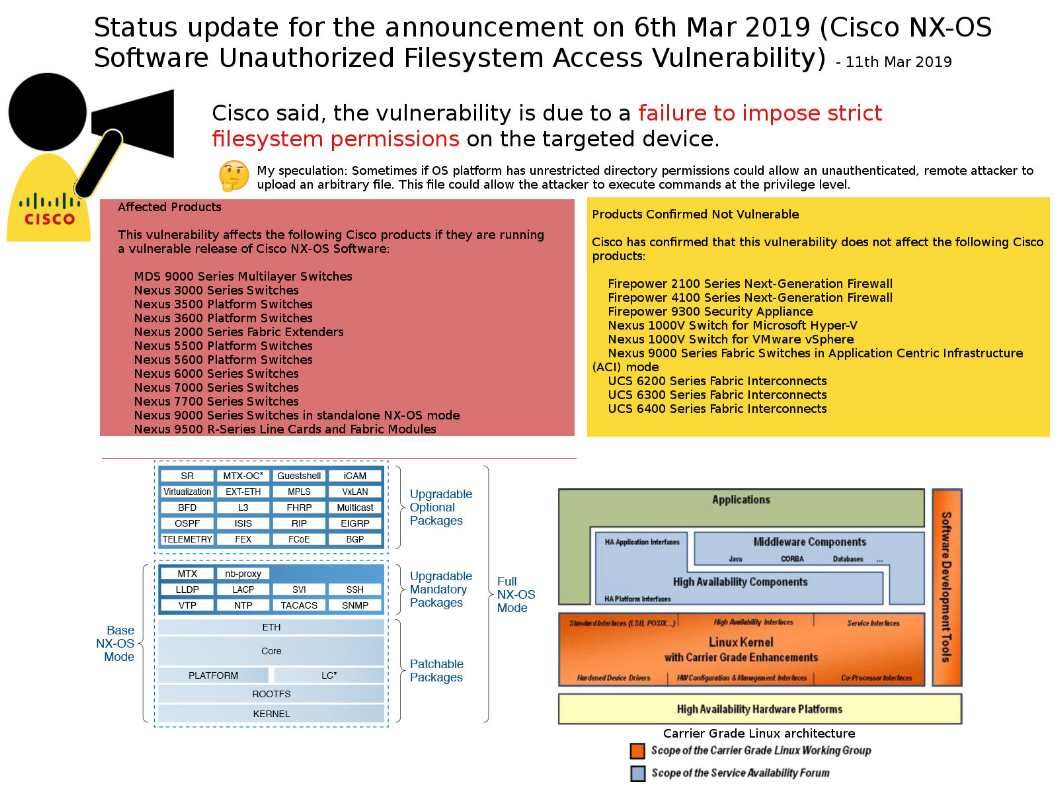
Status update for the announcement on 6th Mar 2019 (Cisco NX-OS Software Unauthorized Filesystem Access Vulnerability) – 11th Mar 2019.

Preface: On 6th Mar, 2019, Cisco announcement that there are vulnerabilities found on Cisco FXOS and NX-OS Software. The total 26 of the vulnerabilities have a Security Impact Rating (SIR) of High. Successful exploitation of the vulnerabilities could allow an attacker to gain unauthorized access.

Technical background:
Cisco NX-OS based on Wind River Linux and is inter-operable with other Cisco operating systems. The command-line interface of NX-OS is similar to that of Cisco IOS. Recent NX-OS has both Cisco-style CLI and Bash shell available.

Status update on 11th Mar 2019: The vulnerability is due to a failure to impose strict filesystem permissions on the targeted device.
For more details, please refer url: https://tools.cisco.com/security/center/content/CiscoSecurityAdvisory/cisco-sa-20190306-nxos-file-access

My speculation: Sometimes if OS platform has unrestricted directory permissions could allow an unauthenticated, remote attacker to upload an arbitrary file. This file could allow the attacker to execute commands at the privilege level.

CVE-2019-0187: Apache JMeter Missing client auth for RMI connection when distributed test is used! Mar 2019

Preface: If your company hasn’t been performing load testing, it is hard to know the web application actual performance. Deploying JMeter will display the test results in a graph updated in real time.

Synopsis: Perhaps software developers did not imagine that JMeter design weakness will be hazardous of web server. And therefore we might found Jmeter function still activate after services launch.

Vulnerability detail: Apache JMeter Missing client auth for RMI connection when distributed test is used. And therefore attacker could exploit this vulnerability by establishing a Remote Method Invocation (RMI) connection with a jmeter-server while using the RemotejMeterEngine interface.It such a way let attacker execute arbitrary code on a targeted system.

Remedy: Apache.org has released an update at the following link: https://jmeter.apache.org/download_jmeter.cgi

Cisco confirm OCI flaw only affecting small group of items in their product line – 8th Mar 2019

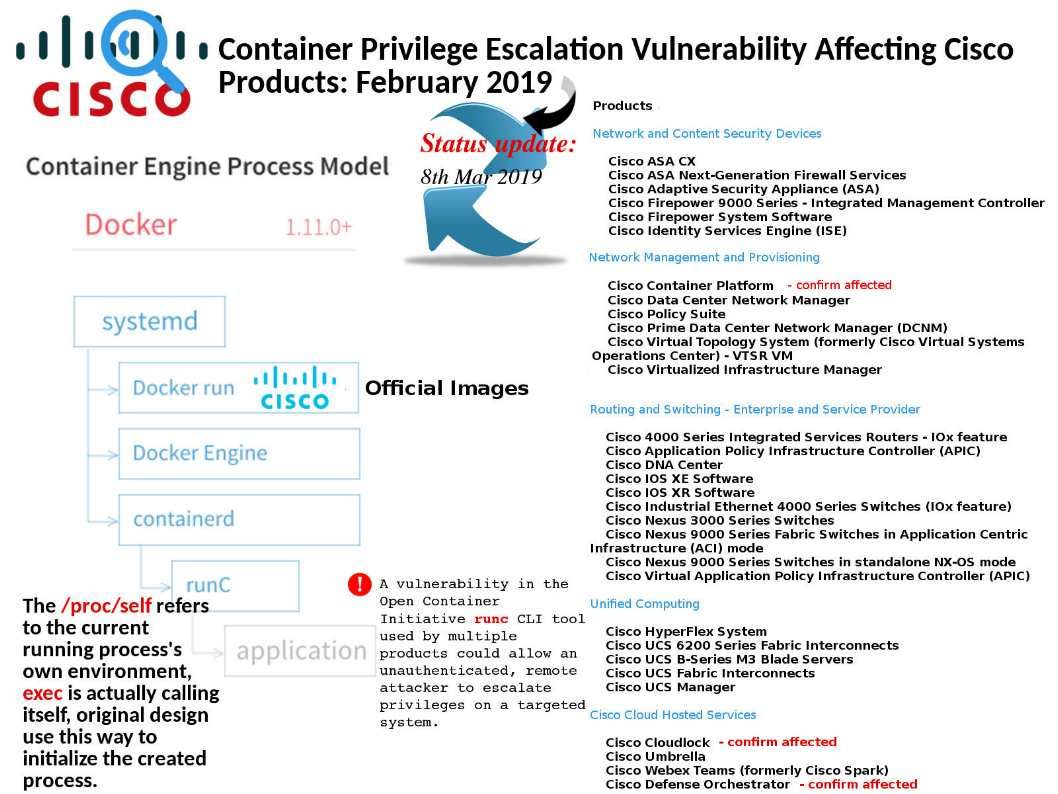
Preface: Container Privilege Escalation Vulnerability Affecting Cisco Products status update

Description: IT world is safe again, Cisco you are super again! There is only 3 items of Cisco product involves into the Container Privilege Escalation Vulnerability found on last month (Feb 2019). Remedy has been proceed. Further details in below:

Network Management and Provisioning:

  • Cisco Container Platform – Fixed Release Availability: 3.1.0 (Mar 2019)

Cisco Cloud Hosted Services:

  • Cisco Cloudlock – Cisco will update affected systems in Sept 2019
  • Cisco Defense Orchestrator – Cisco updated affected systems
    On-prem: 19.8 (Available)

Official details: https://tools.cisco.com/security/center/content/CiscoSecurityAdvisory/cisco-sa-20190215-runc

CVE-2018-11793: Apache Mesos JSON Payload Parsing DoS Vulnerability 5th Mar 2019

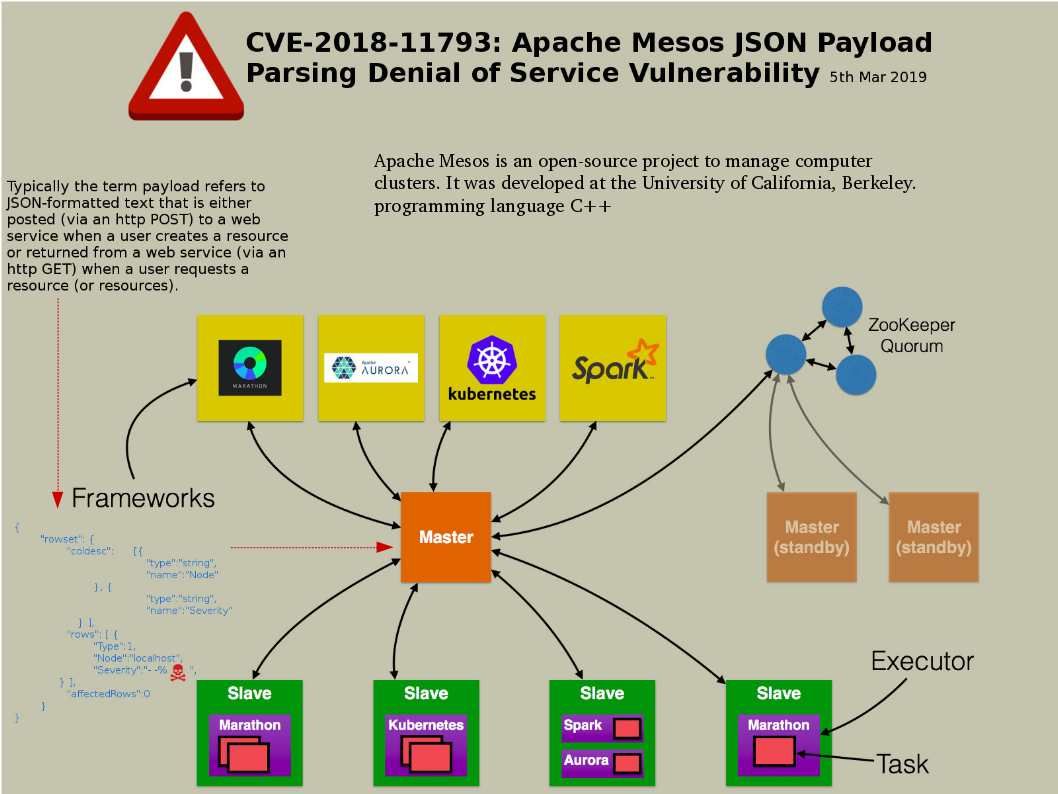
Preface: Apache Mesos is an open-source project to manage computer clusters. It was developed at the University of California, Berkeley.

About Payload in Web services: Typically the term payload refers to JSON-formatted text that is either posted (via an http POST) to a web service when a user creates a resource or returned from a web service (via an http GET) when a user requests a resource (or resources).

Vulnerability detail: A vulnerability in the JSON payload parser of Apache Mesos could allow an unauthenticated, remote attacker to cause a denial of service (DoS) condition an a targeted system.

Official announcement: https://lists.apache.org/thread.html/9be975c53e5ad612c7e0af39f5b88837fbfbc32108e587d3d8499844@%3Cdev.mesos.apache.org%3E

Remedy: http://mesos.apache.org/downloads/

Cisco Event Response: March 2019 Cisco FXOS and NX-OS Software Security Advisory Bundled Publication. 6th Mar 2019

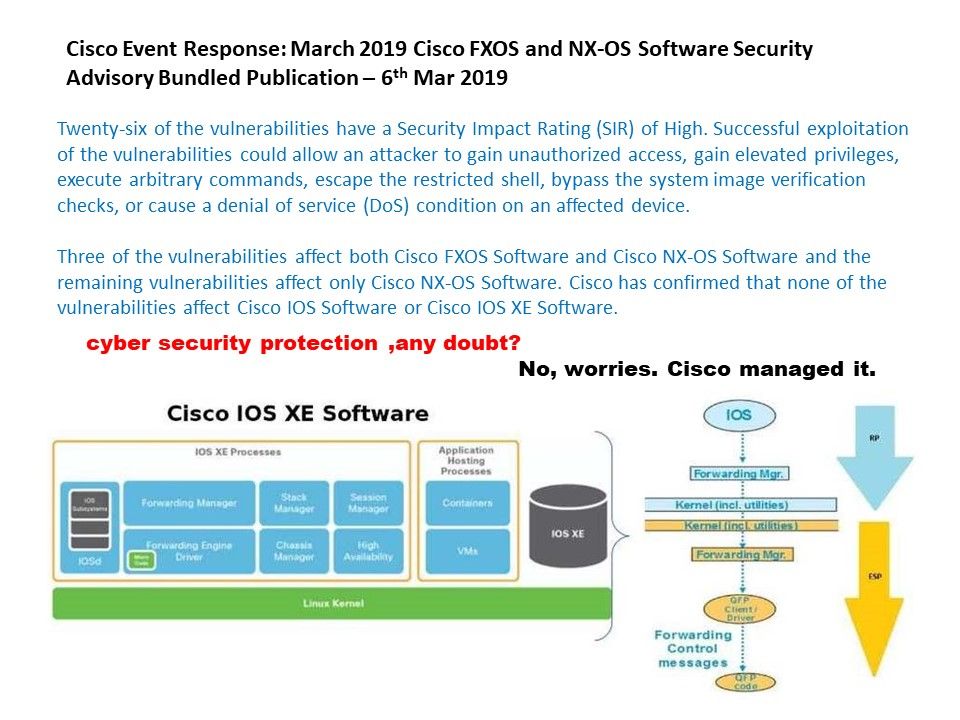
Preface: The urgent announcement by Cisco might scare the customer of Cisco. It is about the vulnerabilities found on Cisco FXOS and NX-OS Software. But no worries, Cisco managed it.

Technical background:
Cisco NX-OS based on Wind River Linux and is inter-operable with other Cisco operating systems. The command-line interface of NX-OS is similar to that of Cisco IOS. Recent NX-OS has both Cisco-style CLI and Bash shell available.
Cisco NX-OS Family perform authentication based on roles. Role-based authorization limits access to switch operations by assigning users to roles.

Vulnerability details: 26 of the vulnerabilities have a Security Impact Rating (SIR) of High. Successful exploitation of the vulnerabilities could allow an attacker to gain unauthorized access, gain elevated privileges, execute arbitrary commands, escape the restricted shell, bypass the system image verification checks, or cause a denial of service (DoS) condition on an affected device.

For more details, please refer to url: https://tools.cisco.com/security/center/viewErp.x?alertId=ERP-70757

Unknown vulnerability Found Affecting Intel CPUs – 5th Mar 2019

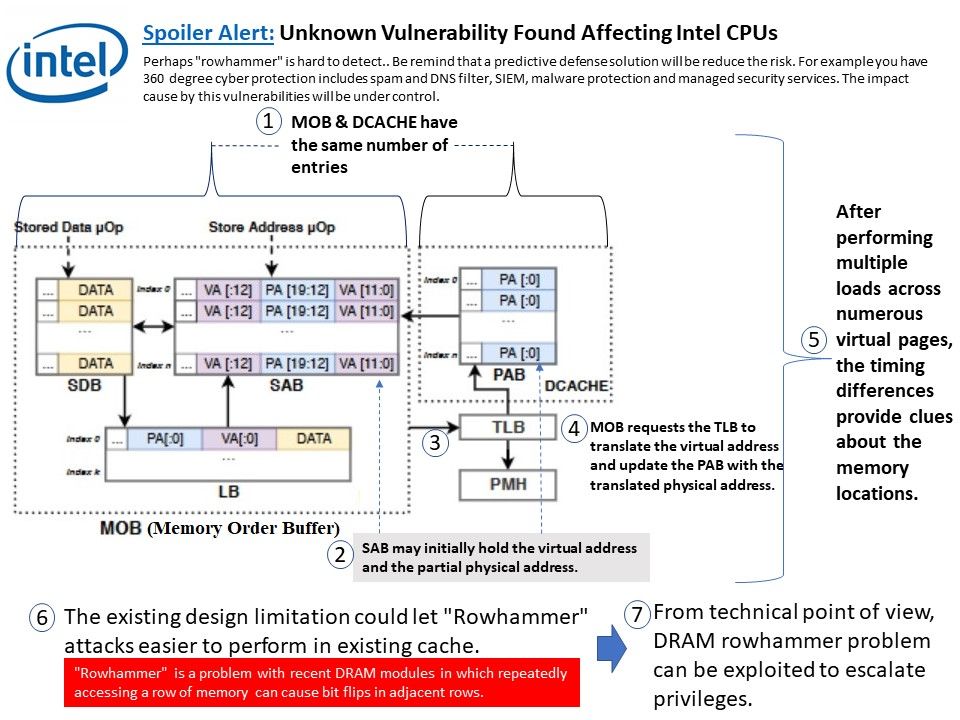
Preface: So called Spoilter, a vulnerability given by Intel CPU design limitation. If hacker successful exploit such vulnerability. They can conduct “Rowhammer” attack for privileges escalation.

Vulnerability detail: The speculative execution function of Intel’s processors aim to increase the performance of a CPU. Meanwhile it caused Intel CPU vulnerability issues in the past. A new found technique is able to determine how virtual and physical memory is related to each other. By discovering time differences, an attacker can determine the memory layout and then know which area to attack. For more details, please refer attached diagram for reference.

Remedy: There is no mitigation plan that can completely erase this problem.

Headline news: https://www.theregister.co.uk/2019/03/05/spoiler_intel_processor_flaw/

Conclusion: Perhaps “rowhammer” is hard to detect.. Be remind that a predictive defense solution will be reduce the risk. For example you have 360 degree cyber protection includes spam and DNS filter, SIEM, malware protection and managed security services. The impact cause by this vulnerabilities will be under control.

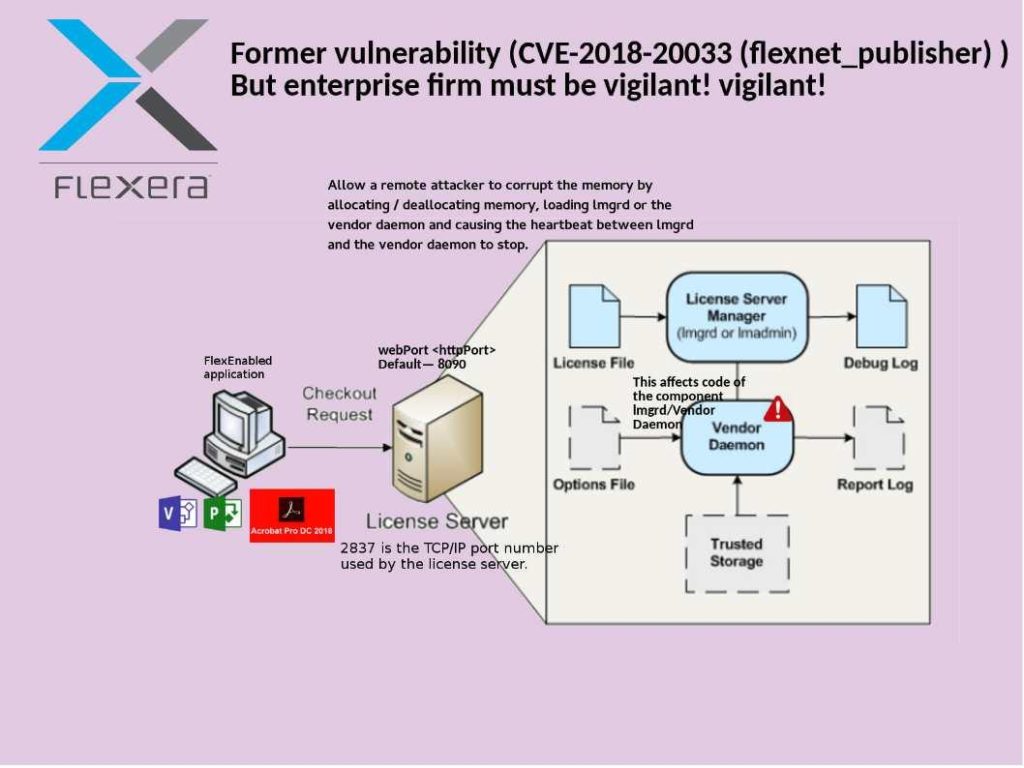
Former vulnerability (CVE-2018-20033 (flexnet_publisher) ) – But enterprise firm must be vigilant! vigilant!

Preface: FlexNet Publisher (formerly known as FLEXlm) is a software license manager from Flexera Software which implements license management and is intended to be used in corporate environments to provide floating licenses to multiple end users of computer software.

Vulnerability background: The design weakness found on 2018. But the official announcement was release on 2019-01-28.

Vulnerability detail: Allow a remote attacker to corrupt the memory by allocating / deallocating memory, loading lmgrd or the vendor daemon and causing the heartbeat between lmgrd and the vendor daemon to stop.

Impact: A successful exploit could allow the attacker to cause the affected software to stop responding, or use the memory corruption to execute arbitrary code.

Official announcement: https://secuniaresearch.flexerasoftware.com/advisories/85979/

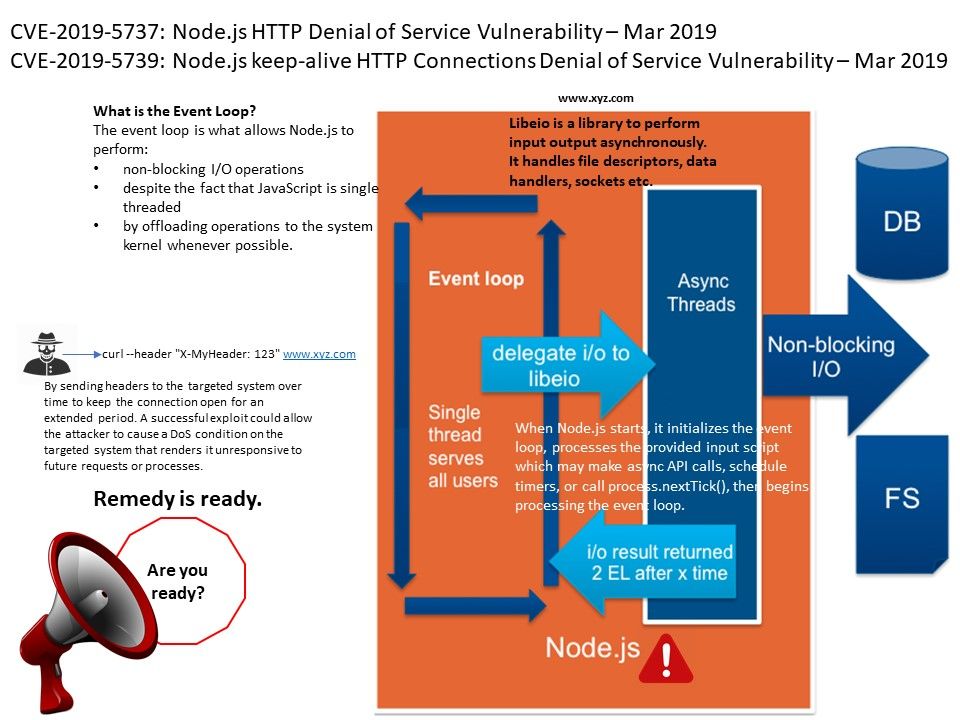
About Node.js vulnerabilities – Mar 2019

Preface: Node.js is popular in technology world. No matter crypto or distributed ledger platform, Docker development, REST API…etc can deploy by node.js.

About node.js?
Node.js is a JavaScript runtime environment that processes incoming requests in a loop, called the event loop (initialization and callbacks) and offers a Worker Pool to handle expensive tasks like file I/O. Modern kernel can handle multiple operations executing in the background. Node.js design aim to let’s kernel tells Node.js so that the appropriate callback may be added to the poll queue to eventually be executed. Perhaps such design concept provides an opportunity to hacker!

Vulnerability details (CVE-2019-5737): An attacker could exploit this vulnerability when establishing an HTTP or HTTPS connection in keep-alive mode by sending headers to the targeted system over time to keep the connection open for an extended period. As a result a denial of service condition occurred. Official announcement display in below url: https://nodejs.org/en/blog/vulnerability/february-2019-security-releases/