CVE-2024-56161 – AMD SEV Confidential Computing Vulnerability (7th Feb 2024)

Preface: Sometimes, when a solution is misused or misconfigured, it can use this testing feature as a sword!

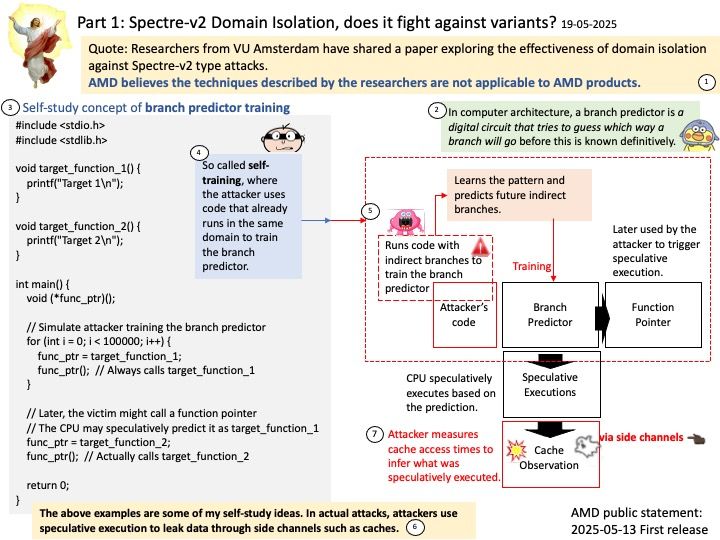
Background: AMD SEV (Secure Encrypted Virtualization) is a hardware-based security feature designed to enhance the confidentiality and integrity of virtual machines (VMs) running on AMD EPYC processors. Here are some key points about it:

  1. Memory Encryption: SEV encrypts the memory of individual VMs using unique encryption keys. This ensures that neither the hypervisor nor other VMs can access the data of a specific VM.
  2. Isolation: SEV creates an isolated execution environment, protecting VMs from potential attacks originating from the hypervisor or other VMs.
  3. SEV-SNP (Secure Nested Paging): This is an extension of SEV that adds strong memory integrity protections. It helps prevent malicious hypervisor-based attacks like data replay and memory re-mapping, further enhancing the security of the VMs.
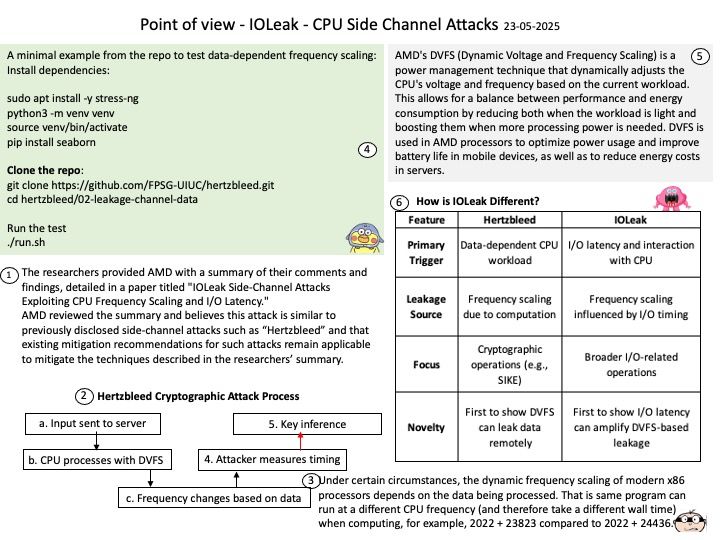
  4. Recent Vulnerability: A recent vulnerability (CVE-2024-56161) was discovered in SEV-SNP, which could allow an attacker with local admin privileges to load malicious CPU microcode, compromising the confidentiality and integrity of VMs. AMD has released patches to mitigate this issue.

Vulnerability details: Improper signature verification in AMD CPU ROM microcode patch loader may allow an attacker with local administrator privilege to load malicious CPU microcode resulting in loss of confidentiality and integrity of a confidential guest running under AMD SEV-SNP.

Office announcement: Please refer to the link for details https://www.amd.com/en/resources/product-security/bulletin/amd-sb-3019.html

CVE-2025-0096 – Fix malloc buffer size (6th Feb 2025)

Original release date: February 3, 2025

Preface: The Hardware Abstraction Layer (HAL) is not outdated with Android 15. In fact, HAL continues to play a crucial role in the Android architecture. Android 15 includes improvements and updates to various HAL components, ensuring they remain relevant and effective for modern hardware and software requirements.

Background: Android 15 continues to use hal_fwlog[.]cc because it remains a crucial component for logging firmware-related events and activities within the Hardware Abstraction Layer (HAL). The HAL provides a standardized interface for hardware vendors, allowing the Android operating system to communicate with hardware components without needing to know the specifics of the hardware. This ensures compatibility and stability across various devices and hardware configurations.

Maintaining hal_fwlog[.]cc helps in diagnosing and troubleshooting hardware issues, ensuring that the system can log and monitor firmware activities effectively. This is essential for maintaining the overall reliability and performance of the Android operating system.

Vulnerability details: Fix malloc buffer size in hal_fwlog[.]cc

The hal_fwlog[.]cc file in Android is part of the Hardware Abstraction Layer (HAL). This file is typically used for logging firmware-related events and activities. The HAL provides a standard interface for hardware vendors to implement, allowing the Android operating system to communicate with hardware components without needing to know the specifics of the hardware.

Official announcement: Please refer to the link for details – https://source.android.com/docs/security/bulletin/2025-02-01

CVE-2025-0091: Block the content scheme intent in AccountTypePreferenceLoader (3rd Feb 2025)

Preface: As of January 2025, Android holds a global market share of 72.15%, which is a big jump from just 12% back in 2010.

Background: The AccountTypePreferenceLoader is a class within the Android Settings app. It is responsible for loading and displaying account preferences, which include settings related to authenticator apps. This class plays a crucial role in managing user accounts and preferences on Android devices.

For example, when you add a new email account or a social media account to your Android device, the AccountTypePreferenceLoader ensures that the specific settings for that account type are properly loaded and displayed in the Settings app. This makes it easier for users to manage their accounts and customize their preferences.

Vulnerability details: AccountTypePreferenceLoader.java, there is a possible way to retrieve protected files from the Settings app due to a confused deputy. This could lead to local information disclosure with no additional execution privileges needed. User interaction is not needed for exploitation.

Official announcement: For more details, please refer to the following link – https://source.android.com/docs/security/bulletin/2025-02-01

CVE-2025-0098 : Prevent activity token leaked to another process (3rd Feb 2025)

Preface: Android frameworks deliver an environment where you already have access to libraries, best practices, and extensive help documentation. As a matter of fact, there are well over ten android frameworks.

Background: TaskFragmentOrganizerController[.]java is a part of the Android Open Source Project (AOSP). It is located in the services/core/java/com/android/server/wm directory of the Android framework. This file is responsible for managing the organization and lifecycle of task fragments within the Android window management system.

The TaskFragmentOrganizerController works closely with the TaskFragmentOrganizer class, which provides an interface for controlling task fragments. These task fragments allow for more flexible and dynamic UI layouts by enabling parts of an activity to be managed independently.

In the context of TaskFragmentOrganizerController[.]java, a token typically refers to an identifier used to manage and track task fragments within the Android window management system. These tokens are often used to ensure that operations on task fragments are performed securely and correctly.

For example, a temporary token might be generated to allow an organizer to reparent an activity through a WindowContainerTransaction. This helps maintain the integrity and security of the task fragments being managed.

Remark: WindowContainerTransaction represents a collection of operations on some WindowContainer that should be applied at once.

Vulnerability details: Malicious app could register the organizer via one-way binder call to disguise as running on pid 0.

Official announcement: Please refer to the link for details – https://source.android.com/docs/security/bulletin/2025-02-01

CVE-2024-7881: To be or not to be (State Injection Into Hardware Prefetchers)?

Preface: instruction cache (I-cache) and a data cache (D-cache)

This is the smallest and fastest type of cache memory. It’s embedded directly into the CPU, allowing it to operate at the same speed as the CPU. The L1 cache is typically divided into two parts: one for storing instructions (L1i) and one for storing data (L1d).

Background: Instruction prefetching can boost execution performance by fetching data before it is needed. The Cortex-X4 core supports the AArch64 prefetch memory instructions, PRFM PLI, into the L1 instruction cache or L2 cache.  These instructions signal to the memory system that memory accesses from a specified address are likely to occur soon. The memory system takes actions that aim to reduce the latency of memory accesses when they occur. The PRFM PLD and PRFM PST instructions perform preloading in the L1 data cache, L2 cache, or L3 cache. PRFM PLD and PRFM PST instructions translate through the Data TLB. The PRFM PLI instruction performs preloading to the L1 instruction cache and L2 cache. Instruction preloading is performed in the background. PRFM PLI instructions translate through the Instruction TLB.

Vulnerability details: An issue has been identified in some Arm-based CPUs that may allow an unprivileged context to trigger a data memory-dependent prefetch engine to fetch the contents of a privileged location (for which it does not have read permission) and consume those contents as an address that is also dereferenced. 

Note that this issue does not affect guest-to-guest and guest-to-hypervisor isolation guarantees. Likewise, in configurations with RME enabled, Granule Protection Checks (GPC) are honoured by the prefetcher. 

Official details: Please refer to the link for details –

https://developer.arm.com/Arm%20Security%20Center/Arm%20CPU%20Vulnerability%20CVE-2024-7881

https://nvd.nist.gov/vuln/detail/CVE-2024-7881

CVE-2024-0140 : NVIDIA RAPIDS contains a vulnerability in cuDF and cuML, where a user could cause a deserialization of untrusted data issue (24th Jan 2025)

Preface: RAPIDS™, part of NVIDIA CUDA-X, is an open-source suite of GPU-accelerated data science and AI libraries with APIs that match the most popular open-source data tools. It accelerates performance by orders of magnitude, at scale, across data pipelines.

Background: RAPIDS is an open-source suite of software libraries and frameworks developed by NVIDIA to accelerate and streamline data science and analytics workflows. One of its key components is cuDF, a GPU-accelerated DataFrame library that mirrors the functionality of Pandas but operates at much higher speeds. This allows for rapid data loading, filtering, and transformation with reduced memory usage.

cuDF: Python bindings for libcudf (Pandas like API for DataFrame manipulation)

cuML: C++/CUDA ML Algorithms: C++/CUDA machine learning algorithms

Vulnerability details: NVIDIA RAPIDS contains a vulnerability in cuDF and cuML, where a user could cause a deserialization of untrusted data issue. A successful exploit of this vulnerability might lead to code execution, data tampering, denial of service, and information.

Official announcement: Please refer to the link for details – https://nvidia.custhelp.com/app/answers/detail/a_id/5597

It is speculated that CVE-2025-0612 and CVE-2025-0611 are related to the rendering engine! (23-01-2025)

Preface: Humans have integrated smartphones (IoT) into their daily lives due to habit formation. Suddenly one day, the browsers of more than 20% of the people on the planet stopped working for half a day. Maybe you’ll see long queues outside the hospital!

It similar as an intangible control to you. Go to AI age/century, smartphone is the great partner of AI.

Background: Edge was initially built with Microsoft’s own proprietary browser engine, EdgeHTML, and their Chakra JavaScript engine. In late 2018, it was announced that Edge would be completely rebuilt as a Chromium-based browser with Blink and V8 engines.

Chrome used only WebCore, and included its own JavaScript engine named V8 and a multiprocess system. Chrome for iOS continues to use WebKit because Apple requires that web browsers on that platform must do so.

Remark: Edge was originally based on Chakra but has more recently been rebuilt using Chromium and the V8 engine. V8 is written in C++, and it’s continuously improved.

Vulnerability details:

CVE-2025-0612 Out of bounds memory access in V8 in Google Chrome prior to 132.0.6834.110 allowed a remote attacker to potentially exploit heap corruption via a crafted HTML page. (Chromium security severity: High)

CVE-2025-0611 Object corruption in V8 in Google Chrome prior to 132.0.6834.110 allowed a remote attacker to potentially exploit heap corruption via a crafted HTML page. (Chromium security severity: High)

Official announcement: Please refer to the link for details

https://nvd.nist.gov/vuln/detail/CVE-2025-0611

https://nvd.nist.gov/vuln/detail/CVE-2025-0612

Node[.]js for WebSockets: It is useful and powerful, but a cost you should pay. The design weakness of Fortinet awaken his competitors (22-01-2025)

Preface: Mars is very cold, with an average temperature of -62 degrees Celsius. Therefore, human living environments need to be designed to withstand extreme cold. Fortunately, however, these temperatures are not beyond our control. In fact, there are cities on Earth where temperatures have reached such low levels. Maybe, this is what Elon Musk meant by his recent (January 2025) speech!

Background: The Node.js Websocket Server can handles several tasks related to the OS Web GUI, including report management, WebSockets, Web CLI in the GUI, and proxying traffic to/from the administrative web GUI.

Node[.]js for WebSockets Common Vulnerabilities

Security Focus:

No Authentication During the Handshake Process: The problem here is that the WebSocket protocol does not allow the server to authenticate the client during the handshake process. Only normal HTTP connection mechanisms can be used. These include HTTP and TLS authentication and cookies. The upgraded handshake still happens from HTTP to WebSocket. However, HTTP sends authentication information directly to WS. This attack can be exploited and we call this attack Cross-Site WebSocket Hijacking.

Data masking: The WebSockets protocol uses this to prevent things like proxy cache poisoning. However, there is a problem. Blocking prevents security tools from performing actions such as identifying patterns in traffic. Software such as DLP (Data Loss Prevention) don’t even know that WebSockets exist. This makes it impossible for them to profile WebSocket traffic. This also makes these software programs unable to identify malicious JavaScript and data leakage, etc.

For more professional advice, you can refer to the Fortinet security advisory on this topic. Please refer to the link for details – https://www.fortiguard.com/psirt/FG-IR-24-535

CVE-2025-21655: io_uring/eventfd: ensure io_eventfd_signal() defers another RCU period (21-01-2025)

Preface: Is io_uring secure? io_uring has produced many security problems. Google has found it necessary to either completely forego io_uring or severely limit its use to trusted code.

Background: io_uring is an asynchronous I/O interface for the Linux kernel. An io_uring is a pair of ring buffers in shared memory that are used as queues between user space and the kernel: Submission queue (SQ): A user space process uses the submission queue to send asynchronous I/O requests to the kernel.

eventfd(2) is a Linux-specific synchronization mechanism. io_uring is capable of posting events on an eventfd instance whenever completions occur.

Vulnerability details: In the Linux kernel, the following vulnerability has been resolved: io_uring/eventfd: ensure io_eventfd_signal() defers another RCU period io_eventfd_do_signal() is invoked from an RCU callback, but when dropping the reference to the io_ev_fd, it calls io_eventfd_free() directly if the refcount drops to zero. This isn’t correct, as any potential freeing of the io_ev_fd should be deferred another RCU grace period. Just call io_eventfd_put() rather than open-code the dec-and-test and free, which will correctly defer it another RCU grace period.

Official announcement: Please refer to the link for details – https://nvd.nist.gov/vuln/detail/CVE-2025-21655

CVE‑2024‑0146: A design weakness in the Virtual GPU Manager, where a malicious guest could cause memory corruption. (20-1-2025)

CVE20240146: A design weakness in the Virtual GPU Manager, where a malicious guest could cause memory corruption. (20-1-2025)

Preface: In Kernel mode, the executing code has complete and unrestricted access to the underlying hardware. It can execute any CPU instruction and reference any memory address. Kernel mode is generally reserved for the lowest-level, most trusted functions of the operating system.

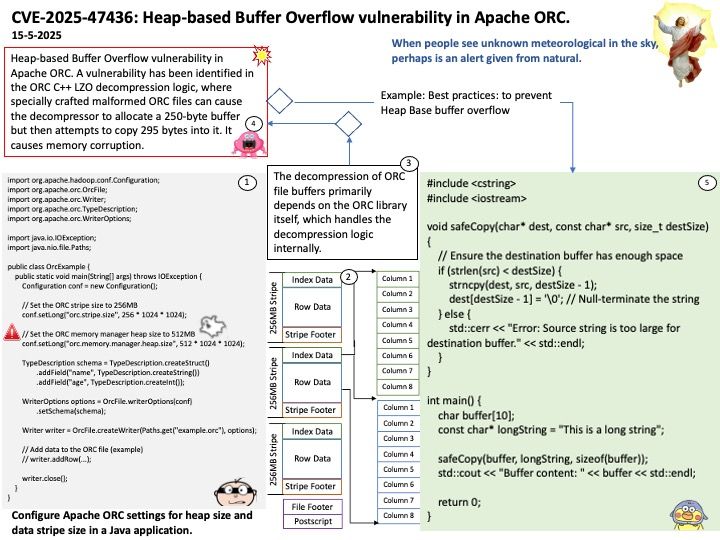
If the destination buffer is not large enough, the function will write null characters to the destination buffer to ensure that the string is null-terminated, but this can lead to a buffer overflow if the null characters overwrite adjacent memory locations.

Background: NVIDIA vGPU software enables multiple virtual machines (VMs) to have simultaneous, direct access to a single physical GPU, using the same NVIDIA graphics drivers that are deployed on non-virtualized operating systems.
NVIDIA Virtual GPU (vGPU) enables multiple virtual machines (VMs) to have simultaneous, direct access to a single physical GPU, using the same NVIDIA graphics drivers that are deployed on non-virtualized operating systems. By doing this, NVIDIA vGPU provides VMs with unparalleled graphics performance, compute performance, and application compatibility, together with the cost-effectiveness and scalability brought about by sharing a GPU among multiple workloads.

Vulnerability details: NVIDIA vGPU software contains a vulnerability in the Virtual GPU Manager, where a malicious guest could cause memory corruption. A successful exploit of this vulnerability might lead to code execution, denial of service, information disclosure, or data tampering.

Impact software products:

Citrix Hypervisor, VMware vSphere, Red Hat Enterprise Linux KVM, Ubuntu

Azure Local

Official announcement: Please refer to the link for details – https://nvidia.custhelp.com/app/answers/detail/a_id/5614/~/security-bulletin%3A-nvidia-gpu-display-driver—january-2025

antihackingonline.com