Category Archives: Potential Risk of CVE

CVE-2024-45163: The 1st time seen CVE -related to malware vulnerability. (22nd Aug 2024)

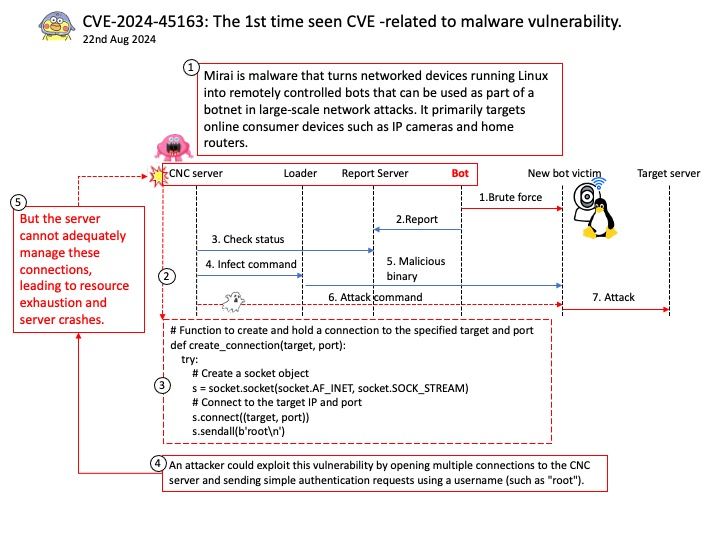
Preface: Mirai is malware that turns networked devices running Linux into remotely controlled bots that can be used as part of a botnet in large-scale network attacks. It primarily targets online consumer devices such as IP cameras and home routers.

Background: The Mirai botnet connects to the CNC (command and control) server via simultaneous TCP. An unauthenticated session remains open, allowing an attacker, for example, to send a recognizable username (such as root), or to send arbitrary data.

Vulnerability details: The Mirai botnet through 2024-08-19 mishandles simultaneous TCP connections to the CNC (command and control) server. Unauthenticated sessions remain open, causing resource consumption. But the CNC server cannot adequately manage these connections, leading to resource exhaustion and server crashes.

Official announcement: Please refer to the link for details – https://nvd.nist.gov/vuln/detail/CVE-2024-45163
CVE-2023-31315: AMD SMM Lock Bypass (21-Aug-2024)

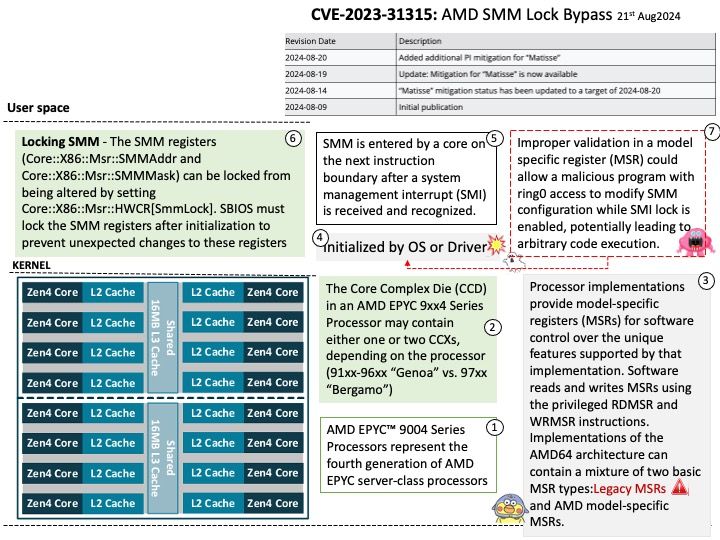
Preface: AMD EPYC™ Processors power the highest-performing x86 servers for the modern data center, on prem and in cloud environments, across industries.

Background: Model-specific registers (MSR) are control registers provided by the processor implementation so that system software can interact with a variety of features, including performance monitoring, checking processor status, debugging, program tracing or toggling specific CPU features.

Intel and AMD may use the same MSR for the same feature, such as the IA32_LSTAR MSR register.

When it came to the Intel Pentium processor, Intel officially introduced two instructions, RDMSR and WRMSR, for reading and writing the MSR temporary register. At this time, MSR was officially introduced. When the RDMSR and WRMSR instructions were introduced, the CPUID instruction was also introduced. This instruction is used to indicate which functions are available in a specific CPU chip, or whether the MSR registers corresponding to these functions exist. The software can query a certain function through the CPUID instruction. Whether these functions are supported on the current CPU.

Vulnerability details: Improper validation in a model specific register (MSR) could allow a malicious program with ring0 access to modify SMM configuration while SMI lock is enabled, potentially leading to arbitrary code execution.

Ref: Researchers from IOActive have reported that it may be possible for an attacker with ring 0 access to modify the configuration of System Management Mode (SMM) even when SMM Lock is enabled.

Official announcement: Please refer to the link for details – https://www.amd.com/en/resources/product-security/bulletin/amd-sb-7014.html

CVE-2023-52910 – iommu/iova: Fix alloc iova overflows issue (21-08-2024)

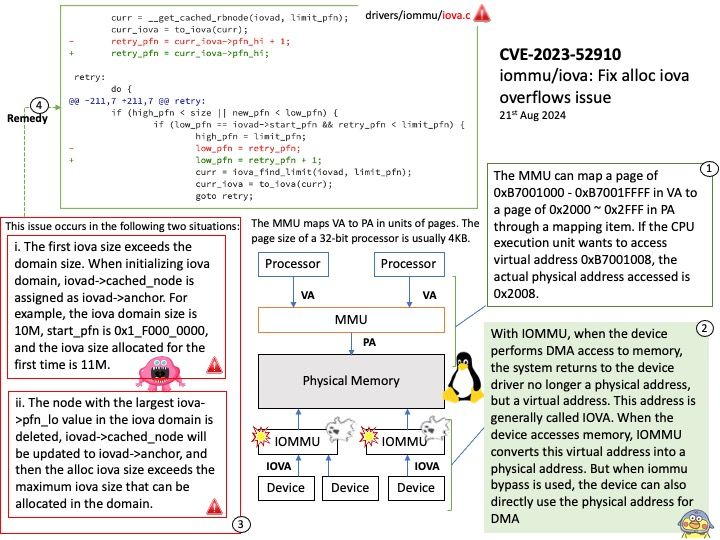
Preface: Modern hardware provides an I/O memory management unit (IOMMU) that mediates direct memory accesses (DMAs) by I/O devices in the same way that a processor’s MMU mediates memory accesses by instructions.

Background: With IOMMU, when the device performs DMA access to memory, the system returns to the device driver no longer a physical address, but a virtual address. This address is generally called IOVA. When the device accesses memory, IOMMU converts this virtual address into a physical address. But when iommu bypass is used, the device can also directly use the physical address for DMA.

Vulnerability details: This issue occurs in the following two situations

-The first iova size exceeds the domain size. When initializing iova domain, iovad->cached_node is assigned as iovad->anchor. For example, the iova domain size is 10M, start_pfn is 0x1_F000_0000, and the iova size allocated for the first time is 11M.

-The node with the largest iova->pfn_lo value in the iova domain is deleted, iovad->cached_node will be updated to iovad->anchor, and then the alloc iova size exceeds the maximum iova size that can be allocated in the domain.

Official announcement: Please refer to the url for details – https://nvd.nist.gov/vuln/detail/CVE-2023-52910

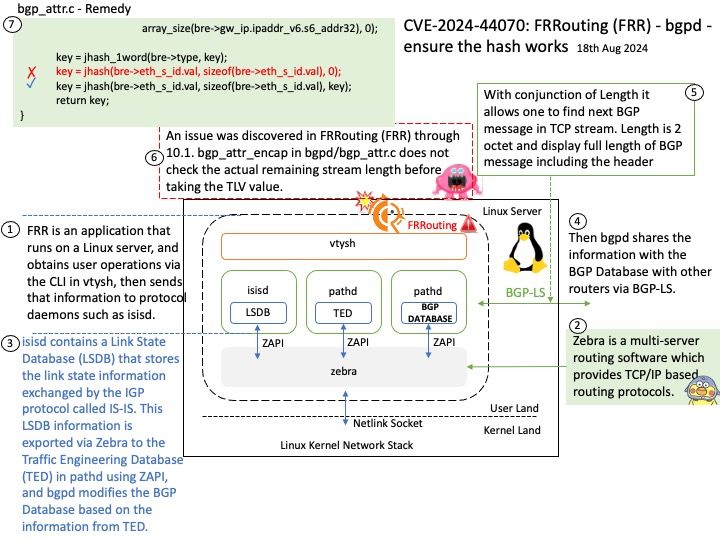
CVE-2024-44070: FRRouting (FRR) – bgpd – ensure the hash works  (18th Aug 2024)

Preface: As Time Goes By , OSS (Open Source Software) for use by cost-conscious commercial companies. It is quite popular in cloud.

Background: FRRouting (FRR) is a free and open source Internet routing protocol suite for Linux and Unix platforms. It implements BGP, OSPF, RIP, IS-IS, PIM, LDP, BFD, Babel, PBR, OpenFabric and VRRP, with alpha support for EIGRP and NHRP.

FRR’s seamless integration with native Linux/Unix IP networking stacks makes it a general purpose routing stack applicable to a wide variety of use cases including connecting hosts/VMs/containers to the network, advertising network services, LAN switching and routing, Internet access routers, and Internet peering.

Vulnerability details: An issue was discovered in FRRouting (FRR) through 10.1. bgp_attr_encap in bgpd/bgp_attr.c does not check the actual remaining stream length before taking the TLV value.

Official announcement: For details, please refer to link – https://www.tenable.com/cve/CVE-2024-44070

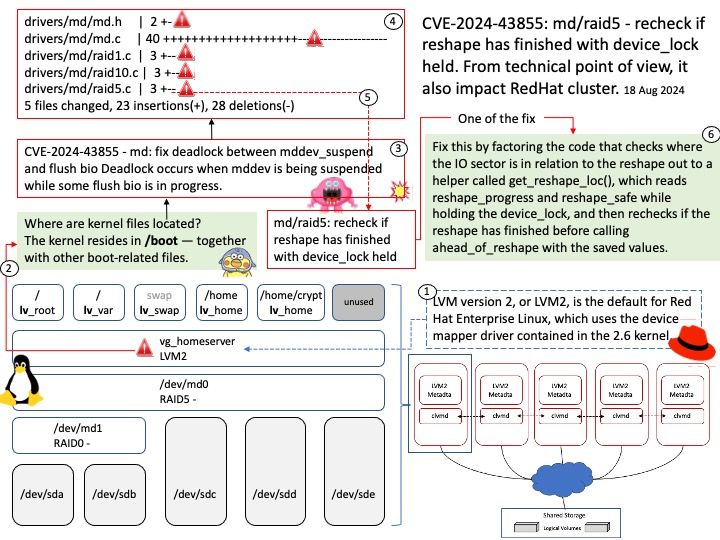
CVE-2024-43855: md/raid5 – recheck if reshape has finished with device_lock held. From technical point of view, it also impact RedHat cluster. (18 Aug 2024)

Preface: LVM version 2, or LVM2, is the default for Red Hat Enterprise Linux, which uses the device mapper driver contained in the 2.6 kernel. LVM2, which is almost completely compatible with the earlier LVM1 version, can be upgraded from versions of Red Hat Enterprise Linux running the 2.4 kernel.

The Clustered Logical Volume Manager (CLVM) is a set of clustering extensions to LVM. These extensions allow a cluster of computers to manage shared storage (for example, on a SAN) using LVM.

Background: In the Mutex concept, when the thread is trying to lock or acquire the Mutex which is not available then that thread will go to sleep until that Mutex is available. Whereas in Spinlock it is different. The spinlock is a very simple single-holder lock. If a process attempts to acquire a spinlock and it is unavailable, the process will keep trying (spinning) until it can acquire the lock. This simplicity creates a small and fast lock.

Vulnerability details: Deadlock occurs when mddev is being suspended while some flush bio is in progress. It is a complex issue.

T1. the first flush is at the ending stage, it clears ‘mddev->flush_bio’ and tries to submit data, but is blocked because mddev is suspended by T4.

T2. the second flush sets ‘mddev->flush_bio’, and attempts to queue md_submit_flush_data(), which is already running (T1) and won’t execute again if on the same CPU as T1.

T3. the third flush inc active_io and tries to flush, but is blocked because ‘mddev->flush_bio’ is not NULL (set by T2).

T4. mddev_suspend() is called and waits for active_io dec to 0 which is inc by T3.

The root issue is non-atomic inc/dec of active_io during flush process.

Official announcement: For details, please refer to link –

https://nvd.nist.gov/vuln/detail/CVE-2024-43855

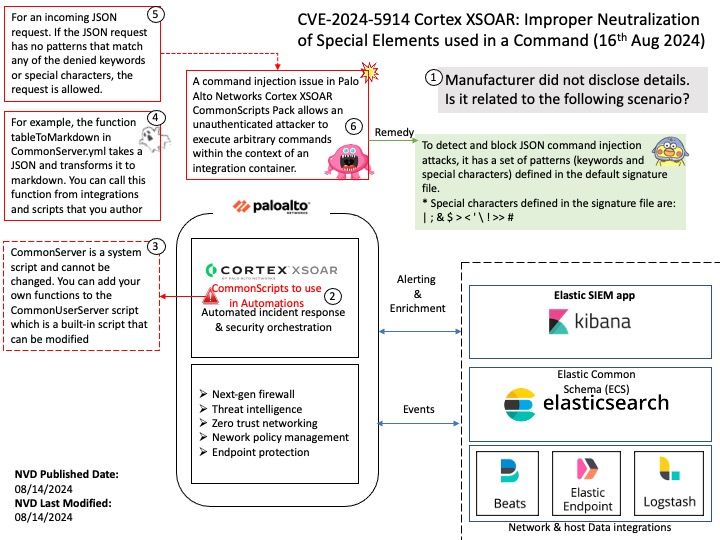
CVE-2024-5914 Cortex XSOAR: Improper Neutralization of Special Elements used in a Command (16th Aug 2024)

Preface: You can hold YAML content in files with any extension: .yml, .yaml or indeed anything else.

Background: Cortex XSOAR combines security orchestration, incident management, and interactive investigation into a seamless experience. The orchestration engine is designed to automate security product tasks and weave in human analyst tasks and workflows. Cortex XSOAR is powered by DBot, which learns from real-life analyst interactions and past investigations to help SOC teams with analyst assignment suggestions, playbook enhancements, and best next steps for investigations. With Cortex XSOAR, security teams can build future-proof security operations to reduce MTTR, create consistent and audited incident management process, and increase analyst productivity.

Remark: dBot is the Databank’s new AI-Powered Assistant.

Common Scripts are scripts that contain common code (functions, variables, etc.) to be used across scripts which can be embedded when writing your own Automation scripts and Integrations. The common scripts appear in the Automation page, but are used to enhance the API in other scripts and integrations.

Vulnerability details: A command injection issue in Palo Alto Networks Cortex XSOAR CommonScripts Pack allows an unauthenticated attacker to execute arbitrary commands within the context of an integration container.

Official announcement: Please refer to the website for details – https://security.paloaltonetworks.com/CVE-2024-5914

CVE-2024-21969: (AMD security focus) Whispering Pixels – Exploiting Uninitialized Register Accesses in Modern GPUs (14th Aug 2024)

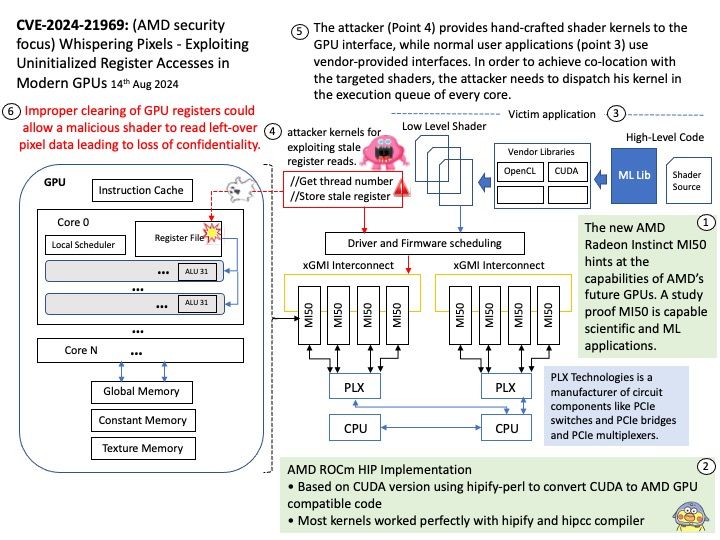
Preface: The new AMD Radeon Instinct MI50 hints at the capabilities of AMD’s future GPUs. A study proof MI50 is capable scientific and ML applications.

Background: The proliferation of graphics processing units (GPUs) has brought unprecedented computing power.

Multiple register-based vulnerabilities found across different GPU implementations.

So-called whisper pixels. The vulnerability poses unique challenges to an adversary due to opaque scheduling and register remapping algorithms present in the GPU firmware, complicating the reconstruction of leaked data.

GPU Programming: An application has to use vendor- provided libraries in order to translate a shader from its high-level source code to an architecture-dependent binary code. Vendors provide these libraries for a variety of high-level languages.

Vulnerability details: Improper clearing of GPU registers could allow a malicious shader to read left-over pixel data leading to loss of confidentiality.

Mitigation: AMD plans to create a new operating mode designed to prevent processes from running in parallel on the GPU, and to clear registers between processes on supported products.

Official announcement: Please refer to the website for details – https://www.amd.com/en/resources/product-security/bulletin/amd-sb-6013.html

CVE-2024-38160: Windows Network Virtualization Remote Code Execution Vulnerability (13th Aug 2024)

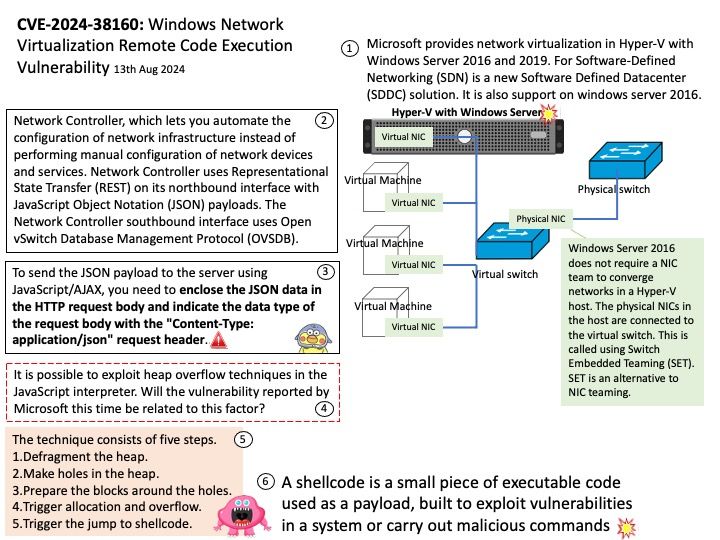
Preface: A HEAP-Based buffer overflow vulnerability occurs when a program writes more data to a heap-allocated memory buffer than the buffer is designed to hold.

Background: Microsoft provides network virtualization in Hyper-V with Windows Server 2016 and 2019. With this feature, workloads on Hyper-V can connect to virtualized Layer 2 networks and traffic is routed between virtual networks in Hyper-V or to and from the physical network via gateways.

Vulnerability details: Windows Network Virtualization Remote Code Execution Vulnerability.

My speculation: The new SDN features starting from windows server 2016. Because Network Controller uses Representational State Transfer (REST) on its northbound interface with JavaScript Object Notation (JSON) payloads.

As a matter of fact, it is possible to exploit heap overflow techniques in the JavaScript interpreter. Are the vulnerabilities reported by Microsoft related to this factor?

Official announcement: Please refer to the url for details – https://nvd.nist.gov/vuln/detail/CVE-2024-38160

CVE-2024-42257: In the Linux kernel, the vulnerability related to ext4 has been resolved (12th Aug 2024)

Published: 2024-08-08

Updated: 2024-08-07

Preface: Ext4 is a series of backwards-compatible extensions of Ext2. It is also the file system of most Linux distributions. Ext4 is supported on other operating systems including Windows, Free BSD, macOS and KolibriOS (read-only)

Background: Ext4 – The fourth generation extension file system is a log file system under the Linux system and is the successor version of the ext3 file system.

Advantage

-Has the largest single file size and volume file system size

-Supports all bytes except NULL and ‘/.’

-You can convert Ext3 file system to Ext4

-Includes advanced features such as stretching, directory indexing,

-delayed allocation and disk defragmentation

-Unlimited subdirectories

Disadvantage

-No data security provided

-Difficulty creating snapshots on different volumes

-Use more disk space

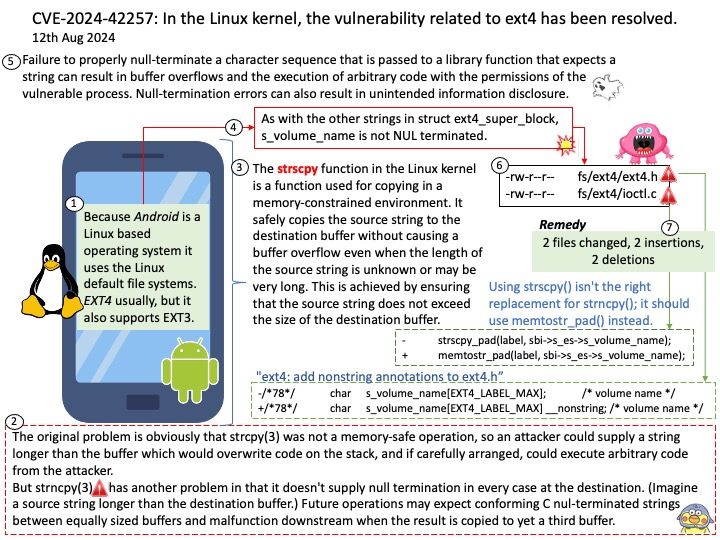
Vulnerability details: In the Linux kernel, the following vulnerability has been resolved: ext4: use memtostr_pad() for s_volume_name As with the other strings in struct ext4_super_block, s_volume_name is not NUL terminated. The other strings were marked in commit 072ebb3bffe6 (“ext4: add nonstring annotations to ext4.h”). Using strscpy() isn’t the right replacement for strncpy(); it should use memtostr_pad() instead.

Ref: Failure to properly null-terminate a character sequence that is passed to a library function that expects a string can result in buffer overflows and the execution of arbitrary code with the permissions of the vulnerable process. Null-termination errors can also result in unintended information disclosure.

Official announcement: Please refer to the link for details – https://www.tenable.com/cve/CVE-2024-42257

CVE-2024-7589: Race condition vulnerability occurs when integration of blacklisted in OpenSSH in FreeBSD. (11-Aug-2024)

Preface: SSH clients are designed for direct user interaction, providing a command-line interface (CLI) or graphical user interface (GUI) on the initiating device. The SSHD operates as a background process, running silently in the background without any user intervention.

Background: How do I make my SSH connection more stable?

SSH servers often have an idle timeout period, after which they automatically disconnect idle sessions. To prevent premature disconnections, consider modifying the server’s idle timeout setting. To modify the idle timeout: Locate the SSH server configuration file, typically located at /etc/ssh/sshd_config .

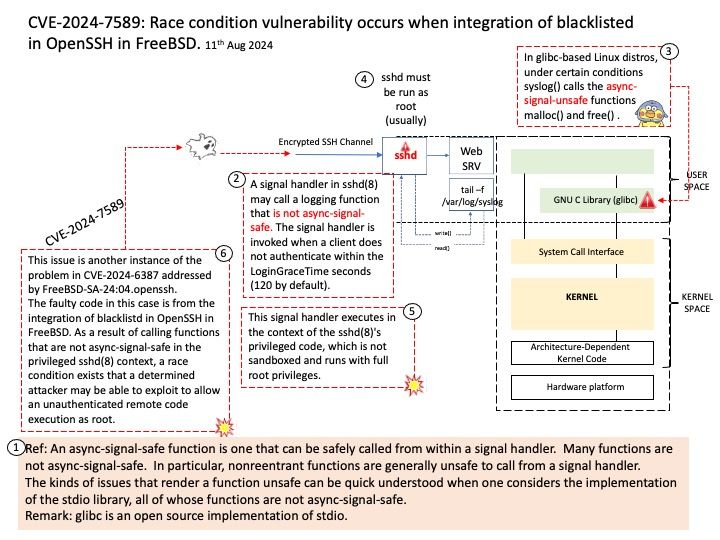
Vulnerability details: A signal handler in sshd(8) may call a logging function that is not async-signal-safe. The signal handler is invoked when a client does not authenticate within the LoginGraceTime seconds (120 by default). This signal handler executes in the context of the sshd(8)’s privileged code, which is not sandboxed and runs with full root privileges. This issue is another instance of the problem in CVE-2024-6387 addressed by FreeBSD-SA-24:04.openssh.

The faulty code in this case is from the integration of blacklistd in OpenSSH in FreeBSD. As a result of calling functions that are not async-signal-safe in the privileged sshd(8) context, a race condition exists that a determined attacker may be able to exploit to allow an unauthenticated remote code execution as root.

Official announcement: Please refer to the link for details https://www.tenable.com/cve/CVE-2024-7589