Category Archives: Potential Risk of CVE

NVIDIA Mellanox OS, ONYX, Skyway, MetroX-2 and MetroX-3 XC contain a vulnerability in web support  (07 Aug 2024)

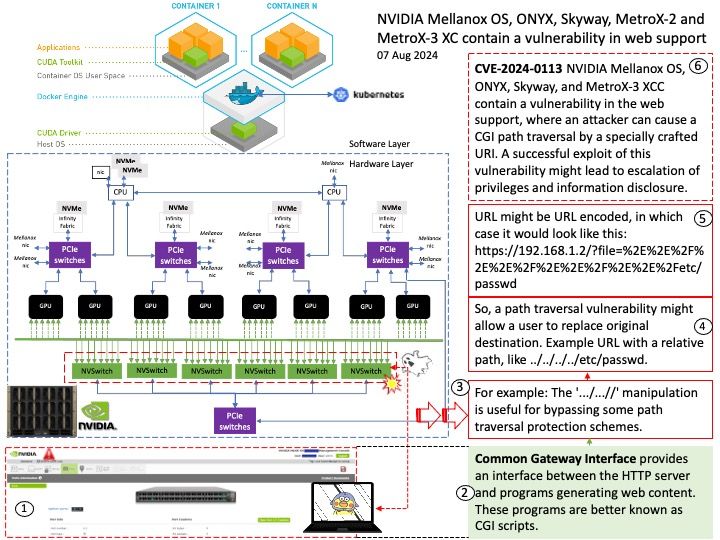
Preface: CGI is a standard protocol that allows web servers to execute external programs or scripts, typically written in languages like Perl or Python, in response to client requests.

Path Traversal: Exploiting lax file path validation, attackers navigate outside the intended directory, accessing restricted files or directories.

Background: MLNX-OSis a next-generation switch operating system for data centers with storage, enterprise, high-performance computing and cloud fabrics. Building networks with MLNX-OS enables scaling to thousands of compute and storage nodes with monitoring and provisioning capabilities, whether they are InfiniBand or Virtual Protocol Interconnect (VPI).

NVIDIA Onyx, with its robust layer-3 protocol stack, built-in monitoring and visibility tools, and high-availability mechanisms, Onyx is an ideal network operating system for enterprise and cloud data centers.

The NVIDIASkyway gateway appliance provides 1.6Tb/s  throughput, enabling scalable and efficient connectivity from InfiniBand data centers to external Ethernet-based infrastructures and storage.

The NVIDIAMetroX-3 XC long-haul system seamlessly and securely extends the reach of the NVIDIA Quantum InfiniBand networking platform, providing high data throughput, In-Network Computing, and native remote direct-memory access (RDMA) communications. Enhancing data security, MetroX-3 XC provides encrypted connectivity over long distances and dense wavelength-division multiplexing (DWDM) infrastructures.

Extending InfiniBand connectivity to 10 or 40 kilometers,. MetroX2 systems enable high data throughput, native remote direct memory access (RDMA).

Vulnerability details: NVIDIA Mellanox OS, ONYX, Skyway, and MetroX-3 XCC contain a vulnerability in the web support, where an attacker can cause a CGI path traversal by a specially crafted URI. A successful exploit of this vulnerability might lead to escalation of privileges and information disclosure.

Official announcement: Please refer to the link for details – https://nvidia.custhelp.com/app/answers/detail/a_id/5563
About CVE-2024-7553: Improper Access Control in MongoDB (8th Aug 2024)

Preface: What Is a Document Database? A document-oriented database is a special type of key-value store where keys can only be strings. Moreover, the document is encoded using standards like JSON or related languages like XML. You can also store PDFs, image files, or text documents directly as values.

Background: As a document database, MongoDB makes it easy for developers to store structured or unstructured data. It uses a JSON-like format to store documents. Most breaches involving MongoDB occur because of a deadly combination of authentication disabled and MongoDB opened to the internet.

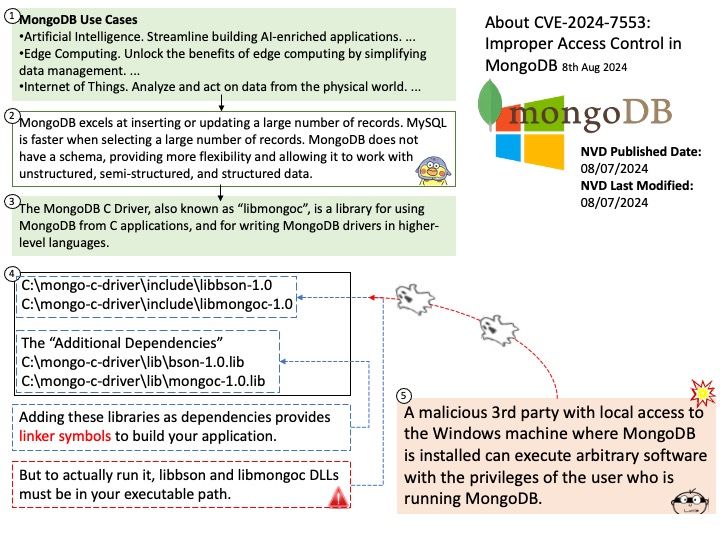
Vulnerability details: Incorrect validation of files loaded from a local untrusted directory may allow local privilege escalation if the underlying operating systems is Windows. This may result in the application executing arbitrary behaviour determined by the contents of untrusted files.

Impact: This issue affects MongoDB Server v5.0 versions prior to 5.0.27, MongoDB Server v6.0 versions prior to 6.0.16, MongoDB Server v7.0 versions prior to 7.0.12, MongoDB Server v7.3 versions prior 7.3.3, MongoDB C Driver versions prior to 1.26.2 and MongoDB PHP Driver versions prior to 1.18.1. Required Configuration: Only environments with Windows as the underlying operating system is affected by this issue

Official announcement: Please refer to the link for details – https://nvd.nist.gov/vuln/detail/CVE-2024-7553

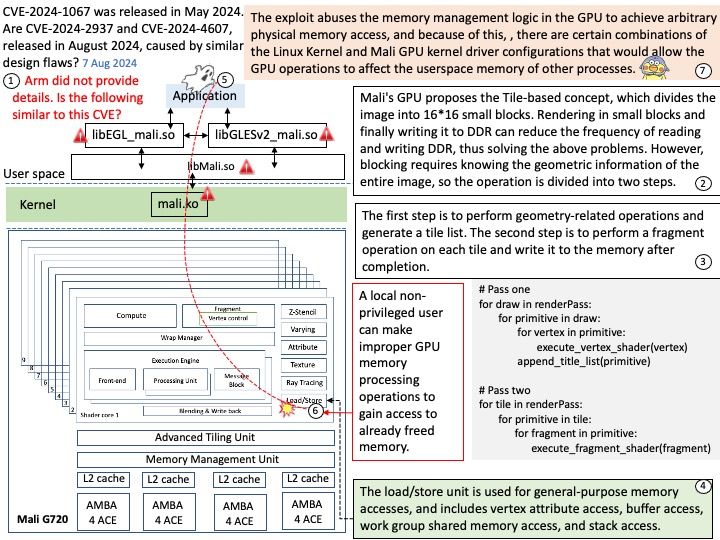
CVE-2024-1067 was released in May 2024.  Are CVE-2024-2937 and CVE-2024-4607, released in August 2024, caused by similar design flaws? (7 Aug 2024)

Preface: May 2021 to May 2023 (ARM GPU evolution)

Valhall 3rd Gen – On May 25, 2021, Arm announced their Valhall 3rd Gen GPU Architecture (as part of TCS21), including the Mali-G710, Mali-G510, and Mali-G310 GPUs.

Valhall 4th Gen – On June 28, 2022, Arm announced their Valhall 4th Gen GPU Architecture (as part of TCS22), including the Immortalis-G715, Mali-G715, and Mali-G615 GPUs.

5th Gen – On May 29, 2023, Arm announced their 5th Gen Arm GPU Architecture (as part of TCS23), including the Immortalis-G720, Mali-G720 and Mali-G620 GPUs.

Background: The New 5th Gen Arm GPU Architecture

The 5th Gen GPU architecture introduces a key feature called Deferred Vertex Shading (DVS), which revolutionizes data flow within the GPU and expands the number of GPU cores, reaching up to 16 cores for enhanced performance.

The Arm 5th Gen GPU architecture is the most efficient GPU architecture Arm has ever created, designed with CPU and system architecture in mind. It redefines parts of the graphics pipeline to significantly reduce memory bandwidth, thus improving total system efficiency and power.

Technical reference: It solves the bandwidth problem of the traditional model because the fragment shader reads a small block each time and puts it on the chip. It does not need to read the memory frequently until the final operation is completed and then writes it to the memory. You can even further reduce memory reads and writes by compressing tiles. In addition, when some areas of the image are fixed, the function can be called to determine whether the tiles are the same to reduce repeated rendering.

Vulnerability details: Judging from the descriptions of the two different vulnerabilities, they appear to be the same (see below):

https://nvd.nist.gov/vuln/detail/CVE-2024-2937

Use After Free vulnerability in Arm Ltd Bifrost GPU Kernel Driver, Arm Ltd Valhall GPU Kernel Driver, Arm Ltd Arm 5th Gen GPU Architecture Kernel Driver allows a local non-privileged user to make improper GPU memory processing operations to gain access to already freed memory.This issue affects Bifrost GPU Kernel Driver: from r41p0 through r49p0; Valhall GPU Kernel Driver: from r41p0 through r49p0; Arm 5th Gen GPU Architecture Kernel Driver: from r41p0 through r49p0.

https://nvd.nist.gov/vuln/detail/CVE-2024-4607

Use After Free vulnerability in Arm Ltd Bifrost GPU Kernel Driver, Arm Ltd Valhall GPU Kernel Driver, Arm Ltd Arm 5th Gen GPU Architecture Kernel Driver allows a local non-privileged user to make improper GPU memory processing operations to gain access to already freed memory.This issue affects Bifrost GPU Kernel Driver: from r41p0 through r49p0; Valhall GPU Kernel Driver: from r41p0 through r49p0; Arm 5th Gen GPU Architecture Kernel Driver: from r41p0 through r49p0.

Affected Products

Bifrost GPU kernel driver versions : r41p0 (inclusive) ~ r49p0 (inclusive)

Valhall GPU Kernel Driver versions: r41p0 (inclusive) ~ r49p0 (inclusive)

Arm 5th Generation GPU Architecture Kernel Driver versions: r41p0 (inclusive) ~ r49p0 (inclusive)

About CVE-2024-21980, SNP firmware design weakness! (5th Aug 2024)

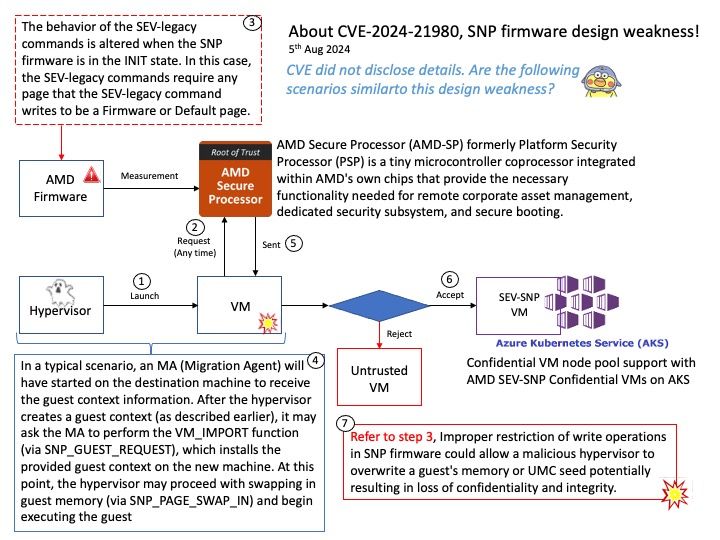
Preface: Confidential node pools use VMs with hardware-based Trusted Execution Environments (TEEs). AMD SEV-SNP Confidential VM denies hypervisor and other host management code access to VM memory and state, and adds defense-in-depth against operator access.

Background: The SNP firmware may exist in two states: UNINIT and INIT.

UNINIT – The platform is uninitialized. This is the reset state of the PSP firmware.

Allowed Platform Commands: SNP_INIT, SNP_PLATFORM_STATUS,

DOWNLOAD_FIRMWARE, GET_ID

INIT – The platform is initialized

Allowed Platform Commands: All SNP commands except SNP_INIT, DOWNLOAD_FIRMWARE

Ref: The behavior of the SEV-legacy commands is altered when the SNP firmware is in the INIT state. In this case, the SEV-legacy commands require any page that the SEV-legacy command writes to be a Firmware or Default page.

Vulnerability details: CVE-2024-21980 – Improper restriction of write operations in SNP firmware could allow a malicious hypervisor to overwrite a guest’s memory or UMC seed potentially resulting in loss of confidentiality and integrity.

Official announcement: Please refer to the link for details – https://www.amd.com/en/resources/product-security/bulletin/amd-sb-3011.html

CVE-2024-3056 – About Podman (5th-Aug-2024)

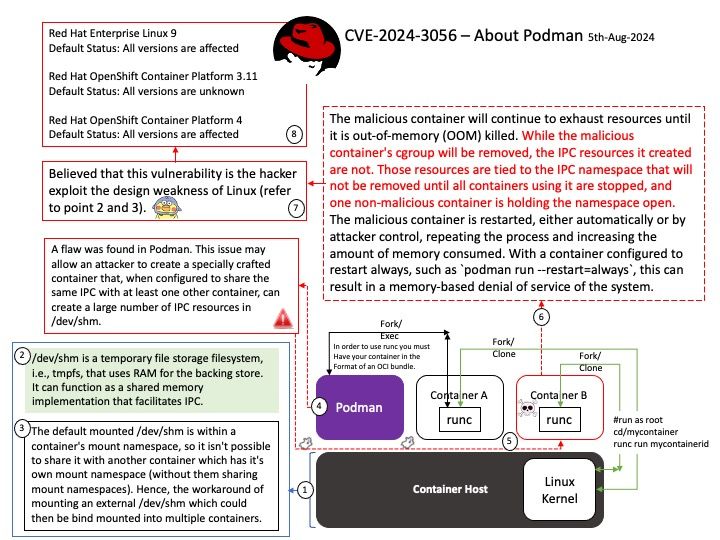
Preface: Size of /dev/shm. A unit can be b (bytes), k (kibibytes), m (mebibytes), or g (gibibytes). If the unit is omitted, the system uses bytes. If the size is omitted, the default is 64m. When size is 0, there is no limit on the amount of memory used for IPC by the container. This option conflicts with –ipc=host.

IPC:Shared Memory

Two processes comunicating via shared memory.

shm_server[.]c — simply creates the string and shared memory portion.

shm_client[.]c — attaches itself to the created shared memory portion and uses the string (printf.

Background: Podman, Podman Desktop, and other open standards-based container tools make Red Hat Enterprise Linux a powerful container host that delivers production-grade support, stability, and security features as well as a path forward to Kubernetes and Red Hat OpenShift.

Vulnerability details: A flaw was found in Podman. This issue may allow an attacker to create a specially crafted container that, when configured to share the same IPC with at least one other container, can create a large number of IPC resources in /dev/shm. The malicious container will continue to exhaust resources until it is out-of-memory (OOM) killed. While the malicious container’s cgroup will be removed, the IPC resources it created are not. Those resources are tied to the IPC namespace that will not be removed until all containers using it are stopped, and one non-malicious container is holding the namespace open. The malicious container is restarted, either automatically or by attacker control, repeating the process and increasing the amount of memory consumed. With a container configured to restart always, such as `podman run –restart=always`, this can result in a memory-based denial of service of the system.

Official announcement: Please refer to the link for details – https://nvd.nist.gov/vuln/detail/CVE-2024-3056

RHSA-2024-4982 -Security Advisory- OpenShift API for Data Protection (OADP) – Security Fix – golang: net/netip – CVE-2024-24790 (2nd Aug 2024)

Preface: The IPv4-mapped IPv6 address format allows the IPv4 address of an IPv4 node to be represented as an IPv6 address. The IPv4 address is encoded into the low-order 32 bits of the IPv6 address, and the high-order 96 bits hold the fixed prefix 0:0:0:0:0:FFFF.

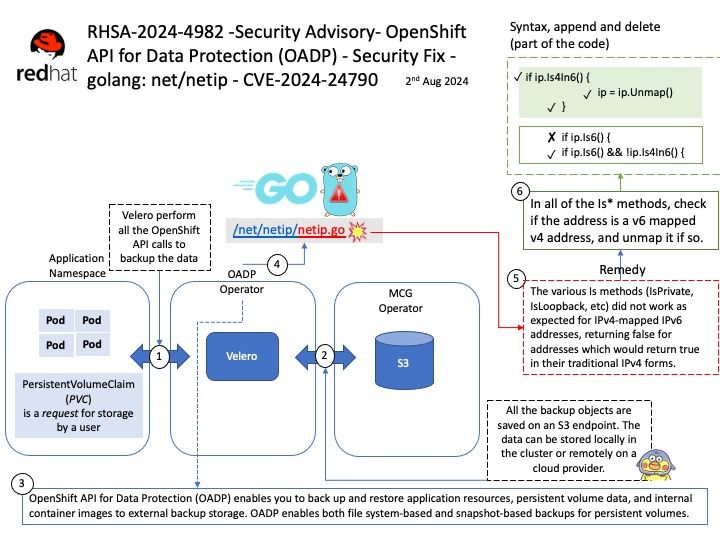
Background: OpenShift API for Data Protection (OADP) enables you to back up and restore application resources, persistent volume data, and internal container images to external backup storage. OADP enables both file system-based and snapshot-based backups for persistent volumes.

Package netip defines an IP address type that’s a small value type. Building on that Addr type, the package also defines AddrPort (an IP address and a port) and Prefix (an IP address and a bit length prefix).

Compared to the net.IP type, Addr type takes less memory, is immutable, and is comparable (supports == and being a map key).

Vulnerability details: OpenShift API for Data Protection (OADP) enables you to back up and restore application resources, persistent volume data, and internal container images to external backup storage. OADP enables both file system-based and snapshot-based backups for persistent volumes.

Security Fixes from Bugzilla: golang: net/netip: Unexpected behavior from Is methods for IPv4-mapped IPv6 addresses (CVE-2024-24790)

Official announcement: Please refer to the website for details – https://access.redhat.com/errata/RHSA-2024:4982

CVE-2024-40782 – Nullptr crash due to `display:ruby block` and continuations. (1st Aug 2024)

Preface: Apple doesn’t allow third party developers to use any other browser engine other than the WebKit which is the engine developed by Apple.

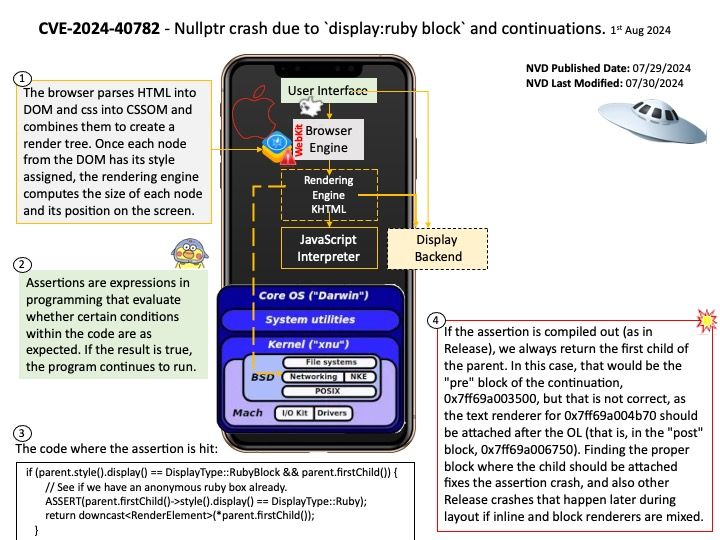
Background: The browser parses HTML into DOM and css into CSSOM and combines them to create a render tree. Once each node from the DOM has its style assigned, the rendering engine computes the size of each node and its position on the screen.

The process that goes from interpreting HTML, CSS, and Javascript to pixel conversion can be grouped in 4 (four) general steps:

  1. Parsing of the HTML document to DOM (Document Object Model).
  2. CSS file interpretation (CSSOM – Cascading Style Sheets Object Model) for each of the DOM nodes.
  3. Creation of the new tree that includes the DOM, and each node’s style and layout.
  4. A render tree is rendered.

Vulnerability details: A use-after-free issue was addressed with improved memory management. This issue is fixed in iOS 16.7.9 and iPadOS 16.7.9, Safari 17.6, iOS 17.6 and iPadOS 17.6, watchOS 10.6, tvOS 17.6, visionOS 1.3, macOS Sonoma 14.6. Processing maliciously crafted web content may lead to an unexpected process crash.

Official announcement: Please refer to the official announcement for details –

https://nvd.nist.gov/vuln/detail/CVE-2024-40782

CVE-2024-33976: Check for correct values rank in UpperBound and LowerBound. (30th Jul 2024)

Preface: Segmentation faults (segfaults) are a common error that occurs when a program tries to access a restricted area of memory. Segfaults can occur for a wide variety of reasons: usage of uninitialized pointers, out-of-bounds memory accesses, memory leaks, buffer overflows, etc.

Background: TensorFlow can be used to develop models for various tasks, including natural language processing, image recognition, handwriting recognition, and different computational-based simulations such as partial differential equations.

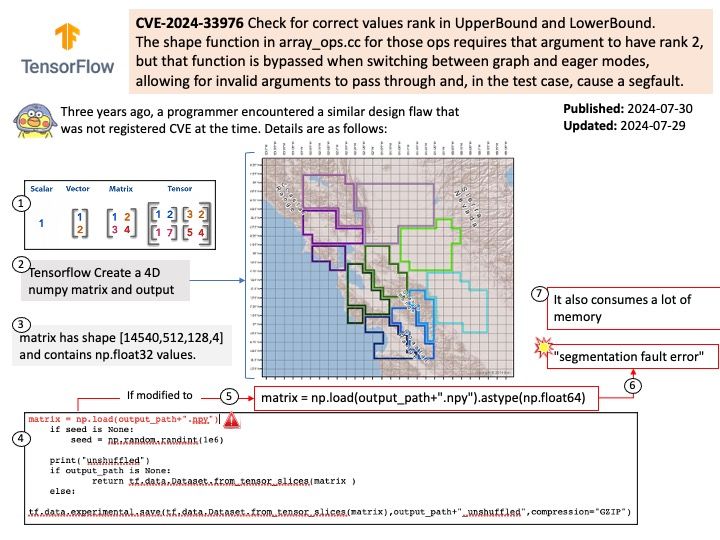
Vulnerability details: TensorFlow is an end-to-end open source platform for machine learning. `array_ops.upper_bound` causes a segfault when not given a rank 2 tensor.

The shape function in array_ops.cc for those ops requires that argument to have rank 2, but that function is bypassed when switching between graph and eager modes, allowing for invalid arguments to pass through and, in the test case, cause a segfault.

Solution: The fix will be included in TensorFlow 2.13 and will also cherrypick this commit on TensorFlow 2.12.

Official announcement: Please refer to the official announcement for details – https://www.tenable.com/cve/CVE-2023-33976

CVE-2024-40836: iOS allows running scripts from shortcuts but making protecting your data difficult! (July 29, 2024)

CVE-2024-40836: iOS allows running scripts from shortcuts but making protecting your data difficult! (July 29, 2024)

Preface: A shortcut is usually implemented as a small file that contains the target URI or GUID of the object, or the name of the target program file that the shortcut represents. Shortcuts can also specify parameters to be passed to the target program when executed.

Background: After you’ve allowed a shortcut access to a web page, Shortcuts takes an extra step to further protect you from potentially malicious scripts by periodically downloading updated malware definitions. Before interacting with a web page, Shortcuts analyses the JavaScript, then consults the malware definitions. Based on this evaluation, Shortcuts is instructed to allow the script, to deny the script, or to display an additional prompt before allowing the shortcut to run.

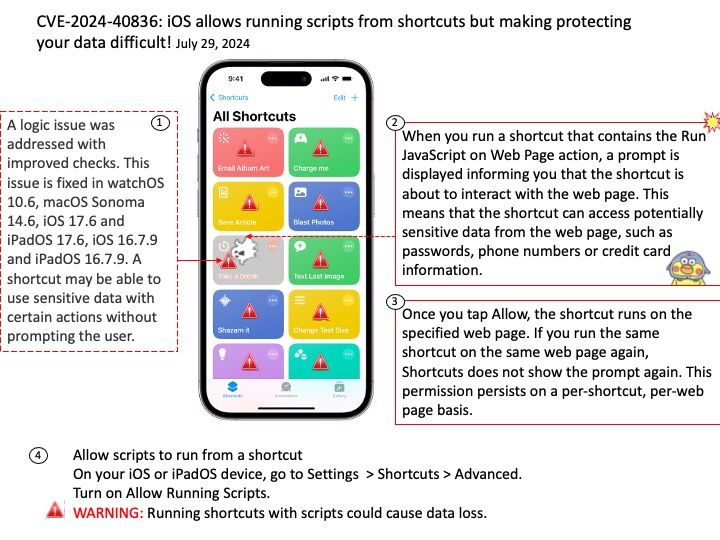
Vulnerability details: A logic issue was addressed with improved checks. This issue is fixed in watchOS 10.6, macOS Sonoma 14.6, iOS 17.6 and iPadOS 17.6, iOS 16.7.9 and iPadOS 16.7.9. A shortcut may be able to use sensitive data with certain actions without prompting the user.

Official announcement: Please refer to the official announcement for details – https://nvd.nist.gov/vuln/detail/CVE-2024-40836

Regarding CVE-2024-0108: The manufacturer did not describe much. Is the situation below exactly what CVE mentioned? (25/07/2024)

Preface: What is an example of autonomous AI?

Autonomous intelligence is artificial intelligence (AI) that can act without human intervention, input, or direct supervision. It’s considered the most advanced type of artificial intelligence. Examples may include smart manufacturing robots, self-driving cars, or care robots for the elderly.

Background: What is Jetson AGX Xavier used for?

As the world’s first computer designed specifically for autonomous machines, Jetson AGX Xavier has the performance to handle the visual odometry, sensor fusion, localization and mapping, obstacle detection, and path-planning algorithms that are critical to next-generation robots.

Vulnerability details: NVIDIA Jetson Linux contains a vulnerability in NvGPU where error handling paths in GPU MMU mapping code fail to clean up a failed mapping attempt. A successful exploit of this vulnerability may lead to denial of service, code execution, and escalation of privileges.

Official announcement: Please refer to the official announcement for details – https://nvidia.custhelp.com/app/answers/detail/a_id/5555