Category Archives: Potential Risk of CVE

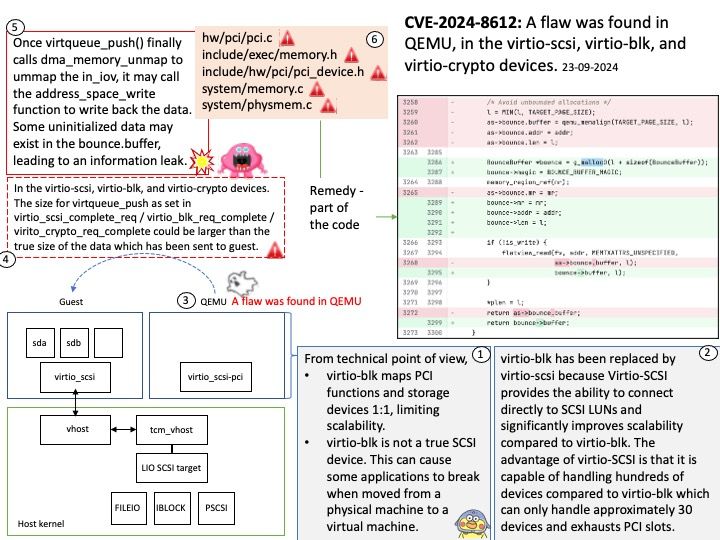
CVE-2024-8612: A flaw was found in QEMU, in the virtio-scsi, virtio-blk, and virtio-crypto devices. (23-09-2024)

Preface: When you got a valid non-NULL pointer to a memory address returned by malloc(), only the requested size of memory is allocated to your process and you’re allowed to use (read and / or write) into that much space only.

Background: When you launch a KVM-based guest, most often you would see QEMU doing the major user space heavy-lifting by providing a PC-like environment—it handles guest memory management, network cards, emulated storage devices, and so forth.

When using QEMU, all I/O travels through a single queue, which can affect performance.

Vulnerability details: In the virtio-scsi, virtio-blk, and virtio-crypto devices. The size for virtqueue_push as set in virtio_scsi_complete_req / virtio_blk_req_complete / virito_crypto_req_complete could be larger than the true size of the data which has been sent to guest.

Once virtqueue_push() finally calls dma_memory_unmap to ummap the in_iov, it may call the address_space_write function to write back the data. Some uninitialized data may exist in the bounce.buffer, leading to an information leak

Ref: A bounce buffer resides in memory low enough for a device to copy from and write data to. It is then copied to the desired user page in high memory. This additional copy is undesirable, but unavoidable. Pages are allocated in low memory which are used as buffer pages for DMA to and from the device.

This CVE only low risk vulnerability. However, but should staying alert.

Official announcement: Please refer to the vendor announcement for details – https://nvd.nist.gov/vuln/detail/CVE-2024-8612
CVE-2024-8375: A vulnerability has been found in Google Deepmind Reverb object deserialization. (20-09-2024)

Preface: As companies and researchers leave Tensorflow and move to PyTorch, Google seems interested in moving its products to JAX to solve some of Tensorflow’s pain points, such as the complexity of the API and the complexity of training in custom chips such as TPUs.

PyTorch optimizes performance by taking advantage of Python’s native support for asynchronous execution. In TensorFlow, you have to manually code and fine-tune every operation to be performed on a specific device to allow for decentralized training.

Background: TensorFlow is open-source Python library designed by Google to develop Machine Learning models and deep learning neural networks.

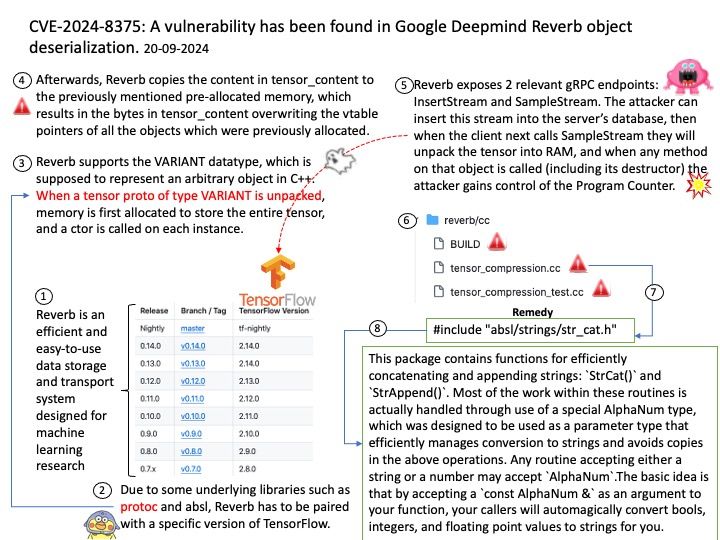
Reverb is an efficient and easy-to-use data storage and transport system designed for machine learning research. Reverb is primarily used as an experience replay system for distributed reinforcement learning algorithms but the system also supports multiple data structure representations such as FIFO, LIFO, and priority queues.

Vulnerability details: This is a retroactive issue for the already-fixed security vulnerability. The Reverb Server stores Tensors represented by protos. These protos contain type information as well as a string field called “tensor_content”. When the Reverb client communicates with the server, it unpacks these protos by turning them back into tensors.

Reverb supports the VARIANT datatype, which is supposed to represent an arbitrary object in C++. When a tensor proto of type VARIANT is unpacked, memory is first allocated to store the entire tensor, and a ctor is called on each instance. Afterwards, Reverb copies the content in tensor_content to the previously mentioned pre-allocated memory, which results in the bytes in tensor_content overwriting the vtable pointers of all the objects which were previously allocated.

Reverb exposes 2 relevant gRPC endpoints: InsertStream and SampleStream. By default, neither is authenticated and there is no authorization. The attacker can insert this stream into the server’s database, then when the client next calls SampleStream they will unpack the tensor into RAM, and when any method on that object is called (including its destructor) the attacker gains control of the Program Counter.

Official announcement: Please refer to the vendor announcement for details – https://www.tenable.com/cve/CVE-2024-8375

CVE-2024-45523 Resource Leak in Bravura Security Fabric API After a Failed Login Attempt (19-09-2024)

Preface: Originally founded in 1992 as M-Tech Information Technology, acquired by Hitachi, Ltd. in 2008, and acquired by the Volaris Group in 2022, Bravura Security, Inc is a leading provider of identity, privileged access, password, and passwordless solutions. Bravura Security Fabric brings together all the benefits of SaaS plus IAM & PAM into one comprehensive solution.

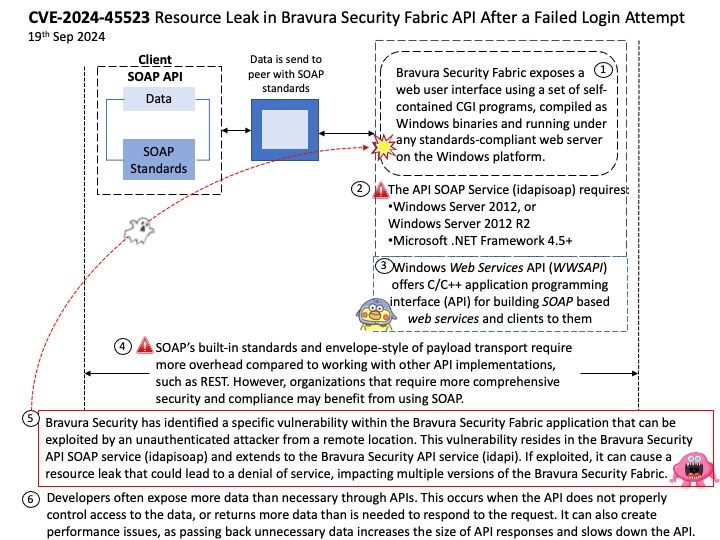
Background: The API Service (idapi) enables client programs to access Bravura Security Fabric workflow and provisioning features programmatically. Client programs communicate with the service using:

SOAP (Simple Object Access Protocol) – Some organizations use the SOAP API to build their own customized front-end to Bravura Security Fabric.

Vulnerability details: An issue was discovered in Bravura Security Fabric versions 12.3.x before 12.3.5.32784, 12.4.x before 12.4.3.35110, 12.5.x before 12.5.2.35950, 12.6.x before 12.6.2.37183, and 12.7.x before 12.7.1.38241. An unauthenticated attacker can cause a resource leak by issuing multiple failed login attempts through API SOAP.

Official announcement: Please refer to the vendor announcement for details –

https://www.bravurasecurity.com/cve-2024-45523-resource-leak-in-api-after-a-failed-login-attempt

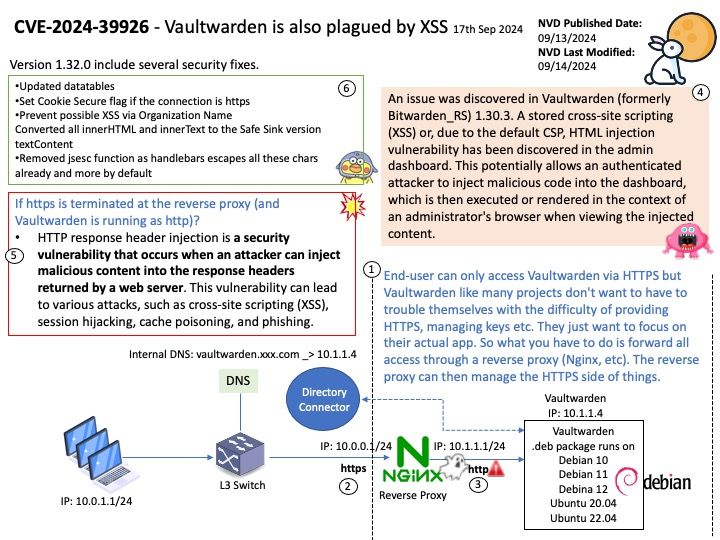
CVE-2024-39926 – Vaultwarden is also plagued by XSS (17th Sep 2024)

Preface: Enables Vaultwarden’s built-in HTTPS functionality (via the Rocket web framework). Rocket’s HTTPS implementation is relatively immature and has limited functionality.

Rocket is a web framework written in Rust. It supports HTTP requests, Web Sockets JSON, templating and more. Its design was inspired by Rails, Flask, Bottle, and Yesod.

Background: Vaultwarden is an unofficial Bitwarden server implementation written in Rust that is compatible with the official Bitwarden client, making it ideal for resource-intensive self-hosted deployments where you don’t want to run the official Bitwarden client.

Vaultwarden implements the Bitwarden APIs required for most functionality, including: Web interface (equivalent to https://vault.bitwarden.com/), Event Logs, Password sharing and access control..etc

Vulnerability details: An issue was discovered in Vaultwarden (formerly Bitwarden_RS) 1.30.3. A stored cross-site scripting (XSS) or, due to the default CSP, HTML injection vulnerability has been discovered in the admin dashboard. This potentially allows an authenticated attacker to inject malicious code into the dashboard, which is then executed or rendered in the context of an administrator’s browser when viewing the injected content. However, it is important to note that the default Content Security Policy (CSP) of the application blocks most exploitation paths, significantly mitigating the potential impact.

Official announcement: Please refer to the vendor announcement for details –

https://nvd.nist.gov/vuln/detail/CVE-2024-39926

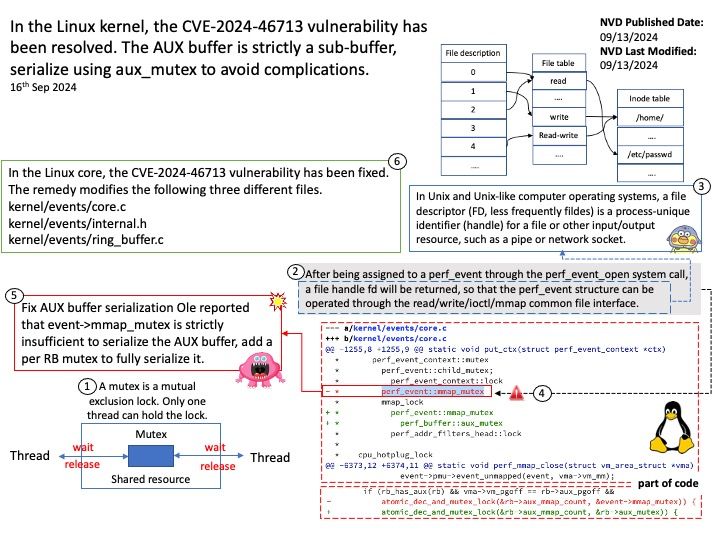
In the Linux kernel, the CVE-2024-46713 vulnerability has been resolved. The AUX buffer is strictly a sub-buffer, serialize using aux_mutex to avoid complications.  (16Sep 2024)

Preface: A mutex is a mutual exclusion lock. Only one thread can hold the lock. Mutexes are used to protect data or other resources from concurrent access. A mutex has attributes, which specify the characteristics of the mutex.

Background: During the boot process, the console provides a lot of important information about the initial phase of the system startup. To avoid loss of the early messages the kernel utilizes what is called a ring buffer. This buffer stores all messages, including boot messages, generated by the printk() function within the kernel code. The messages from the kernel ring buffer are then read and stored in log files on permanent storage, for example, by the syslog service. The buffer mentioned above is a cyclic data structure which has a fixed size, and is hard-coded into the kernel.

Vulnerability details: In the Linux kernel, the following vulnerability has been resolved: perf/aux: Fix AUX buffer serialization Ole reported that event->mmap_mutex is strictly insufficient to serialize the AUX buffer, add a per RB mutex to fully serialize it. Note that in the lock order comment the perf_event::mmap_mutex order was already wrong, that is, it nesting under mmap_lock is not new with this patch.

Official announcement: Please refer to the vendor announcement for details – https://nvd.nist.gov/vuln/detail/CVE-2024-46713

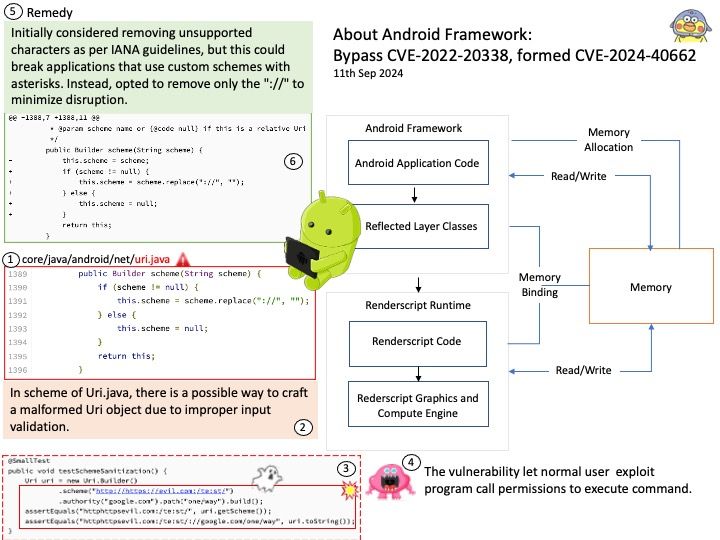
About Android Framework: Bypass CVE-2022-20338, formed CVE-2024-40662 (11th Sep 2024).

Preface: What is a malformed URI? The JavaScript exception “malformed URI sequence” occurs when URI encoding or decoding wasn’t successful.

Background: URI definition In computer terms, a Uniform Resource Identifier (URI) is a string used to identify the name of a certain network resource. This identification allows users to interact with any resource (including local and Internet) through specific protocols.

URI is either an absolute URI whose scheme-specific part begins with a slash character, or a relative URI, that is, a URI that does not specify a scheme. 

Vulnerability details: In scheme of Uri.java, there is a possible way to craft a malformed Uri object due to improper input validation. This could lead to local escalation of privilege with no additional execution privileges needed. User interaction is not needed for exploitation.

Official announcement: Please refer to the vendor announcement for details –

https://www.tenable.com/cve/CVE-2024-40662

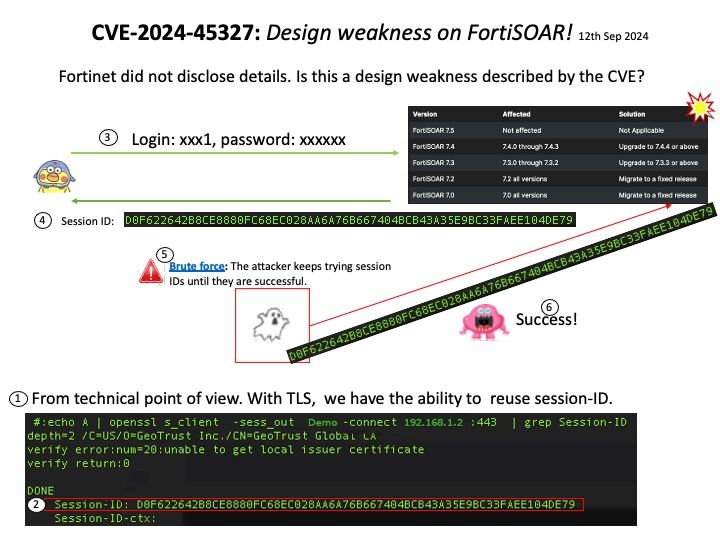
CVE-2024-45327: Design weakness on FortiSOAR! (12th Sep 2024)

Preface: In session hijacking, an attacker gets hold of a valid user session to gain unauthorized access to the account. This is typically done through three methods:

Brute force: The attacker keeps trying session IDs until they are successful.

Calculation: If the session IDs are generated in a non-random manner, the attacker can calculate them.

Theft: The attacker acquires the session ID through techniques like session sniffing, session fixation, and cross-site scripting.

Background: FortiSOAR helps IT/OT security teams thwart attacks by centralizing incident management and automating the myriad of analyst activities required for effective threat investigation and response.

Vulnerability details: An improper authorization vulnerability [CWE-285] in FortiSOAR version 7.4.0 through 7.4.3, 7.3.0 through 7.3.2, 7.2.0 through 7.2.2, 7.0.0 through 7.0.3 change password endpoint may allow an authenticated attacker to perform a brute force attack on users and administrators password via crafted HTTP requests.

Official announcement: Please refer to the vendor announcement for details –

https://fortiguard.fortinet.com/psirt/FG-IR-24-048

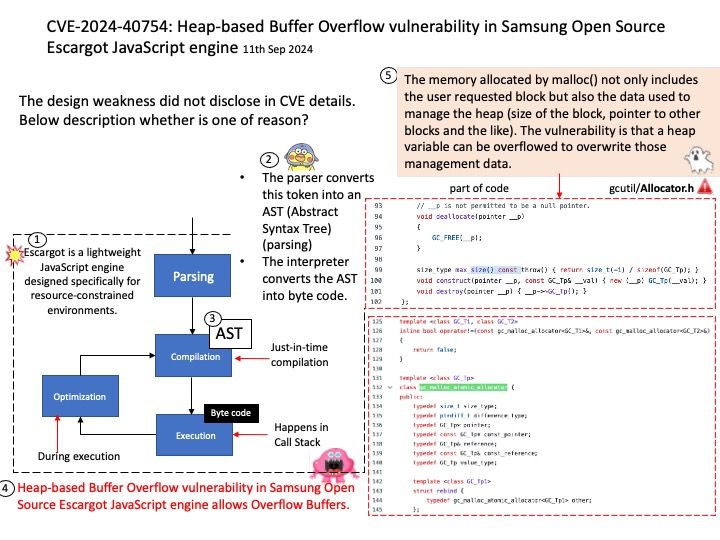
CVE-2024-40754: Heap-based Buffer Overflow vulnerability in Samsung Open Source Escargot JavaScript engine (11th Sep 2024)

Preface: A stack is not flexible, the memory size allotted cannot be changed whereas a heap is flexible, and the allotted memory can be altered.

Background: Escargot is a memory optimized JavaScript engine for mid-range devices such as mobile phone, tablet and TV. C++. •. GNU Lesser General Public License v2.1. Memory Efficiency: The engine is designed with memory constraints in mind, making it suitable for devices with limited RAM and storage. Performance Optimization: Escargot implements various optimization techniques to ensure fast execution of JavaScript code, even on low-power devices.

Vulnerability details: Heap-based Buffer Overflow vulnerability in Samsung Open Source Escargot JavaScript engine allows Overflow Buffers.This issue affects Escargot: 4.0.0.

Ref: The memory allocated by malloc() not only includes the user requested block but also the data used to manage the heap (size of the block, pointer to other blocks and the like). The vulnerability is that a heap variable can be overflowed to overwrite those management data.

Official announcement: Please refer to the vendor announcement for details –

https://www.tenable.com/cve/CVE-2024-40754

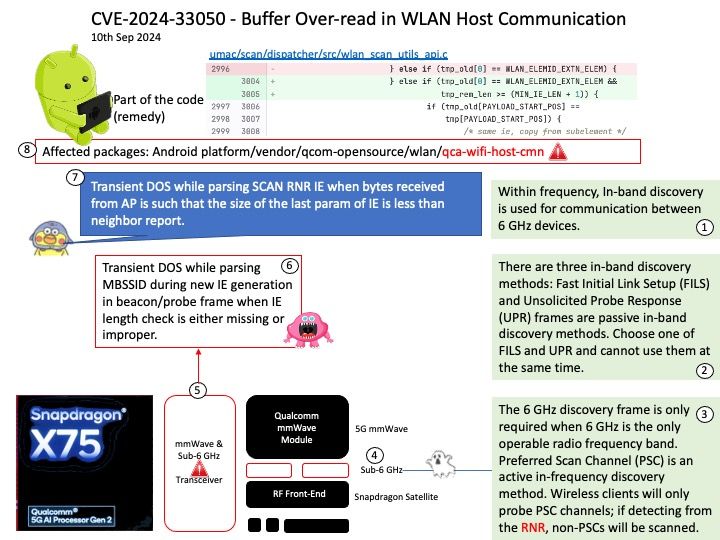
CVE-2024-33050 – Buffer Over-read in WLAN Host Communication (10th Sep 2024)

Preface: In computer programming, transient is a property of any element in the system that is temporary. The term applies to transient applications.

Background: Within frequency, In-band discovery is used for communication between 6 GHz devices. There are three in-band discovery methods: Fast Initial Link Setup (FILS) and Unsolicited Probe Response (UPR) frames are passive in-band discovery methods. Choose one of FILS and UPR and cannot use them at the same time. The 6 GHz discovery frame is only required when 6 GHz is the only operable radio frequency band. Preferred Scan Channel (PSC) is an active in-frequency discovery method. Wireless clients will only probe PSC channels; if detecting from the RNR, non-PSCs will be scanned.

Vulnerability details: Transient DOS while parsing MBSSID during new IE generation in beacon/probe frame when IE length check is either missing or improper.

Ref: The product reads from a buffer using buffer access mechanisms such as indexes or pointers that reference memory locations after the targeted buffer.

Official announcement: Please refer to the vendor announcement for details – https://docs.qualcomm.com/product/publicresources/securitybulletin/september-2024-bulletin.html

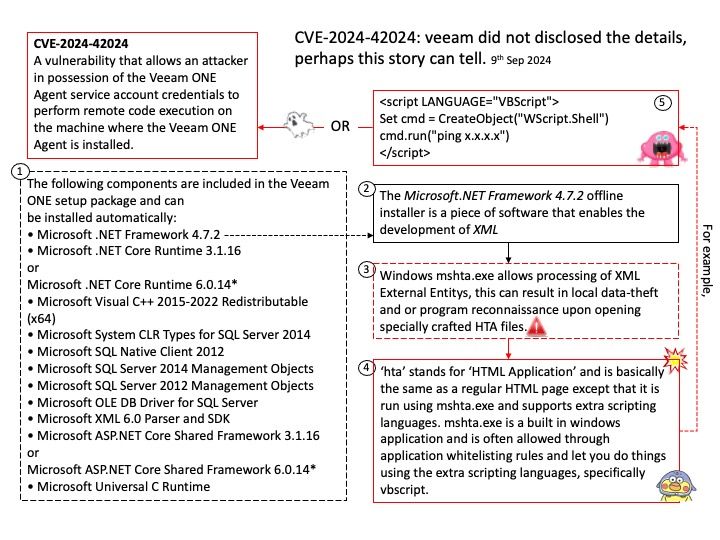
CVE-2024-42024: veeam did not disclosed the details, perhaps this story can tell (9th Sep 2024)

Preface: Veeam ONE agent is a component that enables communication with Veeam Backup & Replication servers, performs collection of logs, and sends remediation commands. It is recommended to install Veeam ONE agent to improve data collection performance in large-scale Veeam Backup & Replication infrastructures.

Background: Veeam ONE supports two deployment scenarios:

• All-in-one

The all-in-one deployment scenario is ideal if you want to consolidate the entire product functionality in one place by installing all product architectural components on a single machine. This scenario is preferable for small- to medium-scale deployments.

• Custom

The custom deployment scenario is more suitable if you want to separate client/server roles and install product architectural components on different machines. This scena rio is recommended for large-scale deployments.

Vulnerability details:  A vulnerability that allows an attacker in possession of the Veeam ONE Agent service account credentials to perform remote code execution on the machine where the Veeam ONE Agent is installed.

Official announcement: Please refer to the link for details – https://www.veeam.com/kb4649