Category Archives: Potential Risk of CVE

CVE-2025-37834: About Linux vmscan[.]c (8th May 2025)

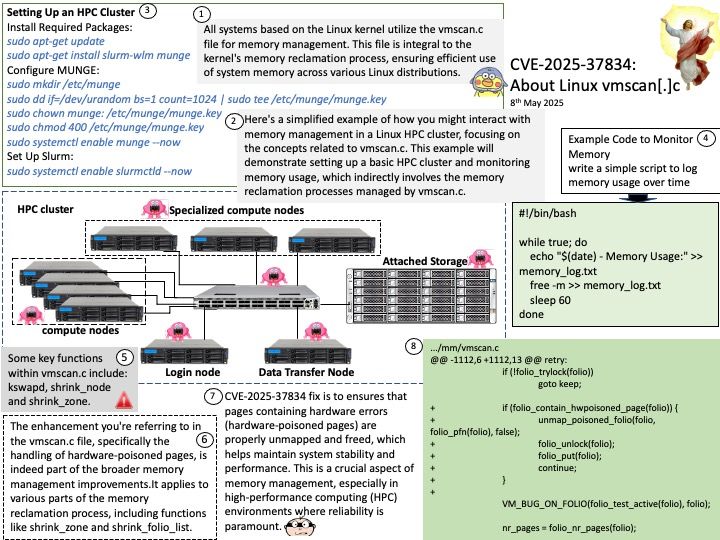
Preface: All systems based on the Linux kernel utilize the vmscan[.]c file for memory management. This file is integral to the kernel’s memory reclamation process, ensuring efficient use of system memory across various Linux distributions.

Background: The vmscan[.]c file in the Linux kernel is responsible for managing memory reclamation. It contains functions that help the system reclaim memory by scanning and freeing up pages that are no longer in use. This process is crucial for maintaining system performance and preventing memory shortages.

Some key functions within vmscan.c include:

kswapd: A kernel thread that periodically scans and frees up memory pages.

shrink_node: This function attempts to reclaim memory from a specific node.

shrink_zone: It works on reclaiming memory from a specific zone within a node.

These functions work together to ensure that the system has enough free memory to operate efficiently.

Vulnerability details: mm/vmscan: don’t try to reclaim hwpoison folio. The vulnerability has been resolved.

The enhancement in the vmscan[.]c file, specifically the handling of hardware-poisoned pages, is indeed part of the broader memory management improvements. This enhancement is not limited to the shrink_node function alone. It applies to various parts of the memory reclamation process, including functions like shrink_zone and shrink_folio_list.

Official announcement: Please see the link for details – https://nvd.nist.gov/vuln/detail/CVE-2025-37834
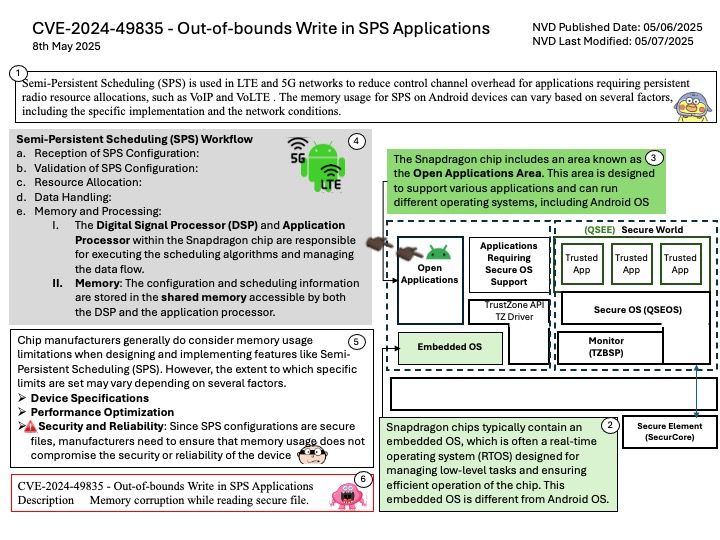
CVE-2024-49835 – Out-of-bounds Write in SPS Applications (8th May 2025)

Preface: Semi-Persistent Scheduling (SPS) is used in LTE and 5G networks to reduce control channel overhead for applications requiring persistent radio resource allocations, such as VoIP and VoLTE . The memory usage for SPS on Android devices can vary based on several factors, including the specific implementation and the network conditions.

A method and apparatus for determining validity of a semi-persistent scheduling (SPS) resource across multiple cells in a wireless communication system is provided. A user equipment (UE) receives a SPS resource configuration including time information related to validity of the SPS resource configuration from a network, and determines whether the SPS resource configuration is valid or not according to the time information.

Background: Semi-Persistent Scheduling (SPS) Workflow

  1. The RF module in the Snapdragon chip receives the SPS resource configuration from the network. This configuration includes time information related to the validity of the SPS resource.
  2. The Physical Layer (PHY) processes the received configuration to determine its validity based on the time information provided.
  3. If the configuration is valid, the Medium Access Control (MAC) layer handles the allocation of radio resources for multiple consecutive Transmission Time Intervals (TTIs). This reduces the need for frequent scheduling decisions and signaling overhead.
  4. The MAC layer coordinates with the Radio Link Control (RLC) layer to manage data transmission using the allocated resources. The RLC layer ensures data integrity and proper sequencing.
  5. The Digital Signal Processor (DSP) and Application Processor within the Snapdragon chip are responsible for executing the scheduling algorithms and managing the data flow.The configuration and scheduling information are stored in the shared memory accessible by both the DSP and the application processor.

Vulnerability details: Out-of-bounds Write in SPS Applications. Memory corruption while reading secure file. This is a type of memory access error that occurs when a program writes data from a memory address outside of the bounds of a buffer. This can result in the program writing data that does not belong to it, which can cause crashes, incorrect behavior, or even security vulnerabilities.

Official announcement: For details, please refer to the link –https://nvd.nist.gov/vuln/detail/cve-2024-49835

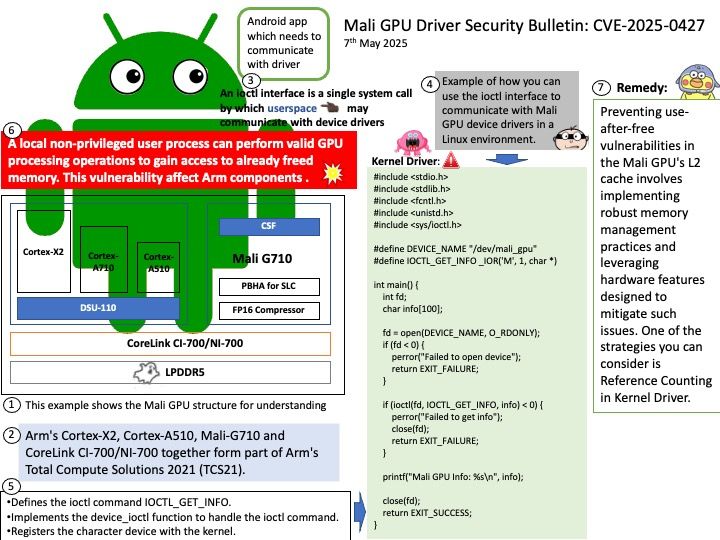
Mali GPU Driver Security Bulletin: CVE-2025-0427

(7th May 2025)

Last updated: 2 May 2025 (official)

Preface: An ioctl interface is a single system call by which userspace may communicate with device drivers. Requests on a device driver are vectored with respect to this ioctl system call, typically by a handle to the device and a request number.

Background: The Arm Mali GPU, when installed on an Android phone, works alongside the CPU rather than replacing it. The Mali GPU is specifically designed for handling graphics processing tasks, such as rendering images, animations, and videos, which helps to offload these tasks from the CPU. This allows the CPU to focus on other computational tasks, improving overall device performance and efficiency.

The Mali GPU itself does not have an embedded CPU; it is a separate component that works in conjunction with the device’s main CPU. This collaboration between the GPU and CPU ensures that graphics-intensive applications, like games and videos, run smoothly while maintaining efficient power usage.

Vulnerability details: Use After Free vulnerability in Arm Ltd Bifrost GPU Kernel Driver, Arm Ltd Valhall GPU Kernel Driver, Arm Ltd Arm 5th Gen GPU Architecture Kernel Driver allows a local non-privileged user process to perform valid GPU processing operations to gain access to already freed memory.

Impact: This issue affects Bifrost GPU Kernel Driver: from r8p0 through r49p3, from r50p0 through r51p0; Valhall GPU Kernel Driver: from r19p0 through r49p3, from r50p0 through r53p0; Arm 5th Gen GPU Architecture Kernel Driver: from r41p0 through r49p3, from r50p0 through r53p0.

Official announcement: Please see the link for details –

https://nvd.nist.gov/vuln/detail/CVE-2025-0427

https://developer.arm.com/documentation/110465/latest

CVE-2024-49739 – GPU DDK misuse ptrace system call (6th May 2025)

Official release posted: 2nd May 2025

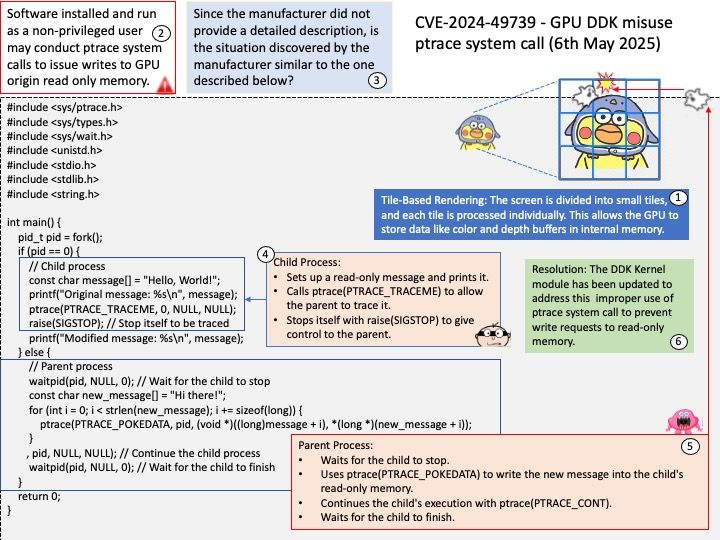
Since the manufacturer did not provide a detailed description, is the situation discovered by the manufacturer similar to this article details?

Preface:

Nvidia is a major player in the GPU market, known for its high-performance graphics cards used in gaming, professional visualization, data centers, and AI applications.

Imagination Technologies specializes in providing GPU processor solutions for graphics and AI vision applications. They focus on mobile devices, automotive, and embedded systems.

Background: All PowerVR GPUs are based on unique Tile Based Deferred Rendering (TBDR) architecture; the only true deferred rendering GPU architecture in the world.  True deferred rendering GPU architecture, specifically Tile-Based Deferred Rendering (TBDR), is a unique approach used by PowerVR GPUs.

Tile-Based Deferred Rendering (TBDR)

– Tile-Based Rendering: The screen is divided into small tiles, and each tile is processed individually. This allows the GPU to store data like color and depth buffers in internal memory, reducing the need for frequent access to system memory. This results in lower energy consumption and higher performance.

– Deferred Rendering: This technique defers texturing and shading operations until the visibility of each pixel in the tile is determined. Only the pixels that will be visible to the user consume processing resources, which enhances efficiency.

Vulnerability details: Software installed and run as a non-privileged user may conduct ptrace system calls to issue writes to GPU origin read only memory.

Resolution: The DDK Kernel module has been updated to address this  improper use of ptrace system call to prevent write requests to read-only memory.

Official announcement: Please see the link for details –

https://www.imaginationtech.com/gpu-driver-vulnerabilities

CVE-2025-21756: Does the vsock design flaw affect Hyper-V? (4th May 2025)

Preface: Hyper-V is still available as a role in Windows Server 2022 and will be supported as long as that operating system is, currently scheduled for end of extended support on October 14, 2031.

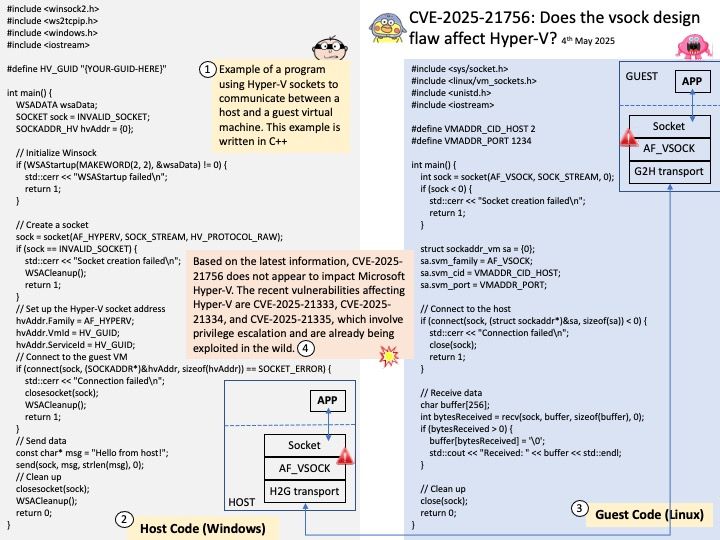
Background: The vsock can also be used in QEMU/KVM as well as HyperV but the code is close source. H2G (host to guest) transports: they run in the host and usually they provide the device emulation; currently we have vhost and vmci transports. G2H (guest to host) transports: they run in the guest and usually they are device drivers; currently we have virtio, vmci, and hyperv transports.

– virtio-vsock provides a way for applications running on a guest VM and the host system to communicate with each other using the standard socket interface ( socket , connect , bind , listen , accept ).

– VMCI sockets communicate between the host and a guest on VMware platform products. You could also use VMCI sockets for interprocess communications on a guest. You cannot use VMCI sockets between the host and a virtual machine running on a different host.

– Starting with the Windows 10 Anniversary Update, anyone can create applications that communicate between a Hyper-V host and its virtual machines over Hyper-V sockets. Hyper-V Sockets is a Windows Sockets that uses a new address family and specialized endpoints for virtualizers. All communications run over Hyper-V sockets without using the network, and all data remains in the same physical memory. Applications that use Hyper-V sockets are similar to Hyper-V Integration Services.

Vulnerability details: Design weakness on vsock.

Remedy: Preserve sockets bindings; this includes both resulting from an explicit bind() and those implicitly bound through autobind during connect().

Prevents socket unbinding during a transport reassignment, which fixes a use-after-free:

Ref: Based on the latest information, CVE-2025-21756 does not appear to impact Microsoft Hyper-V. The recent vulnerabilities affecting Hyper-V are CVE-2025-21333, CVE-2025-21334, and CVE-2025-21335, which involve privilege escalation and are already being exploited in the wild.

Official announcement: Please see the link for details –

https://nvd.nist.gov/vuln/detail/CVE-2025-21756

https://git.kernel.org/pub/scm/linux/kernel/git/stable/linux.git/commit/?id=3f43540166128951cc1be7ab1ce6b7f05c670d8b

CVE-2025-23245: NVIDIA TensorRT-LLM for any platform contains a vulnerability in python executor (30-4-2025)

Preface: DeepSpeed MII, an open-source Python library developed by Microsoft, aims to make powerful model inference accessible, emphasizing high throughput, low latency, and cost efficiency. TensorRT LLM, an open-source framework from NVIDIA, is designed for optimizing and deploying large language models on NVIDIA GPUs.

Background: TensorRT-LLM is a library developed by NVIDIA to optimize and run large language models (LLMs) efficiently on NVIDIA GPUs. It provides a Python API to define and manage these models, ensuring high performance during inference.

The Python Executor within TensorRT-LLM is a component that orchestrates the execution of inference tasks. It manages the scheduling and execution of requests, ensuring that the GPU resources are utilized efficiently. The Python Executor handles various tasks such as batching requests, managing model states, and coordinating with other components like the model engine and the scheduler.

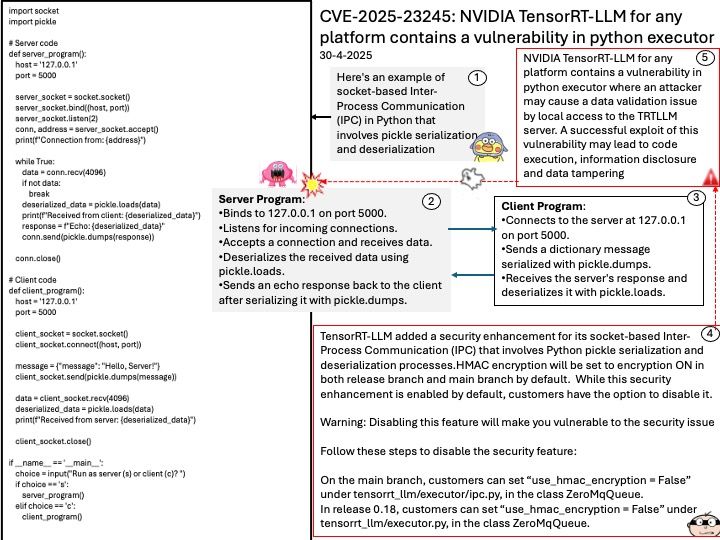
Vulnerability details: NVIDIA TensorRT-LLM for any platform contains a vulnerability in python executor where an attacker may cause a data validation issue by local access to the TRTLLM server. A successful exploit of this vulnerability may lead to code execution, information disclosure and data tampering.

CWE-502: The product deserializes untrusted data without sufficiently ensuring that the resulting data will be valid.

Official announcement: Please refer to the link for details – https://nvidia.custhelp.com/app/answers/detail/a_id/5648

CVE-2024-45552 – Buffer Over-read in Data Network Stack & Connectivity  (30-04-2025)

NVD Published Date: 04/07/2025

NVD Last Modified: 04/07/2025

Preface: Real-time Transport Protocol (RTP) is a network protocol used for delivering audio and video data over the internet in real time. It is designed to provide reliable and efficient transmission of multimedia content, even in the presence of network congestion or packet loss.

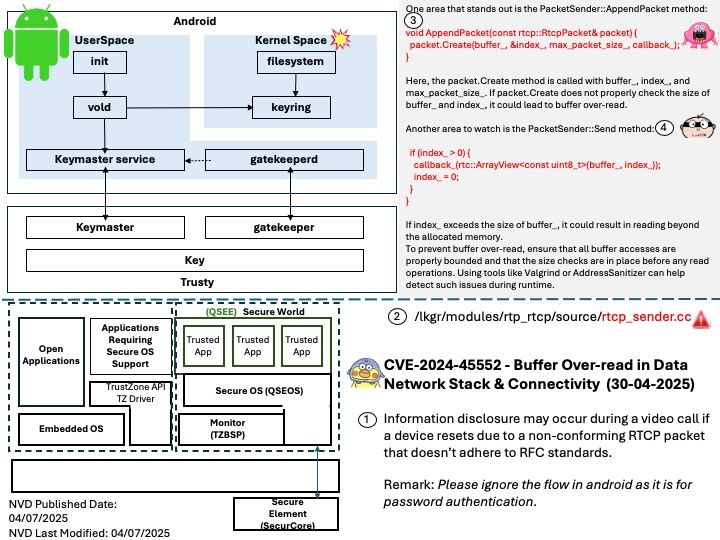
Background: The Snapdragon 865 5G Mobile Platform is designed to handle various networking tasks, including RTCP (Real-Time Transport Control Protocol) packets. The rtcp_sender[.]cc driver, which is responsible for sending RTCP packets, is typically part of the software stack that runs on the device’s operating system rather than being embedded directly within the Snapdragon chipset itself

The Snapdragon 865 provides the necessary hardware support and interfaces for the operating system to manage network communications efficiently . The actual implementation of RTCP handling, including the rtcp_sender[.]cc driver, would be part of the software layer that interacts with the hardware.

Vulnerability details: Information disclosure may occur during a video call if a device resets due to a non-conforming RTCP packet that doesn’t adhere to RFC standards.

Official announcement: Please see the link for details – https://nvd.nist.gov/vuln/detail/CVE-2024-45552

CVE-2025-31201: about RPAC – Reconfigurable Processing Architecture Core – iPhone XS and later (28-4-2025)

Official Released April 16, 2025

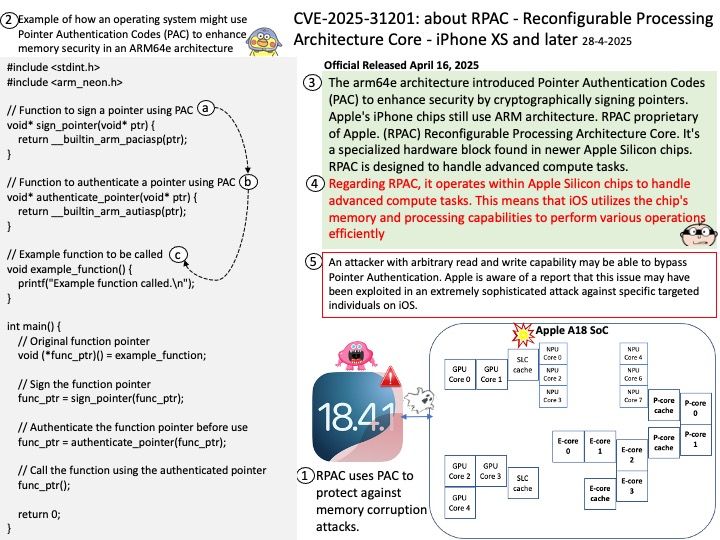
Preface: The Reconfigurable Processing Architecture Core (RPAC) in Apple iOS is a component found in newer Apple Silicon chips. Its major function is to enhance the security and performance of the system by providing a flexible and efficient processing architecture. RPAC is designed to support various computational tasks and can be dynamically reconfigured to optimize performance for different applications.

Background: Arbitrary read and write refer to the ability of an attacker to read from or write to any memory location within a system.

Buffer overflows are a common cause of arbitrary read and write vulnerabilities, but in this CVE, the issue is related to how the RPAC component handles memory and security checks.

RPAC uses PAC to protect against memory corruption attacks. PAC works by cryptographically signing pointers, such as return addresses, to ensure they haven’t been tampered with. This helps prevent unauthorized modifications and ensures the integrity of memory operations.

RPAC performs various security checks to validate memory access and operations. These checks help detect and guard against unexpected changes to pointers and other critical data structures

Vulnerability details: An attacker with arbitrary read and write capability may be able to bypass Pointer Authentication. Apple is aware of a report that this issue may have been exploited in an extremely sophisticated attack against specific targeted individuals on iOS.

Official announcement: Please see the link for details – https://nvd.nist.gov/vuln/detail/CVE-2025-31201

CVE‑2025‑23245 and CVE-2025-23246: About NVIDIA vGPU software Driver (24-04-2025)

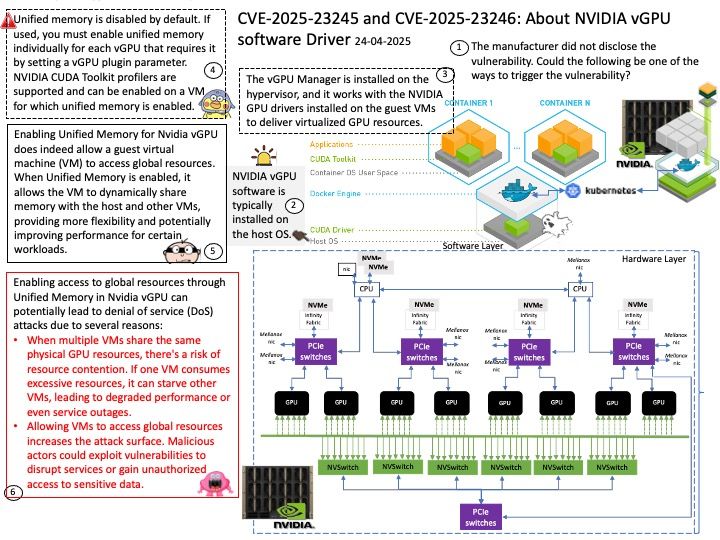
Preface: To virtualize a single NVIDIA GPU into multiple virtual GPUs and allocate them to different virtual machines or users, you can use NVIDIA’s vGPU capability.

Background: Unified memory is disabled by default. If used, you must enable unified memory individually for each vGPU that requires it by setting a vGPU plugin parameter. NVIDIA CUDA Toolkit profilers are supported and can be enabled on a VM for which unified memory is enabled.

Enabling Unified Memory for Nvidia vGPU does indeed allow a guest virtual machine (VM) to access global resources. When Unified Memory is enabled, it allows the VM to dynamically share memory with the host and other VMs, providing more flexibility and potentially improving performance for certain workloads.

Enabling access to global resources through Unified Memory in Nvidia vGPU can potentially lead to denial of service (DoS) attacks due to several reasons:

  • When multiple VMs share the same physical GPU resources, there’s a risk of resource contention. If one VM consumes excessive resources, it can starve other VMs, leading to degraded performance or even service outages.
  • Allowing VMs to access global resources increases the attack surface. Malicious actors could exploit vulnerabilities to disrupt services or gain unauthorized access to sensitive data.

Vulnerability details:

CVE-2025-23246: NVIDIA vGPU software for Windows and Linux contains a vulnerability in the Virtual GPU Manager (vGPU plugin), where it allows a guest to consume uncontrolled resources. A successful exploit of this vulnerability might lead to denial of service.

CWE-732: Incorrect Permission Assignment for Critical

CVE-2025-23245: NVIDIA vGPU software for Windows and Linux contains a vulnerability in the Virtual GPU Manager (vGPU plugin), where it allows a guest to access global resources. A successful exploit of this vulnerability might lead to denial of service.

CWE-400: Uncontrolled Resource Consumption

Official announcement: Please see the link for details –

https://nvidia.custhelp.com/app/answers/detail/a_id/5630

CVE‑2025‑23244: About NVIDIA GPU Display Driver (24-04-2025)

Preface: The NVIDIA Tesla R570 driver is used for various data center GPUs, including the NVIDIA A100 and NVIDIA V100. These GPUs are designed for high-performance computing, AI, and deep learning applications.

Background:

The CUDA software environment consists of three parts:

  • CUDA Toolkit (libraries, runtime and tools) – User-mode SDK used to build CUDA applications
  • CUDA driver – User-mode driver component used to run CUDA applications (for example, libcuda.so on Linux systems)
  • NVIDIA GPU device driver – Kernel-mode driver component for NVIDIA GPUs

On Linux systems, the CUDA driver and kernel mode components are delivered together in the NVIDIA display driver package.

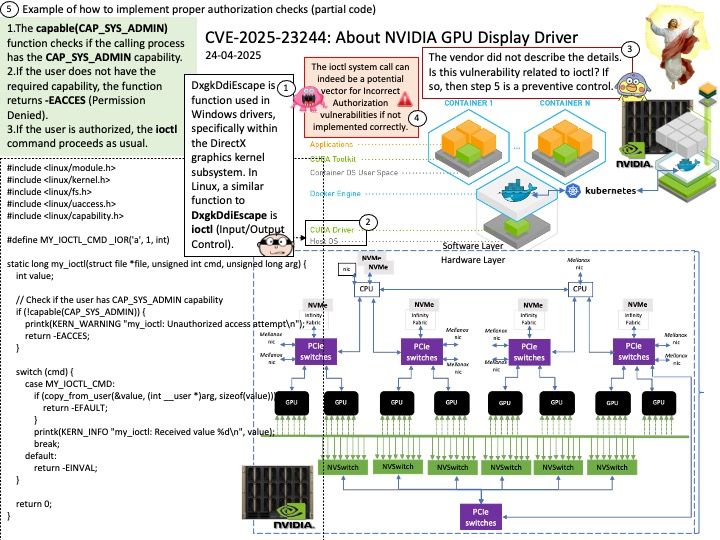
DxgkDdiEscape is a function used in Windows drivers, specifically within the DirectX graphics kernel subsystem. In Linux, a similar function to DxgkDdiEscape is ioctl (Input/Output Control).

The ioctl system call can indeed be a potential vector forIncorrect Authorization vulnerabilities if not implemented correctly.

Vulnerability details: NVIDIA GPU Display Driver for Linux contains a vulnerability which could allow an unprivileged attacker to escalate permissions. A successful exploit of this vulnerability might lead to code execution, denial of service, escalation of privileges, information disclosure, and data tampering.

Impact: Code execution, denial of service, escalation of privileges, information disclosure, and data tampering

Official announcement: Please see the link for details – https://nvidia.custhelp.com/app/answers/detail/a_id/5630