Category Archives: Potential Risk of CVE

CVE-2025-23247: NVIDIA CUDA Toolkit for all platforms contains a vulnerability in the cuobjdump binary (28-5-2025)

Preface: ROCm open source software platform is AMD’s core strategy. This platform supports deep learning frameworks such as PyTorch 2.0 and TensorFlow.

Nvidia’s CUDA cores are indispensable for training and deploying neural networks and deep learning models, taking advantage of their parallel processing capabilities. To put that into perspective, a dozen Nvidia H100 GPUs can provide the same deep learning equivalent as 2,000 midrange CPUs.

Background: NVIDIA CUDA provides a simple C/C++ based interface. The CUDA compiler leverages parallelism built into the CUDA programming model as it compiles your program into code.
CUDA is a parallel computing platform and programming interface model created by Nvidia for the development of software which is used by parallel processors. It serves as an alternative to running simulations on traditional CPUs.

The CUDA Toolkit targets a class of applications whose control part runs as a process on a general purpose computing device, and which use one or more NVIDIA GPUs as coprocessors for accelerating single program, multiple data (SPMD) parallel jobs. Such jobs are self-contained, in the sense that they can be executed and completed by a batch of GPU threads entirely without intervention by the host process, thereby gaining optimal benefit from the parallel graphics hardware.

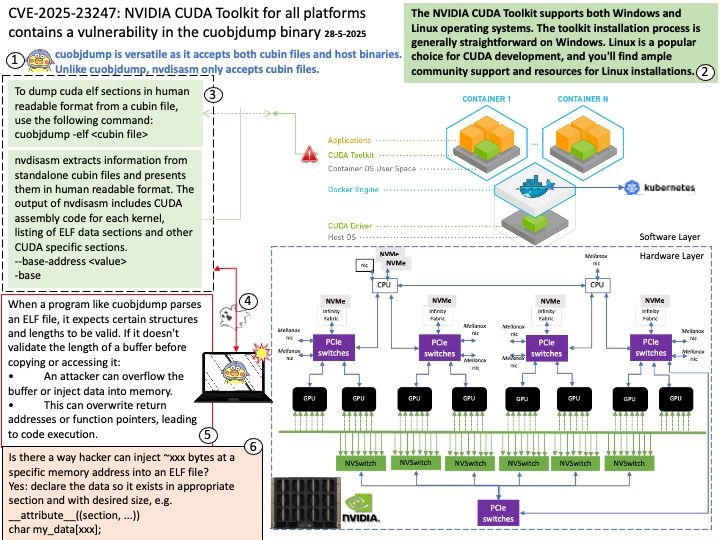
When a program like cuobjdump parses an ELF file, it expects certain structures and lengths to be valid. If it doesn’t validate the length of a buffer before copying or accessing it:

•        An attacker can overflow the buffer or inject data into memory.

•        This can overwrite return addresses or function pointers, leading to code execution.

Vulnerability details: NVIDIA CUDA Toolkit for all platforms contains a vulnerability in the cuobjdump binary, where a failure to check the length of a buffer could allow a user to cause the tool to crash or execute arbitrary code by passing in a malformed ELF file. A successful exploit of this vulnerability might lead to arbitrary code execution.

Official announcement: Please refer to the supplier announcement –https://nvidia.custhelp.com/app/answers/detail/a_id/5643
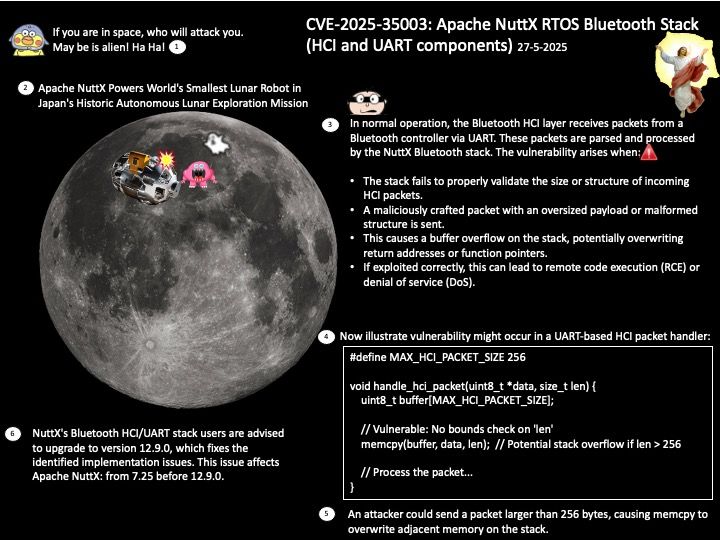
CVE-2025-35003: Apache NuttX RTOS Bluetooth Stack (HCI and UART components) 27-5-2025

Preface: During the Dahe period of Emperor Wenzong of the Tang Dynasty (827-835 AD), there was a scholar named Zheng Renben(鄭仁本), his cousin and his friend Wang Xiucai(王秀才) wandering in Zhongyue Songshan Mountain(中嶽嵩山) and got lost in a deep valley. It was getting dark at this time, and the two were very scared. As they were walking around, they saw someone dressed in white snoring in the grass. They went up to him and asked, “I accidentally entered this path and got lost. Do you know the way to the official road?” The man raised his head, looked, and did not respond and continued to sleep. The two asked the man in white where he came from and called him again and again, so he sat up and said, “Come here.” The man in white introduced: “Do you know that the moon is made of seven treasures? The bright spots on the moon are the result of the sun shining on its convex parts. There are 82,000 people repairing the moon, and I am one of them, one of them…”

Background: The Bluetooth stack in Apache NuttX RTOS is used to enable Bluetooth communication in embedded systems, particularly for devices that require low-power wireless connectivity. This stack typically supports:

  • HCI (Host Controller Interface) over UART or USB
  • Bluetooth Classic and BLE (Bluetooth Low Energy) profiles
  • Device discovery, pairing, and data exchange

It is designed to be modular and lightweight, making it suitable for resource-constrained microcontrollers.

Vulnerability details: Improper Restriction of Operations within the Bounds of a Memory Buffer and Stack-based Buffer Overflow vulnerabilities were discovered in Apache NuttX RTOS Bluetooth Stack (HCI and UART components) that may result in system crash, denial of service, or arbitrary code execution, after receiving maliciously crafted packets.

Remedy: NuttX’s Bluetooth HCI/UART stack users are advised to upgrade to version 12.9.0, which fixes the identified implementation issues. This issue affects Apache NuttX: from 7.25 before 12.9.0.

Official announcement: Please see the link for details – https://www.tenable.com/cve/CVE-2025-35003

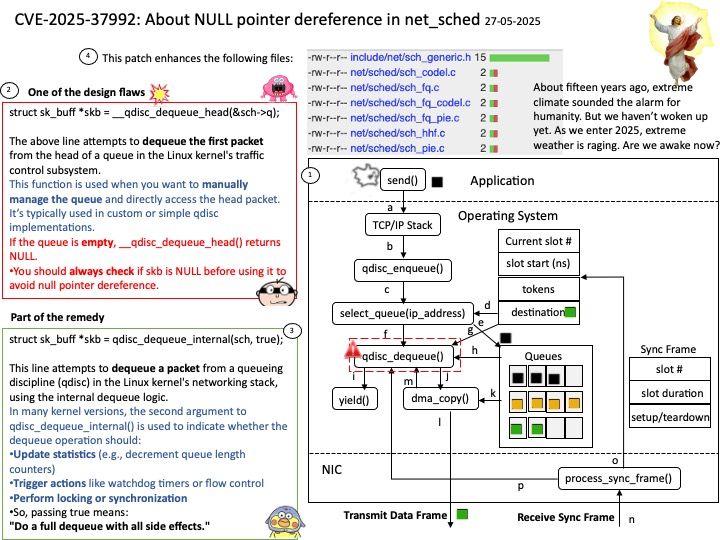
CVE-2025-37992: About NULL pointer dereference in net_sched (27-05-2025)

Preface: Linux powers large parts of the Internet, cloud infrastructure, and supercomputers. But it is difficult to determine the exact number of Linux systems in the world. This appears to be a technology trend that includes AI system infrastructure.

Background: In Linux, a “qdisc” stands for queueing discipline. It’s a core component of the Linux traffic control system, responsible for managing and scheduling network traffic on a per-interface basis. Essentially, a qdisc determines how the kernel handles packets before sending them to the network adapter.

Vulnerability details: Previously, when reducing a qdisc’s limit via the ->change() operation, only the main skb queue was trimmed, potentially leaving packets in the gso_skb list. This could result in NULL pointer dereference when we only check sch->limit against sch->q[.]qlen.

Remedy: This patch introduces a new helper, qdisc_dequeue_internal(), which ensures both the gso_skb list and the main queue are properly flushed when trimming excess packets. All relevant qdiscs (codel, fq, fq_codel, fq_pie, hhf, pie) are updated to use this helper in their ->change() routines.

Official announcement: Please see the link for details –

https://nvd.nist.gov/vuln/detail/CVE-2025-37992

https://git.kernel.org/pub/scm/linux/kernel/git/stable/linux.git/commit/?id=fe88c7e4fc2c1cd75a278a15ffbf1689efad4e76

Point of view – IOLeak – CPU Side Channel Attacks  23-05-2025

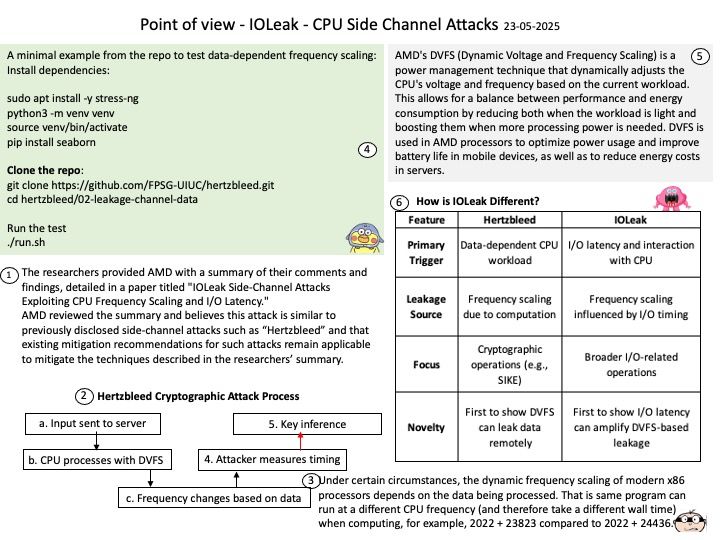
Preface: Hertzbleedis about inferring secrets from timing differencescaused by how CPUs adjust their frequency under load.

Background: The Hertzbleed vulnerability does not specifically target the L2 cache of AMD CPUs. Instead, it exploits a broader mechanism related to dynamic frequency scaling — a feature used by modern CPUs (including AMD Zen 2 and Zen 3) to adjust clock speeds based on workload and thermal conditions.

How is IOLeak Different?

FeatureHertzbleedIOLeak
Primary TriggerData-dependent CPU workloadI/O latency and interaction with CPU
Leakage SourceFrequency scaling due to computationFrequency scaling influenced by I/O timing
FocusCryptographic operations (e.g., SIKE)Broader I/O-related operations
NoveltyFirst to show DVFS can leak data remotelyFirst to show I/O latency can amplify DVFS-based leakage

Ref: AMD’s DVFS (Dynamic Voltage and Frequency Scaling) is a power management technique that dynamically adjusts the CPU’s voltage and frequency based on the current workload. This allows for a balance between performance and energy consumption by reducing both when the workload is light and boosting them when more processing power is needed. DVFS is used in AMD processors to optimize power usage and improve battery life in mobile devices, as well as to reduce energy costs in servers.

Vulnerability details: The researchers provided AMD with a summary of their comments and findings, detailed in a paper titled “IOLeak Side-Channel Attacks Exploiting CPU Frequency Scaling and I/O Latency.”

AMD reviewed the summary and believes this attack is similar to previously disclosed side-channel attacks such as “Hertzbleed” and that existing mitigation recommendations for such attacks remain applicable to mitigate the techniques described in the researchers’ summary.

Official announcement: Please see the link for details – https://www.amd.com/en/resources/product-security/bulletin/amd-sb-7042.html

CVE-2025-27558: FragAttacks against mesh networks (21-05-2025)

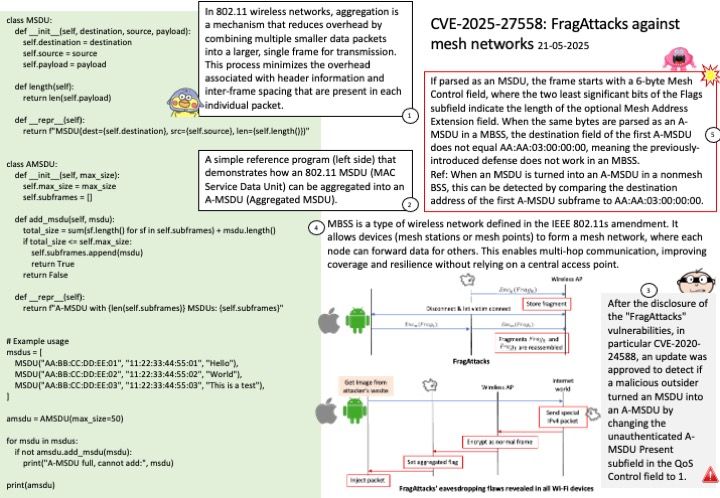
Preface: A Mesh Basic Service Set (MBSS) is a self-contained wireless network created by a group of interconnected mesh stations (STAs). Each mesh station can act as both an access point and a mesh node, enabling communication and data sharing within the mesh network. The MBSS uses a “mesh profile” to define the network’s characteristics, including a Mesh ID and other parameters. Unlike traditional Wi-Fi setups that rely on a single router, mesh networks create a more resilient, decentralized system.

Background: FragAttacks, short for Fragmentation and Aggregation attacks, are a category of Wi-Fi vulnerabilities that exploit design flaws in how Wi-Fi devices handle data packets. These flaws affect a wide range of Wi-Fi devices, potentially allowing attackers to steal information or disrupt network services.

Vulnerability details: IEEE P802.11-REVme D1.1 through D7.0 allows FragAttacks against mesh networks. In mesh networks using Wi-Fi Protected Access (WPA, WPA2, or WPA3) or Wired Equivalent Privacy (WEP), an adversary can exploit this vulnerability to inject arbitrary frames towards devices that support receiving non-SSP A-MSDU frames. NOTE: this issue exists because of an incorrect fix for CVE-2020-24588. P802.11-REVme, as of early 2025, is a planned release of the 802.11 standard.

Ref: CVE-2020-24588: The 802.11 standard that underpins Wi-Fi Protected Access (WPA, WPA2, and WPA3) and Wired Equivalent Privacy (WEP) doesn’t require that the A-MSDU flag in the plaintext QoS header field is authenticated. Against devices that support receiving non-SSP A-MSDU frames (which is mandatory as part of 802.11n), an adversary can abuse this to inject arbitrary network packets.

Official announcement: For details, please refer to the link –

https://nvd.nist.gov/vuln/detail/CVE-2025-27558

CVE-2025-37991 – PA-RISC: Fix double SIGFPE crash (21-05-2025)

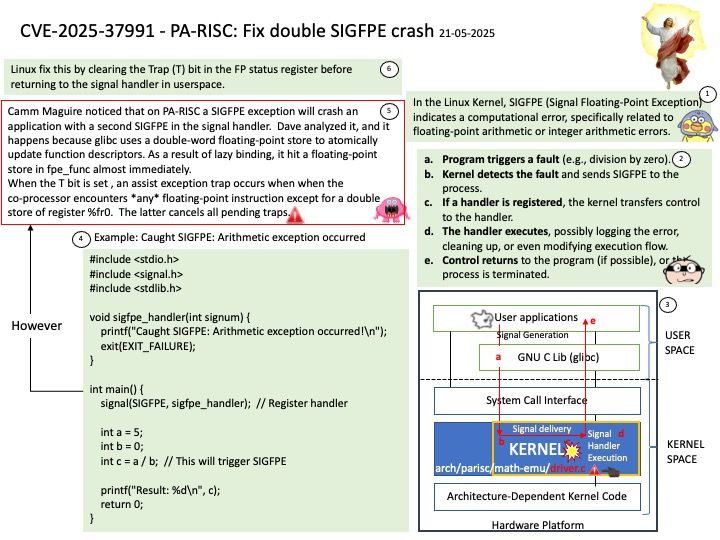
Preface: In the Linux Kernel, SIGFPE (Signal Floating-Point Exception) indicates a computational error, specifically related to floating-point arithmetic or integer arithmetic errors. This signal is triggered by events like floating-point overflow, underflow, or division by zero. While named “Floating-Point Exception,” it actually covers a broader range of arithmetic errors.

Background: What triggers SIGFPE?

  • Floating-point errors: These include overflow (exceeding the maximum representable value), underflow (falling below the minimum non-zero value), and division by zero.
  • Integer errors: Specifically, integer division by zero can also trigger SIGFPE. 

How it works in the Linux Kernel:

  • When a process encounters an arithmetic error that triggers SIGFPE, the kernel sends this signal to the process.
  • By default, if a signal handler is not registered for SIGFPE, the process will be terminated.
  • If a signal handler is registered, the handler can be used to attempt to recover from the error, such as by retrying the operation or taking alternative actions.
  • The si_code field in a signal handler can provide more information about the specific type of arithmetic error that caused SIGFPE. For example, FPE_INTDIV indicates integer division by zero, according to a post on Stack Overflow

Vulnerability details: Camm Maguire noticed that on PA-RISC a SIGFPE exception will crash an application with a second SIGFPE in the signal handler.  Dave analyzed it, and it happens because glibc uses a double-word floating-point store to atomically update function descriptors. As a result of lazy binding, it hit a floating-point store in fpe_func almost immediately.

When the T bit is set , an assist exception trap occurs when when the co-processor encounters *any* floating-point instruction except for a double store of register %fr0.  The latter cancels all pending traps. 

Remedy: Linux fix this by clearing the Trap (T) bit in the FP status register before returning to the signal handler in userspace.

Official announcement: For details, please refer to the link –https://nvd.nist.gov/vuln/detail/CVE-2025-37991

CVE-2025-47935 and CVE-2025-47944: About Multer design weakness (19-05-2025)

Preface: In a typical web application, there are three layers of middleware: Web server middleware. Application server middleware and Database middleware. A common request for file upload applications.

For example: uploading user avatars, attaching documents or handling multimedia content.

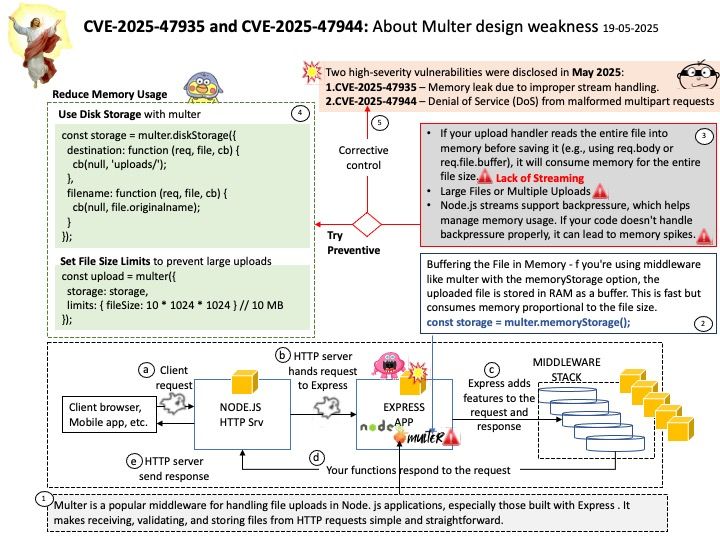
Multer is a node.js middleware for handling multipart/form-data, which is primarily used for uploading files.

Background: Express is the most popular Node.js web framework, and is the underlying library for a number of other popular Node.js frameworks.

Multer is a popular middleware for handling file uploads in Node. js applications, especially those built with Express . It makes receiving, validating, and storing files from HTTP requests simple and straightforward.

Vulnerability details: Multer is a node.js middleware for handling `multipart/form-data`. Versions prior to 2.0.0 are vulnerable to a resource exhaustion and memory leak issue due to improper stream handling. When the HTTP request stream emits an error, the internal `busboy` stream is not closed, violating Node.js stream safety guidance. This leads to unclosed streams accumulating over time, consuming memory and file descriptors. Under sustained or repeated failure conditions, this can result in denial of service, requiring manual server restarts to recover. All users of Multer handling file uploads are potentially impacted. Users should upgrade to 2.0.0 to receive a patch. No known workarounds are available.

Official announcement: For details, please refer to the link –

https://nvd.nist.gov/vuln/detail/CVE-2025-47935

https://nvd.nist.goc/vuln/detail/CVE-2025-47944

CVE-2025-47436: Heap-based Buffer Overflow vulnerability in Apache ORC. (15-5-2025)

Preface: Traditional row-based formats for data normalization have several limitations:

Complex Queries: Normalization often requires joining multiple tables to retrieve data, which can make queries more complex and slower.

Maintenance Challenges: Maintaining a highly normalized database can be more difficult, as changes to the schema may require updates to multiple tables.

Background: Apache ORC (Optimized Row Columnar) is a free and open-source, column-oriented data storage format designed for use in Hadoop and other big data processing systems. It was created to address the limitations of traditional row-based formats, providing a more efficient way to store and process large datasets. ORC is widely used by data processing frameworks like Apache Spark, Apache Hive, Apache Flink, and Apache Hadoop.

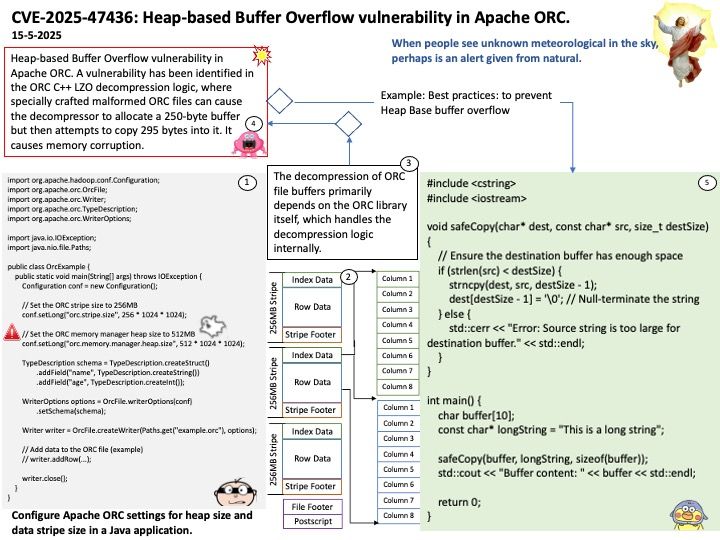
Vulnerability details: Heap-based Buffer Overflow vulnerability in Apache ORC. A vulnerability has been identified in the ORC C++ LZO decompression logic, where specially crafted malformed ORC files can cause the decompressor to allocate a 250-byte buffer but then attempts to copy 295 bytes into it. It causes memory corruption.

Remedy: This issue affects Apache ORC C++ library: through 1.8.8, from 1.9.0 through 1.9.5, from 2.0.0 through 2.0.4, from 2.1.0 through 2.1.1. Users are recommended to upgrade to version 1.8.9, 1.9.6, 2.0.5, and 2.1.2, which fix the issue.

Official announcement: Please see the link for details –

https://nvd.nist.gov/vuln/detail/CVE-2025-47436

CVE-2025-21460: Improper Input Validation in Automotive Software platform based on QNX. (13th May 2025)

Preface: As of June 26, 2023, QNX software is now embedded in over 255 million vehicles worldwide, including most leading OEMs and Tier 1s, such as BMW, Bosch, Continental, Dongfeng Motor, Geely, Ford, Honda, Mercedes-Benz, Subaru, Toyota, Volkswagen, Volvo, and more.

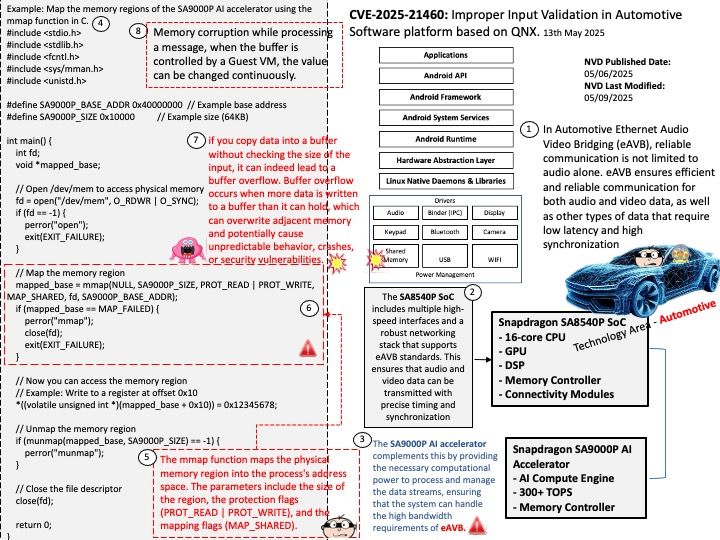
Background: In Automotive Ethernet Audio Video Bridging (eAVB), reliable communication is not limited to audio alone. eAVB ensures efficient and reliable communication for both audio and video data, as well as other types of data that require low latency and high synchronization. This includes applications such as infotainment systems, advanced driver-assistance systems (ADAS), and vehicle-to-vehicle communication.

The standards for eAVB, including Time-Sensitive Networking (TSN), provide guaranteed latencies and the ability to build redundant network paths for safety-critical communications. This makes eAVB a versatile solution for various types of data within the automotive network.

Vulnerability details:

Improper Input Validation in Automotive Software platform based on QNX

Description: Memory corruption while processing a message, when the buffer is controlled by a Guest VM, the value can be changed continuously.

Official announcement: Please see the link for details – https://nvd.nist.gov/vuln/detail/CVE-2025-21460

About CVE-2025-37889 – ASoC framework Consistently treat platform_max as control value (12th May 2025)

Preface: The overall project goal of the ALSA System on Chip (ASoC) layer is to provide better ALSA support for embedded system-on-chip processors.

Advanced Linux Sound Architecture (ALSA) is a software framework and part of the Linux kernel that provides an application programming interface (API) for sound card device drivers.

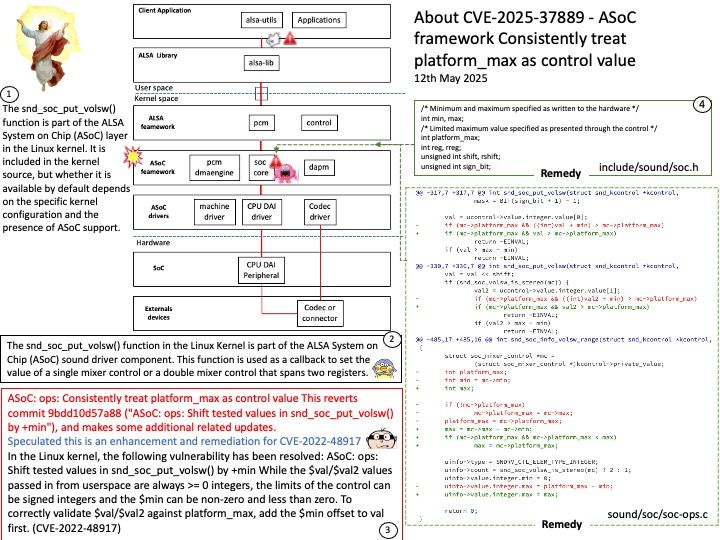
Background: The snd_soc_put_volsw() function is part of the ALSA System on Chip (ASoC) layer in the Linux kernel. It is included in the kernel source, but whether it is available by default depends on the specific kernel configuration and the presence of ASoC support. Here’s a brief overview of its features:

Purpose: It sets the volume control values for the sound subsystem.

Arguments: It takes two arguments: kcontrol, which represents the mixer control, and ucontrol, which contains the control element information.

Return Value: It returns 0 on success.

Vulnerability details: ASoC: ops: Consistently treat platform_max as control value This reverts commit 9bdd10d57a88 (“ASoC: ops: Shift tested values in snd_soc_put_volsw() by +min”), and makes some additional related updates.

Speculated this is an enhancement and remediation for CVE-2022-48917

In the Linux kernel, the following vulnerability has been resolved: ASoC: ops: Shift tested values in snd_soc_put_volsw() by +min While the $val/$val2 values passed in from userspace are always >= 0 integers, the limits of the control can be signed integers and the $min can be non-zero and less than zero. To correctly validate $val/$val2 against platform_max, add the $min offset to val first. (CVE-2022-48917)

Official announcement: Please see the link for details –

https://nvd.nist.gov/vuln/detail/CVE-2025-37889