Category Archives: Potential Risk of CVE

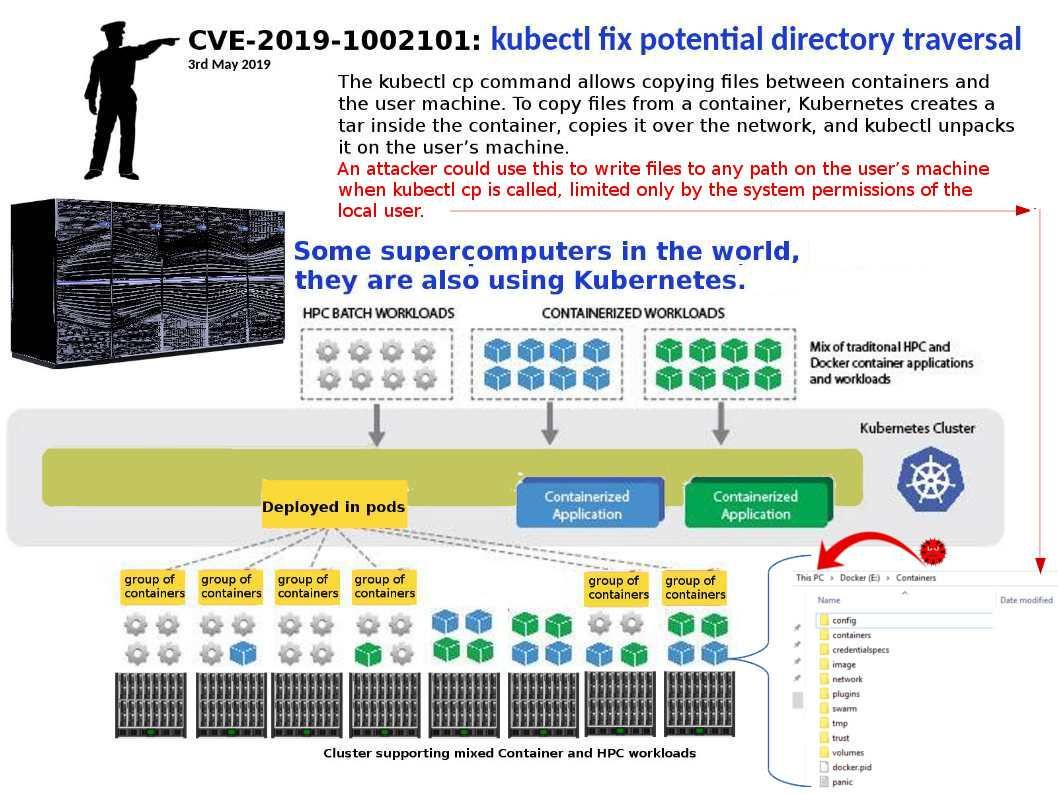
CVE-2019-1002101: Vulnerabilities found in Kubernetes’ kubectl cp command (3rd May 2019)

Preface: Some supercomputers in the world, they are also using Kubernetes.

Technical background: kubectl controls the Kubernetes cluster manager.Make use of “kubectl cp” command is able to copy files and directories to and from containers.

Vulnerability details: An attacker can fool a user to use the kubectl cp command to copy and store a malicious tar file in a container. Successful exploitation may allow an attacker to overwrite or delete any file in the user’s security context.

Remedy: Kubernetes has released a software update via the following link: https://github.com/kubernetes/kubernetes/releases

Comment: This vulnerability looks has difficulties to compromise the system. However the level of risk depends on the feature of the docker services. So do not contempt the issue because it is hard to predict the level of risk.
Cisco Security Advisories and Alerts – 1st May 2019

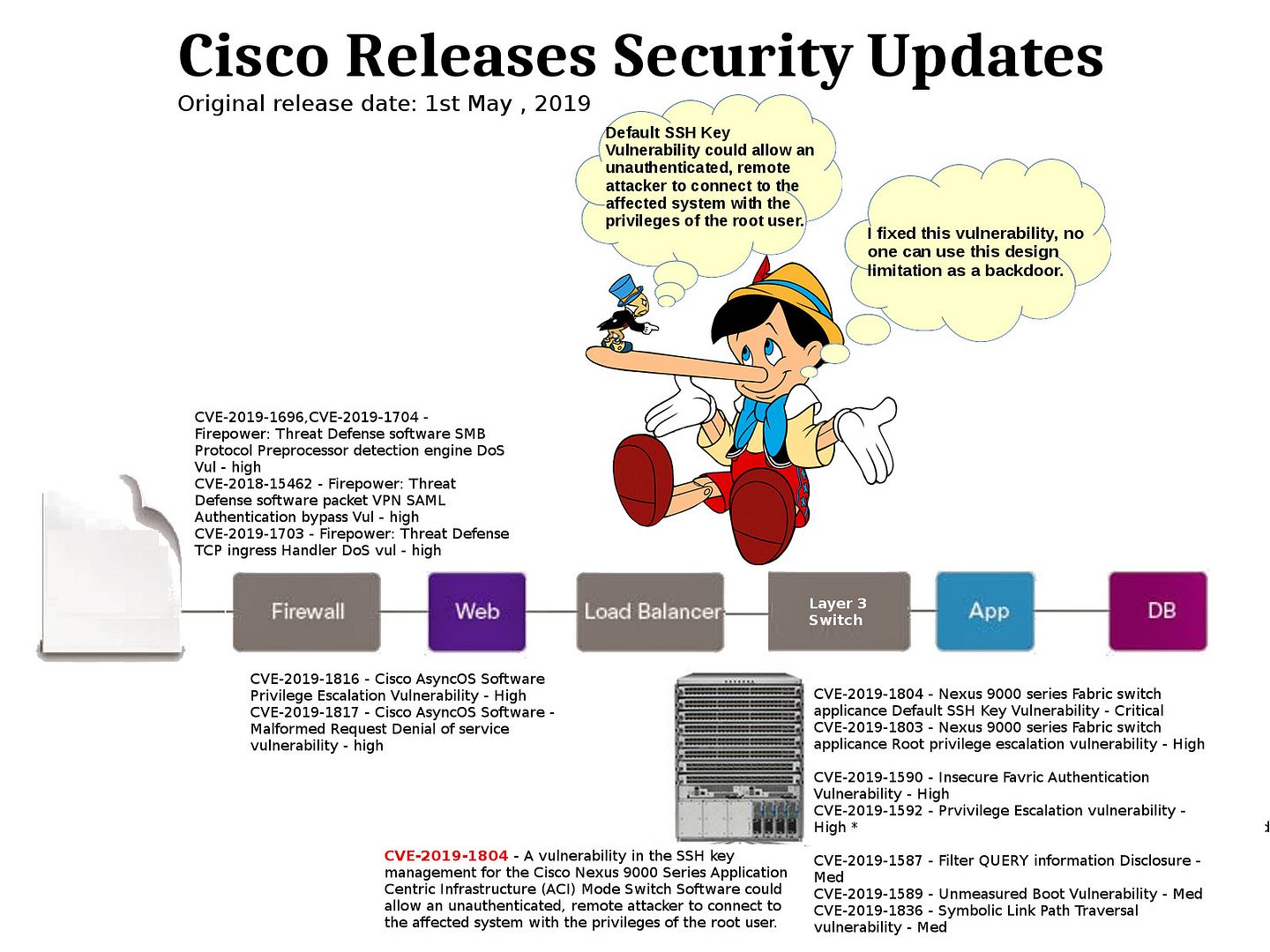
Preface: People judge an issue depends on your point of view. A design flaw or limitation of product in normal view point will make people dissatisfy. It is annoying and blame the designer what he is doing, does he dreaming?
From hacker point of view, the flaw can become a backdoor.

Highlight: CVE-2019-1804 – Cisco Nexus 9000 Series Fabric Switches Application Centric Infrastructure Mode Default SSH Key Vulnerability

Vulnerability details: The vulnerability occurs because default SSH key pair that is present in all devices. By default, most SSH implementations (e.g., OpenSSH) allow users to configure their own authorized key files (placing a public key in an account so they can access it using a private key). If organizations don’t keep an up to date inventory of authorized keys and regularly review it, users or even attackers may place authorized keys in unexpected places for future access.

Attention: For user who purchase directly from Cisco but do not hold a Cisco service contract. Do not worry, you should provides the product serial number and CVE reference number to Cisco as evidence of entitlement to a free upgrade. Besides, ther are many security update this week, please contact your cisco partner for update details.

Reference: Official announcement – https://tools.cisco.com/security/center/content/CiscoSecurityAdvisory/cisco-sa-20190501-nexus9k-sshkey

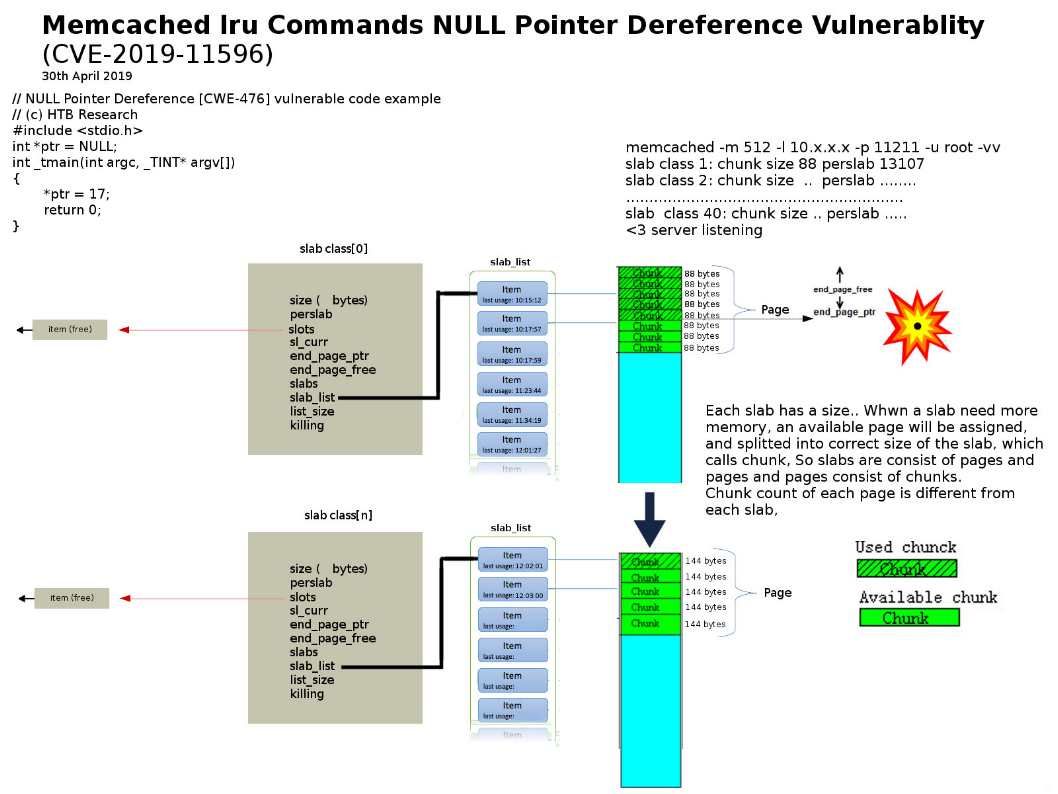
CVE-2019-11596: Memcached lru Commands NULL Pointer Dereference Vulnerablity – 29th Apr 2019

Preface: In modern smart world, efficiency is the key words. Do we need that?

Background: Memcached is a decentralized cache memory system. Use Memcached can improve database performance. Redis and Memcached are popular today. The reason is that both are the open-source products. And they can boost up database performance. Redis and Memcached are both in-memory data storage systems.

Vulnerability details: A vulnerability in Memcached could allow an unauthenticated, remote attacker to cause a denial of service (DoS) condition on a targeted system.
The vulnerability exists because the lru mode and lru temp_ttl commands, as implemented in the memcached.c source code file, do not properly perform memory operations, which could result in a NULL pointer dereference memory operation error. NULL pointer dereference erros are common in C/C++ languages. Pointer is a programming language data type that references a location in memory. Once the value of the location is obtained by the pointer, this pointer is considered dereferenced.

Remedy: Remediation at the following links – https://github.com/memcached/memcached/commit/d35334f368817a77a6bd1f33c6a5676b2c402c02

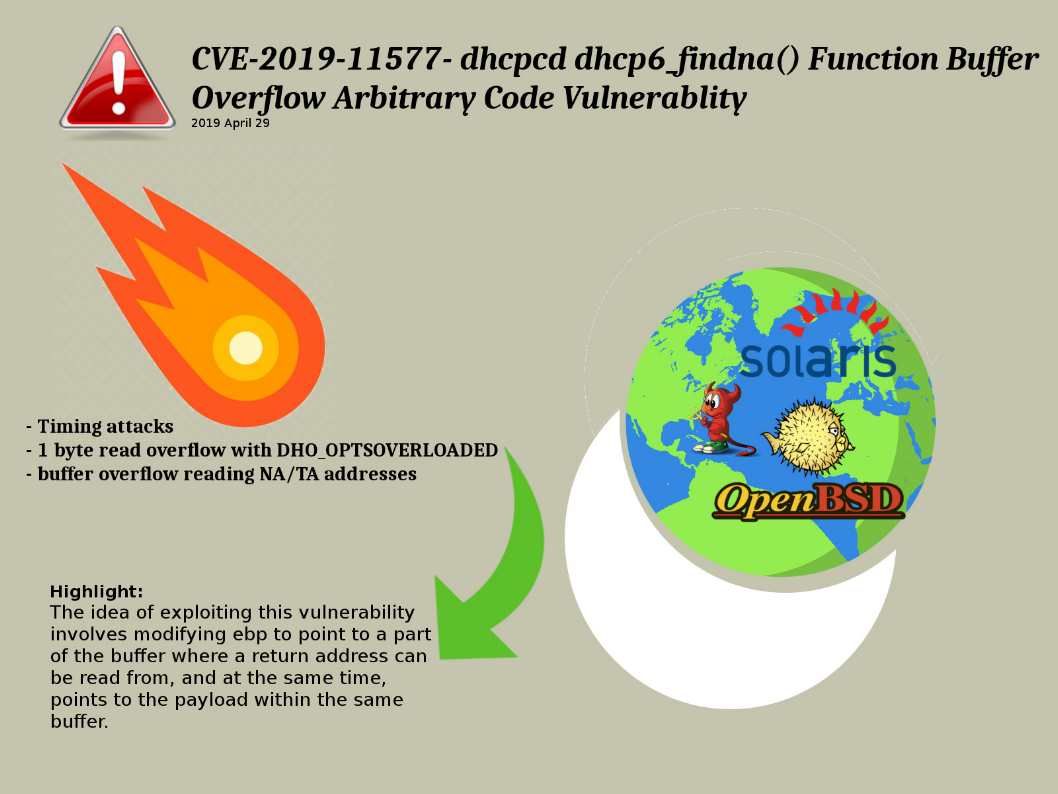
CVE-2019-11577 – dhcpcd up to 7.2.0 dhcp.c DHO_OPTSOVERLOADED memory corruption (29th Apr 2019)

Preface: IT world can’t without DHCP function! It looks like public vehicle in our daily life.

Background: dhcpcd is a DHCP and DHCPv6 client. It is currently the most feature-rich open source DHCP client.

Vulnerabilities Details:
One of the vulnerabilities exists because the dhcp6_findna() function (src / dhcp6.c source code file) does not correctly handle reading specific addresses.
The idea of exploiting this vulnerability involves modifying ebp to point to a part of the buffer where a return address can be read from, and at the same time, points to the payload within the same buffer. We so called 1-byte buffer overflows.R

Remedy:

DHCPv6 – https://roy.marples.name/git/dhcpcd.git/commit/?id=8d11b33f6c60e2db257130fa383ba76b6018bcf6
DHCP – https://roy.marples.name/projects/dhcpcd

A Vulnerability in Oracle WebLogic Could Allow for Remote Code Execution – 26th April 2019

Preface: On April 17, 2019, the National Information Security Vulnerability Sharing Platform (CNVD) recorded the Oracle WebLogic wls9-async deserialization remote command execution vulnerability reported by China Minsheng Banking Co., Ltd.

Synopsis: There are reports of this vulnerability being actively exploited in the wild in April 2019.

Vulnerability details:
CVE-2019-2725 – A vulnerability has been discovered in the Oracle WebLogic components (WLS9_ASYNC and WLS-WSAT) that could allow for remote code execution. But this vulnerability seems not a zero-day. The similar vulnerability has been found in 2017.
Perhaps attached diagram can provides hints to you.

Non official remedy:
Option 1: Find and delete ws9_ async_response.war, wIs-wsat.war and restart the Weblogic service.

Option 2: Control access to URLs for /_async/* and /wls-wsat/* (note) paths through access policy control.

Official announcement: https://www.oracle.com/technetwork/security-advisory/alert-cve-2019-2725-5466295.html

PHP Vulnerability Alert – 25th Apr 2019

Preface: Error handling in PHP is still primitive. However you can code your way around most problems.

Synopsis: From technical point of view, a JPEG file with malicious EXIF data, and a PHP code that executes it. This PHP code can be easily inserted into any other PHP file found in the server, probably not noticed as malicious in a quick check.

Vulnerability details:
PHP EXIF exif_iif_add_tag Heap Buffer Overflow Vulnerability – A successful exploit could allow the attacker to access sensitive information, which could be used to conduct additional attacks.
PHP EXIF exif_process_IFD_in_MAKERNOTE Heap Buffer Overflow Vulnerability – A successful exploit could allow the attacker to access sensitive information, which could be used to conduct further attacks.

Remedy: PHP Project has released software updates, please refer url: https://php.net/downloads.php

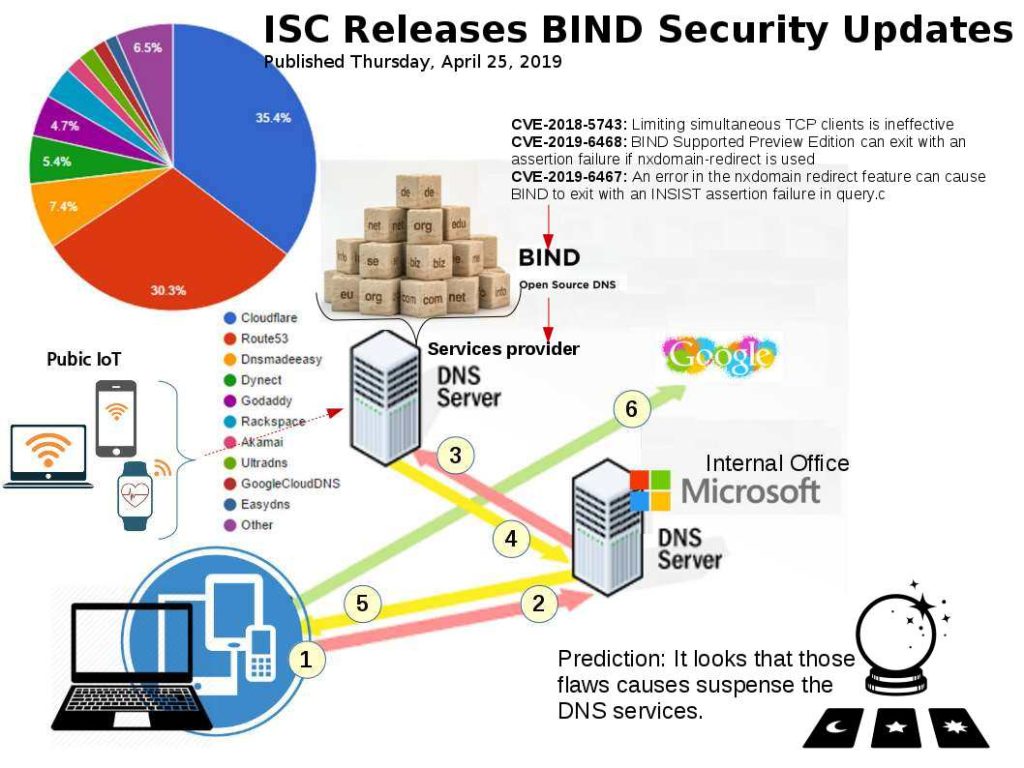
ISC Releases BIND Security Updates – 25th Apr 2019 (CVE-2019-6467,CVE-2019-6468 & CVE-2018-5743)

Preface: Operating system · Linux, NetBSD, FreeBSD, OpenBSD, macOS, Windows · Type · DNS server · License · Mozilla Public License (ISC license before 9.11). Website, www.isc.org/downloads/bind. BIND is the most widely used Domain Name System (DNS).

Alert: A design limitation of BIND let remote attacker could exploit these vulnerabilities to cause a denial-of-service condition. Official details shown as below:

CVE-2019-6467: https://kb.isc.org/docs/cve-2019-6467
CVE-2019-6468: https://kb.isc.org/docs/cve-2019-6468
CVE-2018-5743: https://kb.isc.org/docs/cve-2018-5743

Technical highlight: CVE-2018-5743 flaw impact the limiting simultaneous TCP clients is ineffective. It potentially lead to exhaustion of all available free file descriptors on that system. That is, when you open a file, the operating system creates an entry to represent that file and store the information about that opened file. So if there are 50 files opened in your OS then there will be 50 entries in OS (somewhere in kernel). So it may potential trigger additional unknown vulnerability.

Apr 2019 – A vulnerability in NTP could allow an unthenticated, remote attack to compromise a target system completely.

Preface: Kiss O’Death Packet and Other NTP Vulnerabilities potentially turn back the Internet’s Clocks and causes unpredictable problem.

NTP vulnerability – historical record: There was a loophole in 2013,, the attack relies on the exploitation of the ‘monlist’ feature of NTP, as described in CVE-2013-5211, which is enabled by default on older NTP-capable devices. This command causes a list of the last 600 IP addresses which connected to the NTP server to be sent to the victim.

CVE-2019-11331 vulnerability details: The vulnerability is due to improper use of UDP port 123 by the affected software. Threat actor can make a malicious packet input to the targeted system. A successful exploit could allow the attacker to conduct an off-path attack.

Remedy: NTP.org had not released a security advisory. Stay tuned.

Much of the Python ecosystem already uses urllib3 but no exception. It has vulnerability occurred! CVE-2019-11324 – 23rd Apr 2019.

Preface: An IT ecosystem is “the network of organizations that drives the creation and delivery of information technology products and services.

About urllib3: Much of the Python ecosystem already uses urllib. It brings additional features that are missing from the Python standard libraries. For instance – Client-side SSL/TLS verification, Helpers for retrying requests and dealing with HTTP redirects,……

Vulnerability details: A vulnerability in urllib3 could allow an unauthenticated, remote attacker to bypass security restrictions on a targeted system.

Findings: The vulnerability exists because the affected software mishandles CA certificates that are related to the use of the ssl_context, ca_certs, or ca_certs_dir parameters.

Remedy: Software updates at the following link: https://github.com/urllib3/urllib3/releases

CVE-2019-0228 Apache PDFBox XML Parser XML External Entity Vulnerability – 22nd Apr 2019

Preface: We are all familiar with the .doc and .pdf formats. Because this is our choice in the business world.

Synopsis: Apache PDFBox is an open source pure-Java library that can be used to create, render, print, split, merge, alter, verify and extract text and meta-data of PDF files.

Vulnerability details: A vulnerability in Apache PDFBox could allow an unauthenticated, remote attacker to conduct an XML External Entity (XXE) attack on a targeted system. Apache PDFBox 2.0.14 does not properly initialize the XML parser, which allows context-dependent attackers to conduct XML External Entity (XXE) attacks via a
crafted XFDF.

Remedy: Apache has released software updates at the following link: https://pdfbox.apache.org/download.cgi