Category Archives: Cell Phone (iPhone, Android, windows mobile)

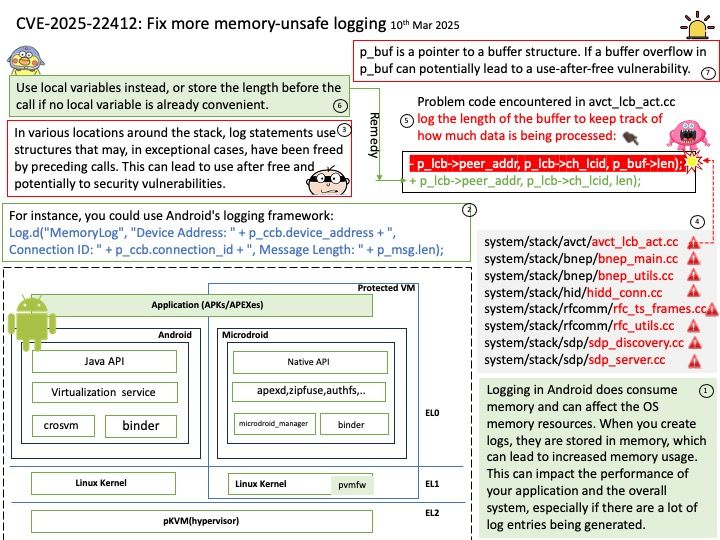
CVE-2025-22412: Fix more memory-unsafe logging (10th Mar 2025)

Preface: In smartphones, the System on Chip (SoC), such as those made by Qualcomm, integrates various components including the CPU, GPU, and memory. The embedded OS and applications run on this SoC, utilizing its built-in memory (RAM) for processing tasks.
The flash storage (often referred to as flashdisk) in smartphones is primarily used for storing persistent data like images, documents, apps, and the operating system itself. This storage is separate from the RAM used by the CPU and GPU for active processing
 
Background: Logging in Android does consume memory and can affect the OS memory resources. When you create logs, they are stored in memory, which can lead to increased memory usage. This can impact the performance of your application and the overall system, especially if there are a lot of log entries being generated.
 
Vulnerability details: In various locations around the stack, log statements use structures that may, in exceptional cases, have been freed by preceding calls.  This can lead to use after free and potentially to security vulnerabilities.
 
Ref: p_buf is a pointer to a buffer structure. If a buffer overflow in p_buf can potentially lead to a use-after-free vulnerability.
 
Official announcement: Please refer to the link for details – https://android.googlesource.com/platform/packages/modules/Bluetooth/+/806774b1cf641e0c0e7df8024e327febf23d7d7c
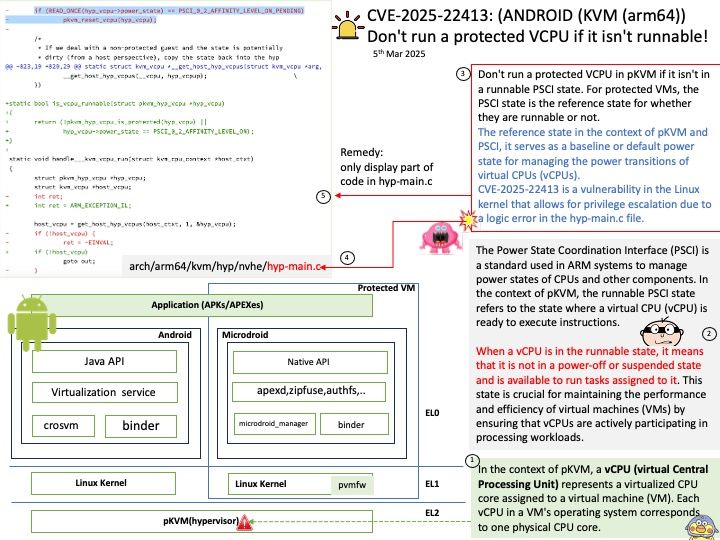
CVE-2025-22413: (ANDROID (KVM (arm64)) Don’t run a protected VCPU if it isn’t runnable! (5 March 2025)

Preface: The protected Kernel-based Virtual Machine (pKVM) is an advanced virtualization technology built on top of the Linux Kernel-based Virtual Machine (KVM). It is designed to enhance security and isolation for virtual machines (VMs) running on Android devices.

Key points about pKVM:

Enhanced Security: pKVM restricts access to the payloads running in guest VMs marked as ‘protected’ at the time of creation. This ensures that even if the host Android system is compromised, the guest VMs remain secure.

Isolation: It provides strong confidentiality and integrity guarantees by isolating memory and devices into individual protected VMs (pVMs).

Compatibility: pKVM is compatible with existing operating systems and workloads that rely on KVM-based virtual machines.

Background: In the context of pKVM, a vCPU (virtual Central Processing Unit) represents a virtualized CPU core assigned to a virtual machine (VM). Each vCPU in a VM’s operating system corresponds to one physical CPU core.

In pKVM, vCPUs are used to manage and allocate processing power to protected virtual machines (pVMs), ensuring that each VM has the necessary resources to operate securely and efficiently.

Vulnerability details: Don’t run a protected VCPU in pKVM if it isn’t in a runnable PSCI state. For protected VMs, the PSCI state is the reference state for whether they are runnable or not.

Official announcement: Please refer to the link for details – https://android.googlesource.com/kernel/common/+/1a3366f0d3d9b94a8c025d9863edc3b427435c4c

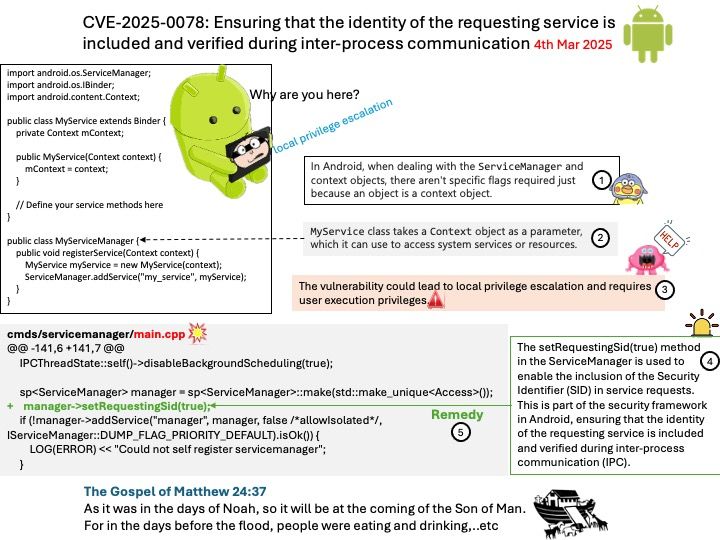
CVE-2025-0078: Ensuring that the identity of the requesting service is included and verified during inter-process communication (4th Mar 2025)

Preface: The Gospel of Matthew 24:37

As it was in the days of Noah, so it will be at the coming of the Son of Man. For in the days before the flood, people were eating and drinking,..etc

Background: In Android, the ServiceManager is a key component in the Binder IPC (Inter-Process Communication) mechanism. It manages system services and provides a way for clients to obtain references to these services.

Here’s a brief overview of how the ServiceManager operates:

  1. Initialization: The ServiceManager is started by the init process during the system boot. It is defined in the init.rc script, which specifies the service and its executable path.
  2. Service Registration: When a service wants to register with the ServiceManager, it calls the addService method. This method takes the service name and a reference to the service’s Binder interface.
  3. Service Lookup: Clients can query the ServiceManager to get a reference to a registered service using the getService method. This method returns the Binder interface of the requested service.
  4. Security and Permissions: Starting from Android 8.1, SELinux policies have become stricter. Services must be defined in the plat_service_contexts file to be allowed to register with the ServiceManager. This ensures that only authorized services can be registered and accessed..
  5. Communication: Once a service is registered, clients can communicate with it through Binder IPC. The ServiceManager acts as a mediator, ensuring that the communication is secure and efficient.

Vulnerability details: local privilege escalation

Bug fixes: The setRequestingSid(true) method in the ServiceManager is used to enable the inclusion of the Security Identifier (SID) in service requests. This is part of the security framework in Android, ensuring that the identity of the requesting service is included and verified during inter-process communication (IPC).

Official announcement: Please refer to the vendor announcement for details – https://android.googlesource.com/platform/frameworks/native/+/c32d4defe0f4e5cad86437d6672de7a76caf1a79

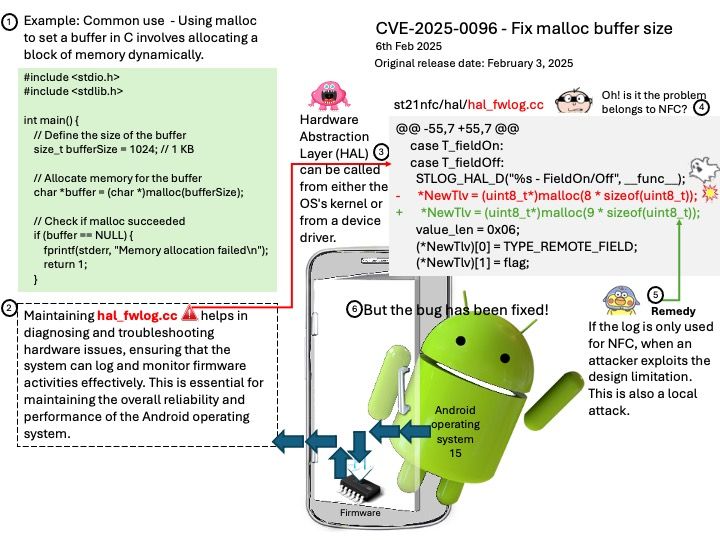
CVE-2025-0096 – Fix malloc buffer size (6th Feb 2025)

Original release date: February 3, 2025

Preface: The Hardware Abstraction Layer (HAL) is not outdated with Android 15. In fact, HAL continues to play a crucial role in the Android architecture. Android 15 includes improvements and updates to various HAL components, ensuring they remain relevant and effective for modern hardware and software requirements.

Background: Android 15 continues to use hal_fwlog[.]cc because it remains a crucial component for logging firmware-related events and activities within the Hardware Abstraction Layer (HAL). The HAL provides a standardized interface for hardware vendors, allowing the Android operating system to communicate with hardware components without needing to know the specifics of the hardware. This ensures compatibility and stability across various devices and hardware configurations.

Maintaining hal_fwlog[.]cc helps in diagnosing and troubleshooting hardware issues, ensuring that the system can log and monitor firmware activities effectively. This is essential for maintaining the overall reliability and performance of the Android operating system.

Vulnerability details: Fix malloc buffer size in hal_fwlog[.]cc

The hal_fwlog[.]cc file in Android is part of the Hardware Abstraction Layer (HAL). This file is typically used for logging firmware-related events and activities. The HAL provides a standard interface for hardware vendors to implement, allowing the Android operating system to communicate with hardware components without needing to know the specifics of the hardware.

Official announcement: Please refer to the link for details – https://source.android.com/docs/security/bulletin/2025-02-01

CVE-2025-0098 : Prevent activity token leaked to another process (3rd Feb 2025)

Preface: Android frameworks deliver an environment where you already have access to libraries, best practices, and extensive help documentation. As a matter of fact, there are well over ten android frameworks.

Background: TaskFragmentOrganizerController[.]java is a part of the Android Open Source Project (AOSP). It is located in the services/core/java/com/android/server/wm directory of the Android framework. This file is responsible for managing the organization and lifecycle of task fragments within the Android window management system.

The TaskFragmentOrganizerController works closely with the TaskFragmentOrganizer class, which provides an interface for controlling task fragments. These task fragments allow for more flexible and dynamic UI layouts by enabling parts of an activity to be managed independently.

In the context of TaskFragmentOrganizerController[.]java, a token typically refers to an identifier used to manage and track task fragments within the Android window management system. These tokens are often used to ensure that operations on task fragments are performed securely and correctly.

For example, a temporary token might be generated to allow an organizer to reparent an activity through a WindowContainerTransaction. This helps maintain the integrity and security of the task fragments being managed.

Remark: WindowContainerTransaction represents a collection of operations on some WindowContainer that should be applied at once.

Vulnerability details: Malicious app could register the organizer via one-way binder call to disguise as running on pid 0.

Official announcement: Please refer to the link for details – https://source.android.com/docs/security/bulletin/2025-02-01

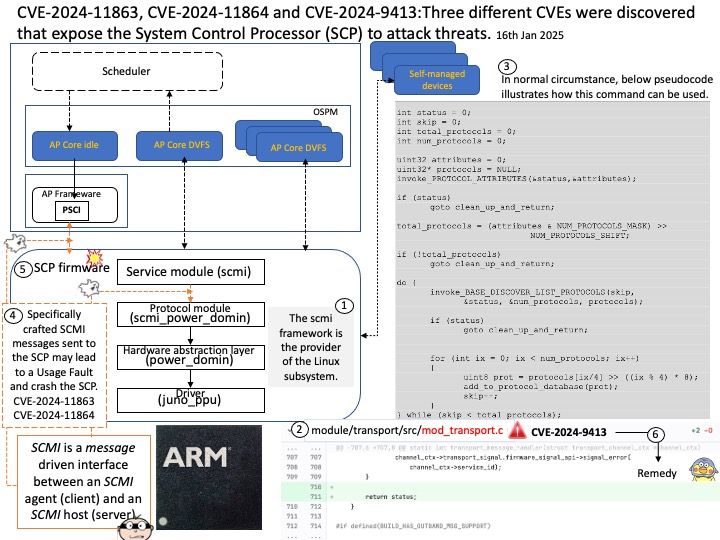
CVE-2024-11863, CVE-2024-11864 and CVE-2024-9413: Three different CVEs were discovered that expose the System Control Processor (SCP) to attack threats. (16th Jan 2025)

Preface: SCMI is a message driven interface between an SCMI agent (client) and an SCMI host (server)

Background: SCP Firmware provides a software reference implementation for the System Control Processor (SCP) and Manageability Control Processor (MCP) components found in several Arm Compute Sub-Systems. Power Control System Architecture (PCSA) defines the concept of a System Control Processor (SCP), a specialized processor that abstracts power and system management tasks from the application processor.

A small area of SRAM is reserved for SCMI communication between application processors and SCP. Entity that sends commands to the platform using SCMI. For example, the OSPM running on an AP or an on-chip management controller.

Vulnerability details:

CVE-2024-9413 – The transport_message_handler function in SCP-Firmware release versions 2.11.0-2.15.0 does not properly handle errors, potentially allowing an Application Processor (AP) to cause a buffer overflow in System Control Processor (SCP) firmware.

CVE-2024-11863 and CVE-2024-11864 – Specifically crafted SCMI messages sent to an SCP running SCP-Firmware release versions up to and including 2.15.0 may lead to a Usage Fault and crash the SCP

Official announcement: For detail, please refer to link –

https://developer.arm.com/Arm%20Security%20Center/SCP-Firmware%20Vulnerability%20CVE-2024-11863-11864

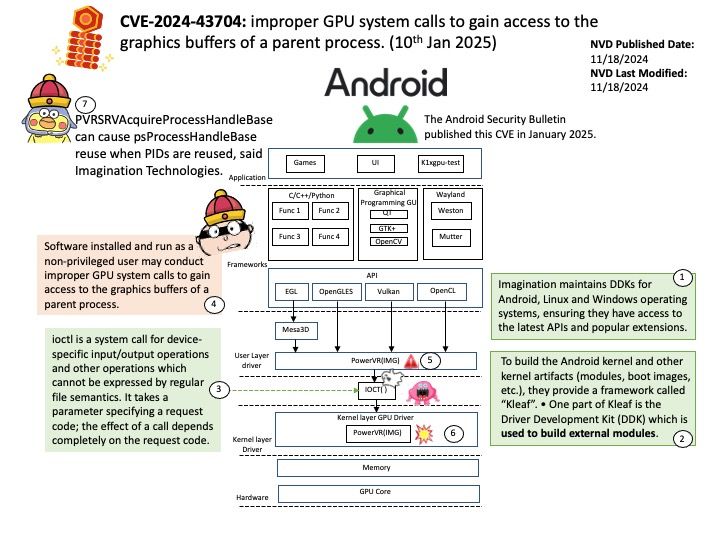
CVE-2024-43704: improper GPU system calls to gain access to the graphics buffers of a parent process. (10th Jan 2025)

Preface: PowerVR is a division of Imagination Technologies (formerly VideoLogic) that develops hardware and software for 2D and 3D rendering, and for video encoding, decoding, associated image processing and DirectX, OpenGL ES, OpenVG, and OpenCL acceleration. 

Background: Imagination maintains DDKs for Android, Linux and Windows operating systems, ensuring they have access to the latest APIs and popular extensions.

To build the Android kernel and other kernel artifacts (modules, boot images, etc.), they provide a framework called “Kleaf”. • One part of Kleaf is the Driver Development Kit (DDK) which is used to build external modules.

Vulnerability details: Software installed and run as a non-privileged user may conduct improper GPU system calls to gain access to the graphics buffers of a parent process.

PVRSRVAcquireProcessHandleBase can cause psProcessHandleBase reuse when PIDs are reused, said imagination Technologies.

Official announcement: Please refer to the link for details –

https://source.android.com/docs/security/bulletin/2025-01-01

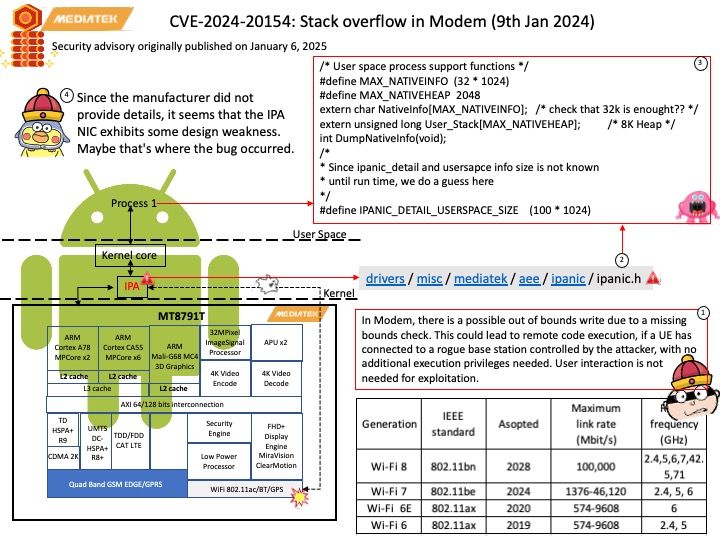
CVE-2024-20154: Stack overflow in Modem (9th Jan 2024)

Preface: Vulnerability findings appear to have changed compared to five years ago. As a matter of fact, the trend of open source concept driven the a lot of details visible,   a bunch of vulnerabilities have accumulated in 2024, and the Android security advisory on January 2025 shows you what’s the actual status.

Manufacturers will have an easier time managing vulnerabilities because the patches released today were discovered by them months or a year ago.

Background: Chipsets affected by this vulnerability: MT2735, MT6767, MT6768, MT6769, MT6769K, MT6769S, MT6769T, MT6769Z, MT6779, MT6781, MT6783, MT6785, MT6785T, MT6785U, MT6789, MT6833P, MT6853, MT6853T, MT6855, MT6855T, MT6873, MT6875, MT6875T, MT6877, MT6877T, MT6877TT, MT6880, MT6880T, MT6880U, MT6883, MT6885, MT6889, MT6890, MT6891, MT6893, MT8666, MT8673, MT8675, MT8765, MT8766, MT8768, MT8771, MT8781, MT8786, MT8788, MT8788E, MT8789, MT8791T, MT8795T, MT8797, MT8798

An example: The MediaTek MT8791T integrates Bluetooth, FM, WLAN, and GPS modules and is a highly integrated baseband platform that includes a modem and application processing subsystem to support LTE/5G/NR and C2K tablet applications. The chip integrates two Arm®Cortex-A78 cores running at up to 2.6 GHz, six Arm®Cortex-A55 cores running at up to 2.0 GHz, and a powerful multi-standard video codec. In addition, an extensive set of interfaces and connectivity peripherals for connecting cameras, touchscreen displays, and UFS/MMC/SD cards are included.

Vulnerability details: In Modem, there is a possible out of bounds write due to a missing bounds check. This could lead to remote code execution, if a UE has connected to a rogue base station controlled by the attacker, with no additional execution privileges needed. User interaction is not needed for exploitation.

Official announcement: Please refer to the link below for details –

https://corp.mediatek.com/product-security-bulletin/January-2025

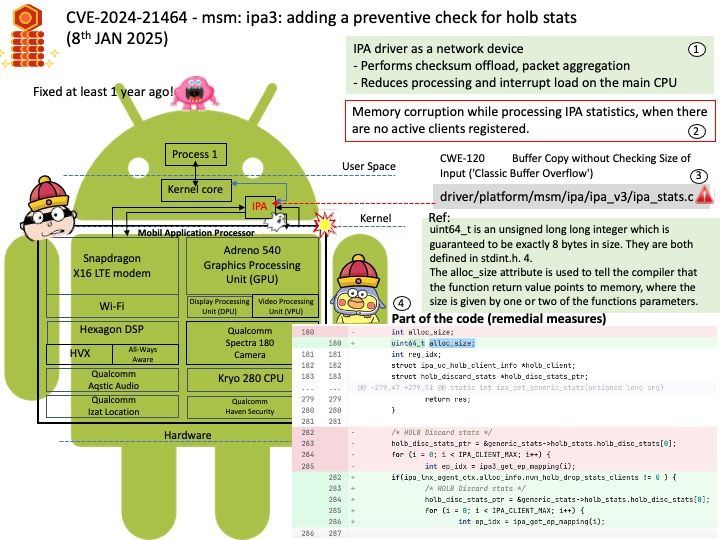
CVE-2024-21464 – msm: ipa3: adding a preventive check for holb stats (8th JAN 2025)

Preface: Vulnerability findings appear to have changed compared to five years ago. As a matter of fact, the trend of open source concept driven the a lot of details visible,   a bunch of vulnerabilities have accumulated in 2024, and the Android security advisory on January 2025 shows you what’s the actual status.

Manufacturers will have an easier time managing vulnerabilities because the patches released today were discovered by them months or a year ago.

Background: IPA Capabilities

● Presented by its driver as a network device

● Performs checksum offload, packet aggregation

○ Reduces processing and interrupt load on the main CPU

● Also implements integrated IPA filtering, routing, and NAT

○ These features are not supported by the upstream driver (yet!)

● Capable of operation independent while AP is asleep

○ Tethered operation (WiFi hotspot)

○ Requires much less power than operating AP

○ This mode is not supported upstream either

Vulnerability details: Memory corruption while processing IPA statistics, when there are no active clients registered.

[CWE-120 Buffer Copy without Checking Size of Input (‘Classic Buffer Overflow’)]

In a classic buffer overflow exploit, the attacker sends data to a program, which it stores in an undersized stack buffer. The result is that information on the call stack is overwritten, including the function’s return pointer

Official announcement: Please refer to the link below for details –

https://source.android.com/docs/security/bulletin/2025-01-01

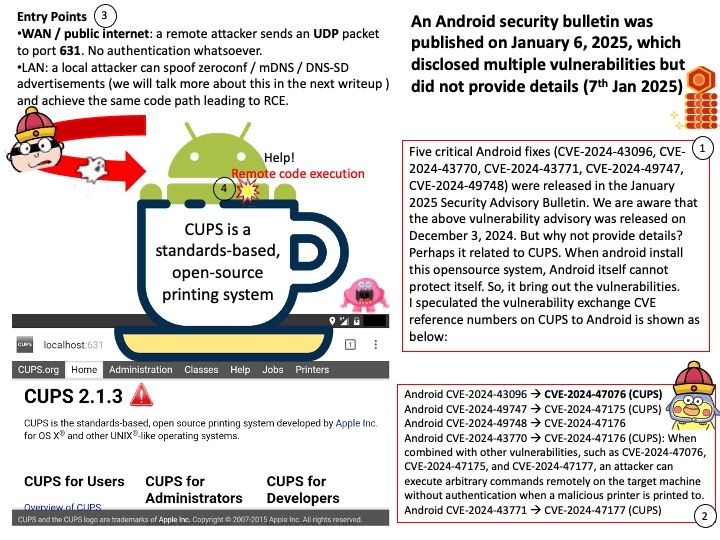
An Android security bulletin was published on January 6, 2025, which disclosed multiple vulnerabilities but did not provide details (7th Jan 2025)

Preface: Vulnerability findings appear to have changed compared to five years ago. As a matter of fact, the trend of open source concept driven the a lot of details visible,   a bunch of vulnerabilities have accumulated in 2024, and the Android security advisory on January 2025 shows you what’s the actual status.

Manufacturers will have an easier time managing vulnerabilities because the patches released today were discovered by them months or a year ago.

Background: CUPS provides the “cups” library to talk to the different parts of CUPS and with Internet Printing Protocol (IPP) printers. The “cups” library functions are accessed by including the <cups/cups.h> header. CUPS is based on the Internet Printing Protocol (“IPP”), which allows clients (applications) to communicate with a server (the scheduler, printers, etc.) to get a list of destinations, send print jobs, and so forth. You identify which server you want to communicate with using a pointer to the opaque structure http_t. The CUPS_HTTP_DEFAULT constant can be used when you want to talk to the CUPS scheduler.

Vulnerability details: Five critical Android fixes (CVE-2024-43096, CVE-2024-43770, CVE-2024-43771, CVE-2024-49747, CVE-2024-49748) were released in the January 2025 Security Advisory Bulletin. We are aware that the above vulnerability advisory was released on December 3, 2024. But why not provide details?

Perhaps it related to CUPS. When android install this opensource system, Android itself cannot protect itself.So, it bring out the vulnerabilities.

I speculated the vulnerability exchange CVE reference numbers on CUPS to Android is shown as below:

Android CVE-2024-43096 – CVE-2024-47076 (CUPS)

Android CVE-2024-49747 – CVE-2024-47175 (CUPS)

Android CVE-2024-49748 – CVE-2024-47176

Android CVE-2024-43770 – CVE-2024-47176 (CUPS): When combined with other vulnerabilities, such as CVE-2024-47076, CVE-2024-47175, and CVE-2024-47177, an attacker can execute arbitrary commands remotely on the target machine without authentication when a malicious printer is printed to.

Android CVE-2024-43771 – CVE-2024-47177 (CUPS)

Official announcement: Please refer to the link below for details –

https://source.android.com/docs/security/bulletin/2025-01-01