All posts by admin

AI network congestion resembles ischemic stroke in humans (21-4-2025)

Preface: In ischemic stroke, every second counts. If TPA thrombolytic agent is used promptly in ischemic stroke, it can dissolve blood clots and reduce brain cell necrosis. But it must be used within three hours, so it is very important to grasp the golden three hours.

HPC systems do indeed function as a collective unit, similar to a single brain, network congestion remains a significant concern due to several technical reasons.  For instance: High Data Transfer Rates, Complex Communication Patterns, Shared Resources and Latency Sensitivity.

Background: HPC systems do indeed function as a collective unit, similar to a single brain, network congestion remains a significant concern due to several technical reasons:

-High Data Transfer Rates: HPC systems often involve massive data transfers between nodes. When multiple nodes simultaneously send and receive large amounts of data, it can overwhelm the network, leading to congestion.

-Complex Communication Patterns: HPC workloads typically involve complex communication patterns, such as all-to-all communication, which can create bottlenecks. Even if the network is designed to handle high traffic, certain patterns can still cause congestion2.

-Shared Resources: HPC systems share network resources among many nodes. When demand for these resources exceeds capacity, it results in congestion. This can delay data transfer and impact overall system performance.

-Latency Sensitivity: Many HPC applications are sensitive to latency. Network congestion increases latency, which can significantly affect the performance of time-critical applications.

-Scalability Challenges: As HPC systems scale up, the complexity and volume of data traffic increase. Ensuring efficient communication across thousands or even millions of nodes becomes challenging, and congestion can arise if the network infrastructure isn’t robust enough.

Solution: Addressing network congestion involves implementing advanced technologies like adaptive routing, congestion control mechanisms, and scalable interconnects.

CVE-2025-3619: Heap buffer overflow in Codecs in Google Chrome on Windows (17-04-2025)

Preface: OpenH264 is a free software library for real-time encoding and decoding video streams in the H. 264/MPEG-4 AVC format.

Background: The Best Video Formats for Uploading to Google Drive. You can upload and preview several video types in Google Drive, such as MP4, WMV, FLV, AVI, H. 264, MPEG4, VP8, to mention a few.

Ref: OpenH264 is a free license codec library which supports H.264 encoding and decoding. A vulnerability in the decoding functions of OpenH264 codec library could allow a remote, unauthenticated attacker to trigger a heap overflow. This vulnerability is due to a race condition between a Sequence Parameter Set (SPS) memory allocation and a subsequent non Instantaneous Decoder Refresh (non-IDR) Network Abstraction Layer (NAL) unit memory usage.

Vulnerability details: Heap buffer overflow in Codecs in Google Chrome on Windows prior to 135.0.7049.95 allowed a remote attacker to potentially exploit heap corruption via a crafted HTML page. (Chromium security severity: Critical)

Official announcement: Please refer to the link for details – https://nvd.nist.gov/vuln/detail/CVE-2025-3619

CVE-2024-45551: Weak Authentication in HLOS (16-04-2025)

NVD Published Date: 04/07/2025

NVD Last Modified: 04/07/2025

Preface: Released on September 3, 2024 as Android 15. Android 16, Internal codename as Baklava, released on 2nd April 2025.

Background: The core of the Android OS operating system is the Android Open Source Project (AOSP), which is free open source software (FOSS) licensed primarily under the Apache License. However, most devices run a proprietary version of Android developed by Google, which comes pre-installed with additional proprietary, closed-source software, most popular Google Mobile Services (GMS), which includes core applications such as Google Chrome, the digital distribution platform Google Play, and the related Google Play Services development platform.

Qualcomm Android source code is divided into development source code and proprietary source code. Proprietary source code is further divided into proprietary non-HLOS software and proprietary HLOS software. HLOS is the High-level Operating System, and non-HLOS software refers to software below the HLOS layer.

Vulnerability details: Cryptographic issue occurs during PIN/password verification using Gatekeeper, where RPMB writes can be dropped on verification failure, potentially leading to a user throttling bypass.

Official announcement: Please see the link for details –

https://nvd.nist.gov/vuln/detail/CVE-2024-45551

CVE-2024-10929: Staying alert! Spectre-BSE exploits affects ARM® Cortex®-A72 (revisions prior to r1p0), Cortex-A73 and Cortex-A75. (15-04-2025)

Preface: The Cortex-A75 is still being used by manufacturers today. For instance, UNISOC and MediaTek continue to incorporate Cortex-A75 cores in their chipsets.

These processors are found in various mid-range and entry-level devices, providing a balance of performance and efficiency.

Background: Branch Status Eviction (BSE) is a vulnerability related to the Spectre class of security issues. It exploits a microarchitectural mechanism that allows an attacker to gain a weak form of control over the victim’s branch history, despite existing protections. This can lead to the manipulation of indirect branches and potentially result in data exfiltration.

Vulnerability details: According to the ARM® security team, Spectre-BSE exploits a micro-architectural mechanism that equips an adversary with a weak form of control over the victim’s branch history despite existing protections.

This can lead to exploitative control of indirect branches and potentially to data exfiltration. This issue affects ARM Cortex®-A72 (revisions prior to r1p0), Cortex-A73 and Cortex-A75.

Official announcement: Please see the link for details – https://www.amd.com/en/resources/product-security/bulletin/amd-sb-8007.html

About the mysterious mask of CVE-2025-22429 (14-4-2025)

Preface: The reason why an unparcel error involving Parcel and BaseBundle is considered a critical Common Vulnerabilities and Exposures (CVE) is due to the potential security risks it poses. Specifically, such errors can lead to: Data Corruption, Security Vulnerabilities and Denial of Service (DoS).

Background: BaseBundle[.]java in Android is a class that provides a mapping from String keys to values of various types. It serves as a base class for Bundle and PersistableBundle, which are more commonly used in Android development. Here are some key functions of BaseBundle:

  • Storing and retrieving data: It allows you to store various types of data (like int, boolean, String, etc.) and retrieve them using specific keys.
  • Clearing data: You can remove all elements from the mapping using the clear() method.
  • Checking for keys: The containsKey(String key) method lets you check if a particular key exists in the mapping.

In most cases, developers work directly with Bundle or PersistableBundle, which extend BaseBundle and provide additional functionalities.

Vulnerability: An unparcel error in Android, often caused by issues with Parcel and BaseBundle, can lead to several consequences.

Ref: If an attacker can manipulate the data being parceled, they might exploit the unparceling process to execute arbitrary code or gain unauthorized access to sensitive information.

Official announcement: Please refer to the link for details –https://android.googlesource.com/platform/frameworks/base/+/ece83fb425b1e912a036e9985b710910e2e3ca37

CVE-2025-21443: Memory corruption while processing message content in eAVB. (13th Apr 2025)

Preface: The Snapdragon SA8540P SoC and SA9000P AI accelerator are designed to work together seamlessly, particularly in advanced driver-assistance systems (ADAS) like GM’s Ultra Cruise. The buffer sharing design between these components is crucial for efficient data processing and low-latency performance. In automotive Ethernet Audio Video Bridging (eAVB), processors handle various types of message content to ensure efficient and reliable communication within the vehicle’s network.

Background: In Automotive Ethernet Audio Video Bridging (eAVB), processors handle the content of various types of messages to ensure efficient and reliable communication within the vehicle network.

Synchronization: eAVB ensures that audio and video streams are synchronized across different devices in the vehicle, providing a seamless infotainment experience.

Low Latency: Messages are designed to be transmitted with minimal delay, which is crucial for real-time applications like advanced driver-assistance systems (ADAS) and infotainment

Fault Tolerance: The system is built to handle faults and ensure continuous operation even in the presence of network issues

High Bandwidth: eAVB supports high-speed data transmission, which is necessary for handling large amounts of audio and video data

Vulnerability details: in Automotive Vehicle Networks. Memory corruption while processing message content in eAVB. Found that Buffer Copy Without Checking Size of Input (‘Classic Buffer Overflow’).

Official announcement: Please refer to the link for details – https://nvd.nist.gov/vuln/detail/CVE-2025-21443

CVE-2025-21425: Memory corruption may occur due to improper access control in HAB process. (10th Apr 2025)

Announcement on January 6, 2022: GM and Qualcomm showcase collaboration at CES that brings first dedicated Snapdragon system-on-chips to GM’s upcoming advanced driver assistance system for fast, robust data processing.

Preface: When the Snapdragon SA8540P SoC and SA9000P AI accelerator work together, they typically use a coordinated boot process. Each component has its own firmware, but they are designed to work seamlessly together within the system.

Background: The High Assurance Boot (HAB) process is indeed located within the embedded OS environment, specifically in the normal world. It is designed to ensure that only authenticated and trusted software images are executed on the device, providing a secure boot mechanism.

Here’s a brief overview of how HAB works:

  1. Digital Signatures: HAB uses digital signatures to authenticate the initial software image. This involves creating a unique identifier (certificate) for the image using asymmetric encryption. The private key is used to encrypt the image, while the public key is attached to it.
  2. Authentication: During boot, the boot ROM uses the public key to decrypt the certificate and verify the image. If the certificate matches the image, it is considered trusted and allowed to run. Otherwise, it is rejected.
  3. Chain of Trust: HAB establishes a chain of trust for subsequent software components, such as the kernel image, ensuring that the entire system remains secure.

Vulnerability details: Improper Access Control in Automotive Linux OS. Memory corruption may occur due top improper access control in HAB process.

Technology Area – Automotive Linux OS

Vulnerability Type – CWE-284 Improper Access Control

Official announcement: Please refer to the link for details –

https://nvd.nist.gov/vuln/detail/CVE-2025-21425

About: CVE-2024-0179 – SMM Callout vulnerability and CVE-2024-21925 – Improper input validation (9th April 2025)

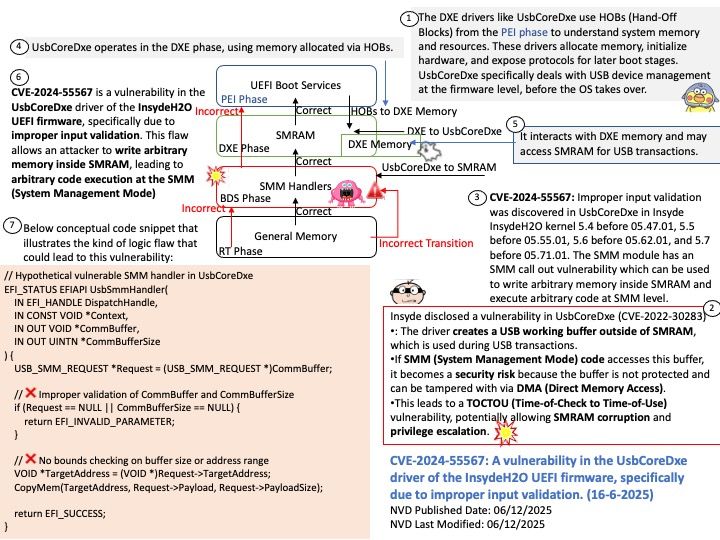
Preface: An SMM Callout is a type of vulnerability found in System Management Mode (SMM) code. This occurs when SMM code calls a function located outside of the System Management RAM (SMRAM) boundaries. The most common scenario is when an SMI (System Management Interrupt) handler tries to invoke a UEFI boot service or runtime service as part of its operation.

This vulnerability can be exploited by attackers with OS-level privileges to modify the physical pages where these services reside, potentially hijacking the privileged execution flow.

Background: STM stands for SMI Transfer Monitor. It is a security mechanism used within the System Management Mode (SMM) of a computer’s firmware. Below are some key points about STM:

Purpose: STM is designed to monitor and control the behavior of SMM code, providing a layer of security by mediating the actions of SMM drivers.

Functionality: It acts as a hypervisor within SMM, functioning alongside the main hypervisor or operating system. STM hosts the SMI (System Management Interrupt) handler in a virtual machine, thereby restricting its access to the platform.

Security: By constraining the SMI handler, STM helps prevent potential security breaches that could undermine the integrity of the system.

Vulnerability details: CVE-2024-21925 is the result of a lack of sufficient input buffer(s) validation within the AmdPspP2CmboxV2 UEFI module. CVE-2024-0179 is an SMM (System Management Mode) Callout vulnerability within the AmdCpmDisplayFeatureSMM UEFI module. Both can allow ring-0 attackers to escalate their privileges, potentially resulting in arbitrary code execution. AMD has begun releasing firmware mitigations to fix these vulnerabilities.  

Official announcement: Please refer to the link for details – https://www.amd.com/en/resources/product-security/bulletin/amd-sb-7027.html

CVE-2025-0050: Arm Mali GPU Userspace Driver could allow an Out-of-Bounds access (8th April 2025)

Preface:

A Use-After-Free (UAF) vulnerability occurs when a program continues to access memory after it has been freed. This can lead to unpredictable behavior, crashes, or even allow an attacker to execute arbitrary code. For example, if a program frees a block of memory but later tries to read or write to that memory, it can cause serious issues.

An Out-of-Bounds vulnerability happens when a program reads or writes data outside the boundaries of allocated memory. This can corrupt data, crash the program, or be exploited by attackers to execute arbitrary code. For instance, if an array has a size of 10 elements and the program tries to access the 11th element, it results in an out-of-bounds access.

Background:

GLES stands for OpenGL for Embedded Systems. It’s a subset of the OpenGL API designed for embedded devices like smartphones, tablets, and other portable devices. GLES is widely used in mobile games and applications because it provides a balance between performance and power consumption.

VK refers to Vulkan, a newer graphics API that provides high-efficiency, cross-platform access to modern GPUs. Vulkan offers more control over the GPU and lower overhead compared to OpenGL, making it suitable for high-performance applications like AAA games and real-time simulations.

Vulnerability details: Improper Restriction of Operations within the Bounds of a Memory Buffer vulnerability in Arm Ltd Bifrost GPU Userspace Driver, Arm Ltd Valhall GPU Userspace Driver, Arm Ltd Arm 5th Gen GPU Architecture Userspace Driver allows a non-privileged user process to make valid GPU processing operations, including via WebGL or WebGPU, to access a limited amount outside of buffer bounds.This issue affects Bifrost GPU Userspace Driver: from r0p0 through r49p2, from r50p0 through r51p0; Valhall GPU Userspace Driver: from r19p0 through r49p2, from r50p0 through r53p0; Arm 5th Gen GPU Architecture Userspace Driver: from r41p0 through r49p2, from r50p0 through r53p0.

Official announcement: Please refer to the link for details – https://nvd.nist.gov/vuln/detail/CVE-2025-0050

Another coincidental design flaw could have caused this vulnerability – Use after free in ANGLE in Google Chrome prior to 123.0.6312.86 allowed a remote attacker to potentially exploit heap corruption via a crafted HTML page.

https://nvd.nist.gov/vuln/detail/cve-2024-2883

System Management Mode (SMM) does not follow best practices. The impact extends beyond the desktop to HPC as well! (7th Apr 2025)

Preface: In the realm of High Performance Computing (HPC), processors that use the x86 architecture typically support System Management Mode (SMM). This includes:

-Intel Xeon Processors: Widely used in HPC systems, Intel Xeon processors support SMM for managing system-wide tasks such as power management and hardware control.

-AMD EPYC Processors: AMD EPYC processors, including the latest generations, also support SMM. These processors are known for their high core counts and robust performance in HPC environments.

Both Intel and AMD continue to leverage SMM in their x86-based processors to ensure efficient and secure system management.

Background: SMM operates transparently to the operating system and applications, allowing it to perform these tasks without interfering with the normal operation of the system.

Under HPC architecture, a cluster of computers essentially operates as a single entity, called a node, that can accept tasks and computations as a collective.

The isolation is particularly beneficial in HPC environments where uninterrupted performance is crucial.

Technical  details: System Management Mode (SMM) uses System Management RAM (SMRAM) to store and manage tasks. SMM is triggered through a System Management Interrupt (SMI), a signal sent from the chipset to the CPU. During platform initialization, the firmware configures the chipset to cause a System Management Interrupt for various events that the firmware developer would like the firmware to be made aware of.

  1. SwSmiHandler: This is the function that will handle the SMI.
  2. RegisterSmiHandler: This function registers the SMI handler with the SMM SW Dispatch protocol.
  3. UefiMain: This is the entry point of the UEFI application, which calls the registration function.

The key steps are locating the SMM SW Dispatch protocol, setting up the context for the SMI handler, and registering the handler.

Reference: Design flaw in SMM published by AMD on Feb 2025. Please refer to the link for details – https://www.amd.com/en/resources/product-security/bulletin/amd-sb-4008.html