All posts by admin

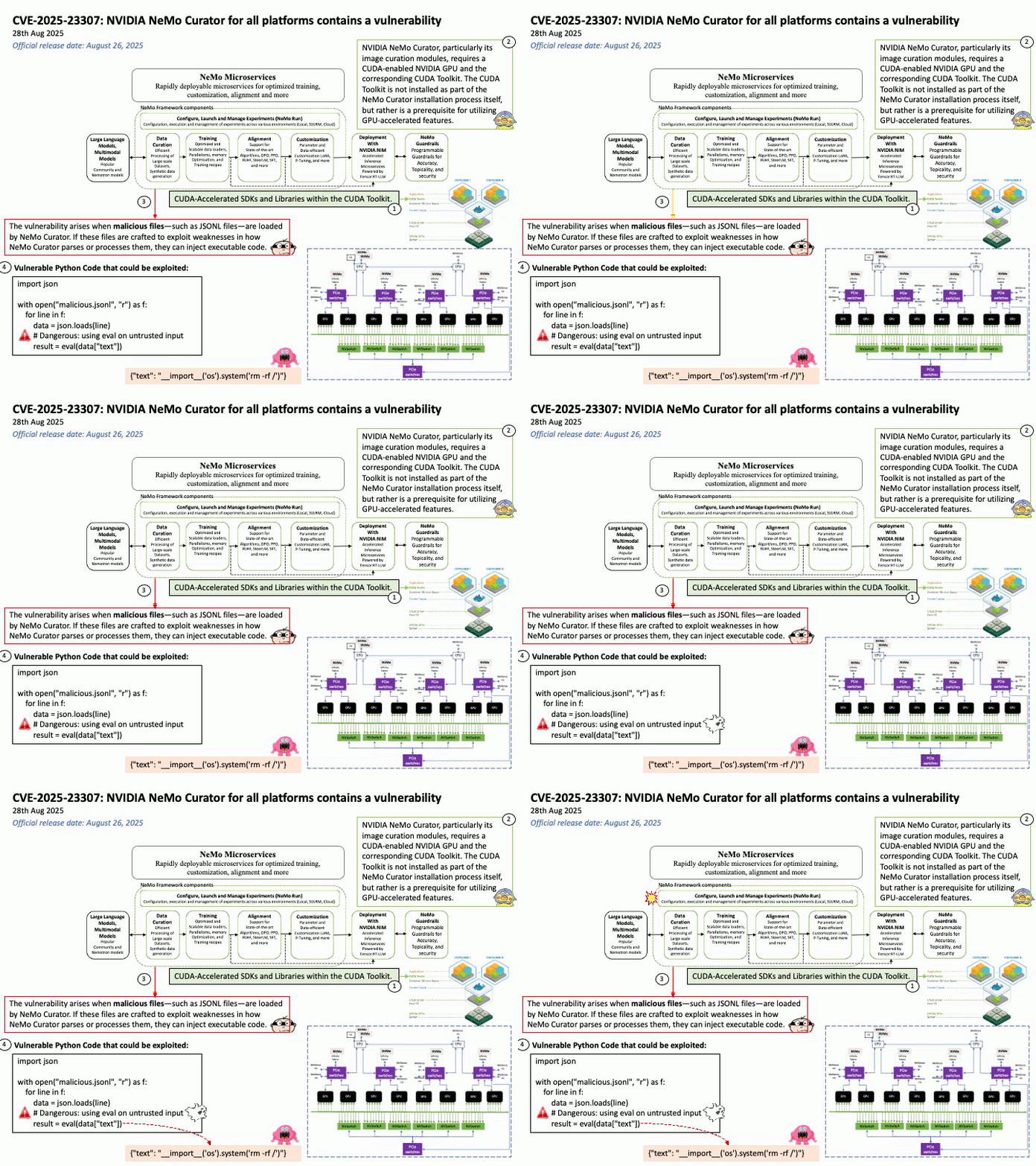
CVE-2025-52556: Insufficient verification of timestamp response signatures. Users should immediately upgrade to rfc3161-client 1.0.3 or later. (23-06-2025)

Preface: rfc3161-client version 1.0.3 is not designed to be installed on the server side. It’s a Python library, specifically a client-side tool, for interacting with RFC 3161 Time-Stamp Protocol (TSP) servers. It’s used to create timestamp requests and process timestamp responses, which is a client-side function of interacting with a time-stamping authority.

Background: The primary design objective of the Python Time-Stamp Protocol (TSP) library is to enable trusted timestamping of digital data. This means providing a secure and verifiable way to associate a specific point in time with electronic documents or signatures. The library allows users to request a timestamp token from a Time-Stamp Authority (TSA), which then attests to the existence of the data at that time.

The Time-Stamp Protocol (TSP), defined in RFC 3161, is a cryptographic protocol used for trusted timestamping of electronic data. It involves a Time-Stamp Authority (TSA) that provides a digitally signed timestamp, proving that a specific piece of data existed before a certain point in time. This is achieved by hashing the data, sending the hash to the TSA, and receiving a timestamp token containing the hash, a unique serial number, a timestamp, and the TSA’s digital signature.

Ref: TSR (Trust Store Repository) embedded certificates up to the trusted root(s) form the foundation of a chain of trust, allowing devices and systems to verify the authenticity and trustworthiness of other certificates. These embedded certificates, often root certificates, act as the ultimate authority, establishing a baseline for trust within the system.

Vulnerability details: rfc3161-client is a Python library implementing the Time-Stamp Protocol (TSP) described in RFC 3161. Prior to version 1.0.3, there is a flaw in the timestamp response signature verification logic. In particular, chain verification is performed against the TSR’s embedded certificates up to the trusted root(s), but fails to verify the TSR’s own signature against the timestamping leaf certificates. Consequently, vulnerable versions perform insufficient signature validation to properly consider a TSR verified, as the attacker can introduce any TSR signature so long as the embedded leaf chains up to some root TSA.

Official announcement: For details, please see the reference website – https://nvd.nist.gov/vuln/detail/CVE-2025-52556

When dreams come true (M78 Nebula) – 20-06-2025

Preface: When I was a kid watching Japanese science fiction TV series, the M78 Nebula is the location of the Kingdom of Light and the hometown of most Ultraman in the Kingdom of Light world. So believe that M78 Nebula was not real! At that time 70s, the internet technologies of today never been develop! The processor is 8087.

Background: The Orion Nebula, or Messier 42(NGC 1976), is a bright cloud of gas and dust in the Orion constellation, about 1,344 light-years from Earth. Orion Nebula is a diffuse nebula in the Milky Way situated south of Orion’s Belt in the constellation of Orion.

Messier 78 or M78, also known as NGC 2068, is a reflection nebula in the constellation Orion. It was discovered by Pierre Méchain in 1780 and included by Charles Messier in his catalog of comet-like objects that same year.

The distance between Messier 78 and Messier 42 is approximately 250 light-years. Messier 42, also known as the Orion Nebula, is about 1,344 light-years away. Messier 78 is approximately 1,600 light-years away.

SETI observations in M78: Till today, there are no confirmed signals from Messier 78 detected by SETI that are widely accepted as evidence of extra-terrestrial intelligence. While the “Wow! signal” is a famous example of a strong, unexplained signal detected by a SETI project, it was not from Messier 78, and its origin remains a mystery. Subsequent searches in the same direction as the Wow! signal have not yielded any further detections.

Ref: SETI, which stands for Search for Extra-terrestrial Intelligence, is a scientific area focused on searching for evidence of civilizations beyond Earth. It involves using telescopes and other instruments to detect potential signals from other star systems that might indicate intelligent life. The SETI Institute is a non-profit research organization dedicated to this quest.

Supplement: The Wow! signal was a strong, narrow-band radio signal detected by the Big Ear radio telescope during a SETI (Search for Extraterrestrial Intelligence) project on August 15, 1977. It was so named because of the exclamation “Wow!” written on the computer printout by astronomer Jerry Ehman when he discovered the anomaly. The signal appeared to come from the direction of the constellation Sagittarius and exhibited characteristics that suggested an extraterrestrial origin, though its source remains unknown.

Question: If I assume that extraterrestrial life is real, why do they would it avoid contact with humans?

Official article: Please refer to the URL for details – https://science.nasa.gov/mission/hubble/science/explore-the-night-sky/hubble-messier-catalog/messier-78/

Did Nikola Tesla encounter a solar flare in 124 years ago? (19-06-2025)

Preface: In 1901, engineer Nikola Tesla made the astonishing claim that he was receiving radio communications from Mars. His description was picked up and reported on broadly in the press.

Reference URL – http://www.antihackingonline.com/science/a-hundred-years-later-communication-was-ready-to-receive-phone-call-again/

Background: Solar flares are a regular part of the solar cycle, which lasts about 11 years on average. In 1901, a major solar event was observed that was not a large storm, but a “huge solar disturbance” with visible Sunspots, bright spots and distinctive coronal disturbances.

A coronal disturbance, often in the form of a coronal mass ejection (CME), is a significant eruption of plasma and magnetic field from the Sun’s outer atmosphere, or corona. These disturbances can propagate through space and, if directed towards Earth, can cause geomagnetic storms and other space weather phenomena.

Ref: Geomagnetic storms, disturbances in Earth’s magnetic field caused by solar activity, can impact our planet in various ways, primarily affecting technology and infrastructure. While not directly harmful to humans due to our planet’s protective magnetic field and atmosphere, they can disrupt communication systems, navigation, and power grids.

Do you think Nikola Tesla encountered a solar flare 124 years ago? Or was the radio communication sent from Mars?

There was a large solar flare in April 1901, specifically on April 21, which was associated with bright faculae. This event was noted by observers and is possibly linked to a short-lived sunspot group. However, the more commonly referenced “huge solar disturbance” from 1901 is related to Nova Persei 1901, a bright nova that appeared in February 1901 and reached its peak brightness in September. The bright patch of faculae in April was likely a separate event.

Do you want to know what the solar flares are like this week?

In June 2025, NASA’s PUNCH mission (Polarimeter to Unify the Corona and Heliosphere) captured detailed images of coronal mass ejections (CMEs) as they erupted from the Sun. Additionally, NASA’s Solar Dynamics Observatory (SDO) observed a strong solar flare on June 17, 2025.

Official announcement: Please see the link for details – https://science.nasa.gov/blogs/solar-cycle-25/2025/06/17/sun-releases-strong-flare-8/
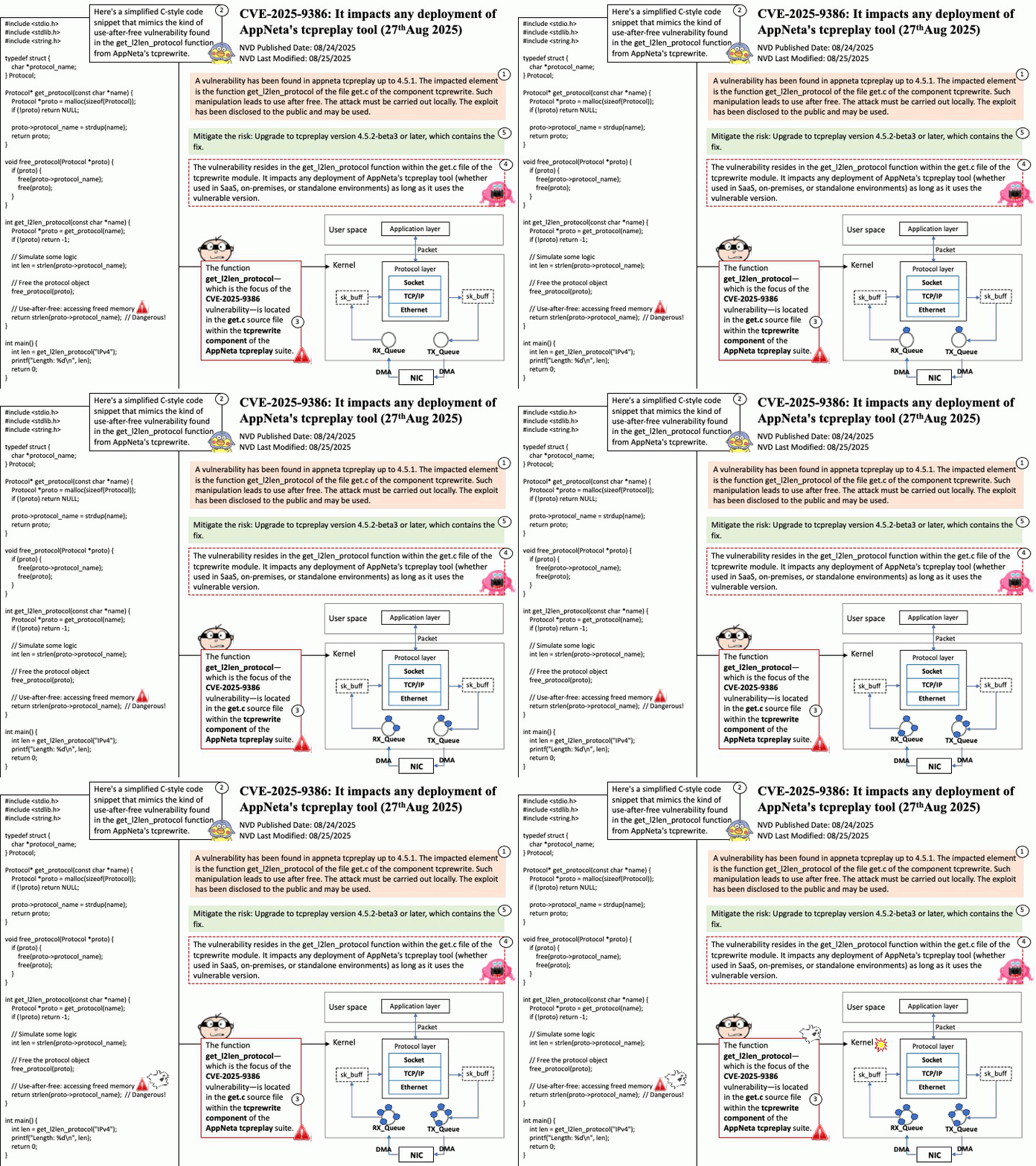
CVE-2025-44952: About Open5GS (19-6-2025)

Preface: Open5GS is a popular open-source 5G core network (5GC) implementation, particularly among researchers and those building private 5G networks. It’s recognized as one of the leading open-source 5GC projects. Open5GS is known for its adherence to 3GPP standards and its mature development, making it suitable for various applications like testbeds, research, and even some deployments

Background: The PFCP library refers to a software component, often implemented in programming languages like Go, designed to support the Packet Forwarding Control Protocol (PFCP). PFCP is a signaling protocol used in mobile core networks, particularly in the context of Control and User Plane Separation (CUPS) within 4G and 5G architectures. It enables communication between control plane elements (like the Session Management Function or SMF) and user plane elements (like the User Plane Function or UPF). PFCP is used by network equipment (like 5G base stations and core network elements) to manage data forwarding.

Vulnerability details: A missing length check in `ogs_pfcp_subnet_add` function from PFCP library, used by both smf and upf in open5gs 2.7.2 and earlier, allows a local attacker to cause a Buffer Overflow by changing the `session.dnn` field with a value with length greater than 101.

Comment: The developer added the strcpy block as a new logic to handle the DNN field. If the patch doesn’t include bounds checking, it introduces a new vulnerability.

Suggestion: the strcpy should be replaced with a safe alternative.

Official announcement: Please refer to the supplier announcement –

https://nvd.nist.gov/vuln/detail/CVE-2025-44952

CVE-2025-23252 – NVIDIA has released a software update for NVIDIA® NVDebug tool to address the security issue.(18-06-2025)

Preface: The NVdebug tool, used for NVIDIA GPU debugging, relies on the NVIDIA Data Center GPU Manager (DCGM) library. Specifically, it utilizes DCGM version 2.2.x or later. DCGM is a suite of tools for managing and monitoring NVIDIA GPUs in data center and cluster environments.

Background: The NV Debug Tool is part of the NVIDIA Nsight Systems and Nsight Graphics development tools. These tools are designed for debugging and profiling GPU-accelerated applications, including those using CUDA and other graphics APIs. It’s useful for debugging both CPU and GPU code, especially for CUDA applications.

Nsight Systems can collect logs for both Nsight Compute and Nsight Graphics. Nsight Systems is a system-wide performance analysis tool, while Nsight Compute focuses on kernel-level profiling and Nsight Graphics specializes in graphics application debugging and profiling. Nsight Systems can gather data that is relevant to both, and the collected data can be analyzed within the respective tools.

Vulnerability details: The NVIDIA NVDebug tool contains a vulnerability that may allow an actor to gain access to restricted components. A successful exploit of this vulnerability may lead to information disclosure.

Ref: CVE-2021-34398: NVIDIA DCGM, all versions prior to 2.2.9, contains a vulnerability in the DIAG module where any user can inject shared libraries into the DCGM server, which is usually running as root, which may lead to privilege escalation, total loss of confidentiality and integrity, and complete denial of service. (Public on May 29, 2025)

Point of view: In attached diagram description, if your system uses NVDebug, it’s very likely that it also includes or interacts with a version of the DCGM library, and therefore could be affected by vulnerabilities in DCGM versions prior to 2.2.9.

Official announcement: Please refer to the supplier announcement –

https://nvidia.custhelp.com/app/answers/detail/a_id/5651

CVE-2025-6087: About @opennextjs/cloudflare package (16-6-2025)

Preface: Next.js is a powerful React framework that simplifies web development by providing features like server-side rendering (SSR), static site generation (SSG), and API routes, all while offering built-in optimizations and a great developer experience. It’s essentially a framework built on top of React, adding extra functionality to create high-performance, SEO-friendly web applications.

Background: The @opennextjs/cloudflare package is a Cloudflare-specific adapter that allows you to deploy Next.js applications to Cloudflare’s developer platform. It essentially transforms a Next.js application, built using next build in standalone mode, to run within the Cloudflare’s workerd runtime using the Workers Node.js compatibility layer. This enables features like server-side rendering (SSR) and serving static assets directly from Cloudflare’s edge network.

Vulnerability details: A Server-Side Request Forgery (SSRF) vulnerability was identified in the @opennextjs/cloudflare package. The vulnerability stems from an unimplemented feature in the Cloudflare adapter for Open Next, which allowed unauthenticated users to proxy arbitrary remote content via the /_next/image endpoint. This issue allowed attackers to load remote resources from arbitrary hosts under the victim site’s domain for any site deployed using the Cloudflare adapter for Open Next.

Impact:

* SSRF via unrestricted remote URL loading

* Arbitrary remote content loading

* Potential internal service exposure or phishing risks through domain abuse

Mitigation: The following mitigations have been put in place:

* Server side updates to Cloudflare’s platform to restrict the content loaded via the /_next/image endpoint to images.

The update automatically mitigates the issue for all existing and any future sites deployed to Cloudflare using the affected version of the Cloudflare adapter for Open Next

* Root cause fix https://github.com/opennextjs/opennextjs-cloudflare/pull/727  to the Cloudflare adapter for Open Next.

Official announcement: Please see the link for details – https://nvd.nist.gov/vuln/detail/CVE-2025-6087
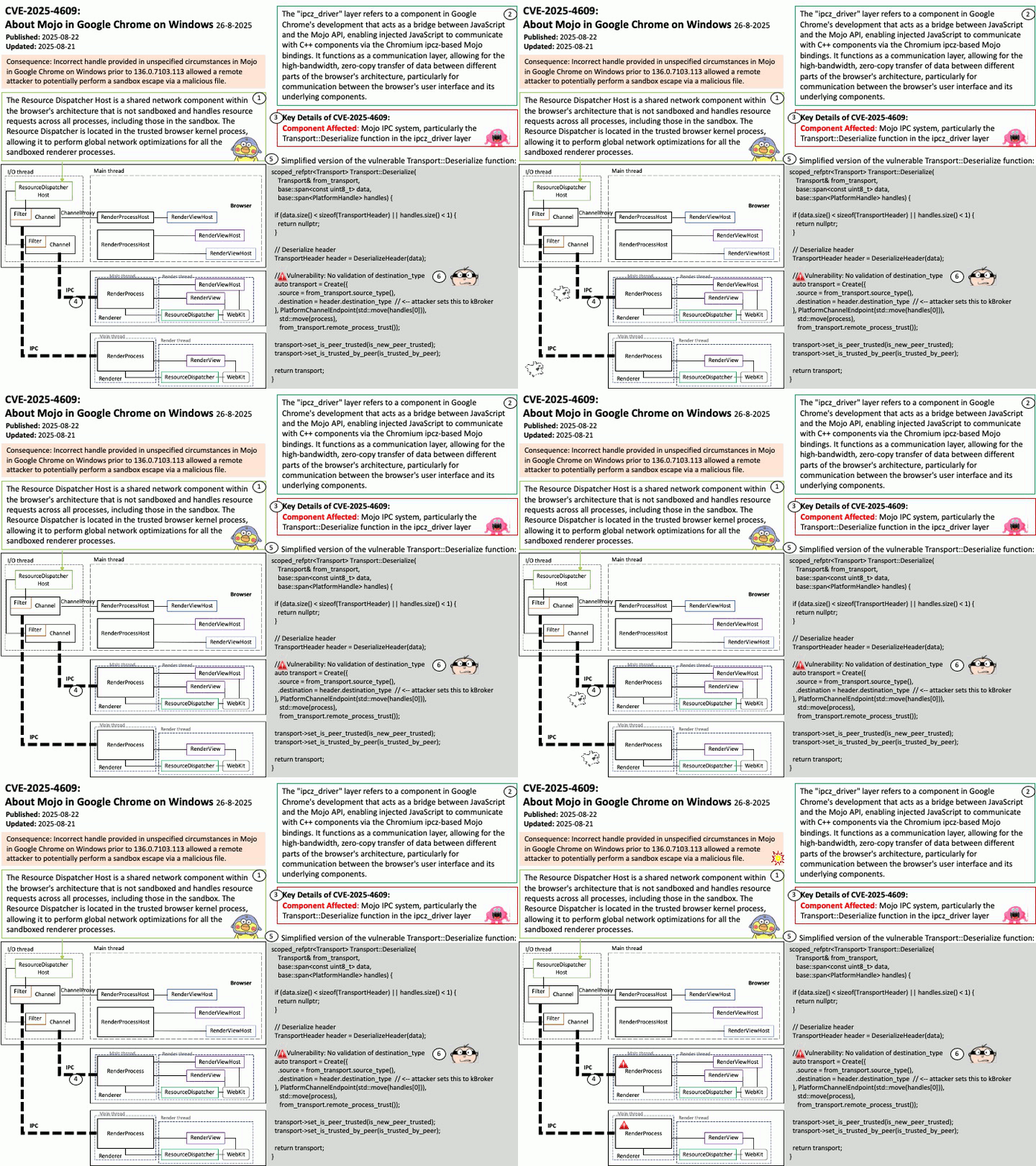
CVE-2024-55567: A vulnerability in the UsbCoreDxe driver of the InsydeH2O UEFI firmware, specifically due to improper input validation. (16-6-2025)

NVD Published Date: 06/12/2025

NVD Last Modified: 06/12/2025

Preface: InsydeH2O is a UEFI firmware developed by Insyde Software, used in a wide range of devices from servers to AI PCs. It’s known for its modular architecture, which allows for flexibility and faster development cycles. The kernel likely refers to the core components of this firmware, responsible for low-level hardware interaction and system initialization.

Background: Both CVEs involve UsbCoreDxe and SMRAM interaction.

CVE-2022-30283 is about unsafe memory placement (outside SMRAM).

If a UEFI driver registers an SMI handler but does not properly isolateits memory region, it might place the handler outside SMRAM. This can happen due to incorrect use of SmmInstallProtocolInterface() or similar APIs.

CVE-2024-55567 is about unsafe memory access (inside SMRAM) due to input validation flaws.

CVE-2024-55567 is a vulnerability in the UsbCoreDxe driver of the InsydeH2O UEFI firmware, specifically due to improper input validation. This flaw allows an attacker to write arbitrary memory inside SMRAM, leading to arbitrary code execution at the SMM (System Management Mode).

Vulnerability details: Improper input validation was discovered in UsbCoreDxe in Insyde InsydeH2O kernel 5.4 before 05.47.01, 5.5 before 05.55.01, 5.6 before 05.62.01, and 5.7 before 05.71.01. The SMM module has an SMM call out vulnerability which can be used to write arbitrary memory inside SMRAM and execute arbitrary code at SMM level.

Official announcement: Please see the link for details –

https://nvd.nist.gov/vuln/detail/CVE-2024-55567

CVE-2025-41234: In specifics condition, Spring Framework vulnerable to reflected file download (RFD) attack. (16-06-2025)

Preface: The Spring Framework is a popular, open-source, Java-based framework that simplifies enterprise application development by providing a comprehensive set of tools and libraries for building robust, scalable, and maintainable applications. It’s known for its core features like dependency injection (DI) and aspect-oriented programming (AOP), and it offers support for various technologies like JDBC, Hibernate, and more. The Spring Framework is a fundamental component of SAP Commerce (formerly known as SAP Hybris). It serves as the foundation for many aspects of the platform, including the Service Layer and the Accelerator storefront.

Ref:  SAP products leverage both Dependency Injection (DI) and Aspect-Oriented Programming (AOP) through the Spring framework, which is heavily integrated into SAP Commerce (formerly Hybris). Spring’s DI allows for managing object dependencies, while AOP provides a way to modularize cross-cutting concerns like logging, security, and transaction management. SAP Commerce (formerly Hybris) licenses can expire. Specifically, the on-premise version of SAP Commerce will reach its End of Mainstream Maintenance (EoMM) on July 31, 2026.

Oracle does not have a direct replacement for SAP Commerce (formerly Hybris) in the same way that SAP replaced Hybris with SAP Commerce Cloud. However, Oracle offers a suite of cloud applications, including Oracle CX Commerce, which serves a similar purpose for B2B and B2C e-commerce and can be considered an alternative. Oracle also provides a broader platform, Oracle Fusion Cloud Applications, which includes various SaaS applications that can be integrated to create a comprehensive business solution, including e-commerce capabilities.

Background: Oracle CX Commerce (formerly known as Oracle Commerce Cloud) utilizes the Spring framework. Specifically, the Oracle Commerce Platform integrates with Spring-based applications. Additionally, the toolkit uses Spring to load objects that represent an EAC (Endeca Application Controller) application. Spring Boot, an extension of the Spring framework, is also used to simplify development, particularly for microservices and web applications.

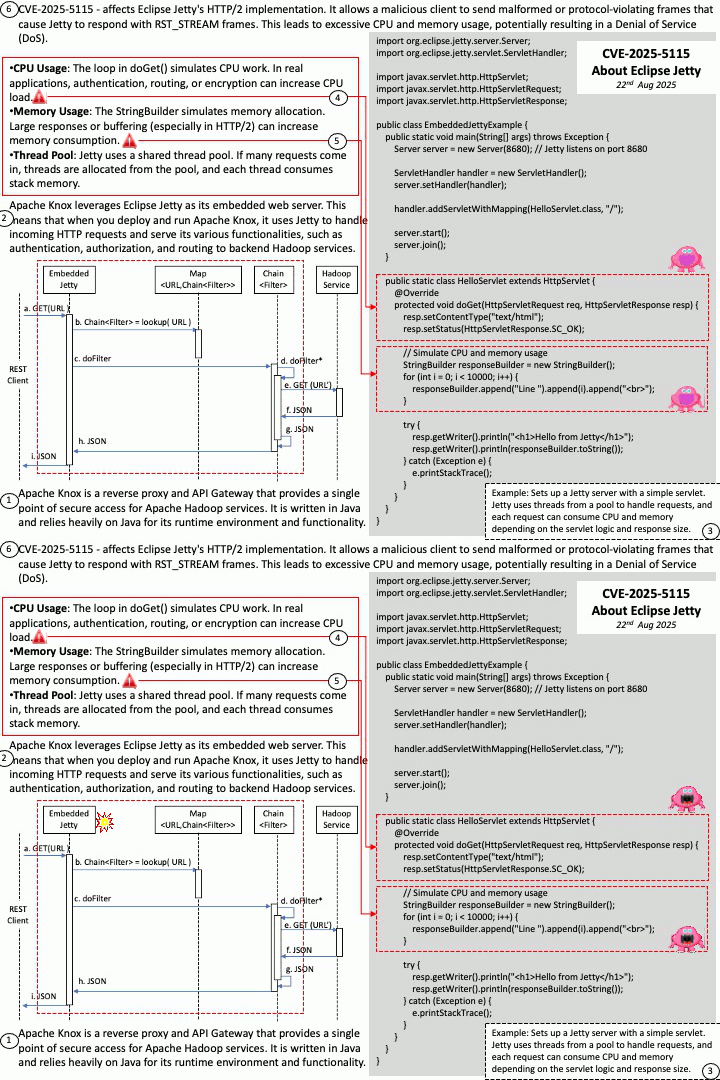
Vulnerability details: In Spring Framework, versions 6.0.x as of 6.0.5, versions 6.1.x and 6.2.x, an application is vulnerable to a reflected file download (RFD) attack when it sets a “Content-Disposition” header with a non-ASCII charset, where the filename attribute is derived from user-supplied input. Specifically, an application is vulnerable when all the following are true:

* The header is prepared with org.springframework.http.ContentDisposition.

* The filename is set via ContentDisposition.Builder#filename(String, Charset).

* The value for the filename is derived from user-supplied input.

* The application does not sanitize the user-supplied input.

* The downloaded content of the response is injected with malicious commands by the attacker (see RFD paper reference for details). An application is not vulnerable if any of the following is true:

* The application does not set a “Content-Disposition” response header.

* The header is not prepared with org.springframework.http.ContentDisposition.

* The filename is set via one of: * ContentDisposition.Builder#filename(String), or

* ContentDisposition.Builder#filename(String, ASCII)

* The filename is not derived from user-supplied input.

* The filename is derived from user-supplied input but sanitized by the application.

* The attacker cannot inject malicious content in the downloaded content of the response.

Official announcement: Please see the link for details –
https://nvd.nist.gov/vuln/detail/CVE-2025-41234

The relationship between the solar wind and the Earth (14-06-2025)

Preface: Auroras are a visible manifestation of geomagnetic storms. Geomagnetic storms are disturbances in Earth’s magnetosphere caused by the interaction of charged particles from the sun (the solar wind) with Earth’s magnetic field. Auroras typically appear in high latitudes, including northern North America and parts of Asia.

Background: The Sun’s corona and heliosphere, while constantly present, are often unseen. The corona, the Sun’s outermost atmosphere, is extremely hot and extends far into space. This hot gas is flung outwards by the Sun, forming the solar wind, which creates the heliosphere, a bubble surrounding our solar system. In June 2025, NASA’s PUNCH (Polarimeter to the Unseen Corona and Heliosphere) mission has been actively observing coronal mass ejections (CMEs). These observations, including detailed images from the Narrow Field Imager (NFI) and Wide Field Imagers, are providing new insights into the origins and paths of CMEs, helping scientists better understand and predict space weather.

Observation: Due to the high-speed flow of the coronal hole, NASA has issued a G2 (moderate) geomagnetic storm warning on June 14.

Ref: Geomagnetic storms, disturbances in Earth’s magnetic field caused by solar activity, can impact our planet in various ways, primarily affecting technology and infrastructure. While not directly harmful to humans due to our planet’s protective magnetic field and atmosphere, they can disrupt communication systems, navigation, and power grids.

Top Stories: Please see the link for details – https://www.livescience.com/space/the-sun/friday-the-13th-solar-storm-could-bring-auroras-to-18-us-states-this-weekend
CVE-2025-36852: “first-to-cache wins” jeopardizes Bucket-based object storage! (12th June 2025)

Preface: Cloud service providers use “first-to-cache wins” (also known as “cache hit”) for improved performance and efficiency. By caching frequently accessed data, they can quickly retrieve it without needing to access the slower underlying storage layer. This reduces latency, enhances user experience, and can also lower costs associated with accessing and processing data.

Background: In a “first-to-cache wins” scenario, the winning location is in CPU embedded memory, specifically the L1 and L2 caches, which are located directly on the processor chip. The L1 cache is the fastest and smallest, while the L2 cache is slower but larger. Both are much faster than accessing physical memory (RAM).

Do well-known cloud service providers implement the concept of “first-to-cache wins”?

Example 1: S3 is designed to store and manage data objects (files, images, etc.) in the cloud. While S3 itself doesn’t have a “first-to-cache wins” mechanism, it can be used as a layer of caching, especially when combined with other caching services like Amazon ElastiCache for Redis.

Example 2: Google Cloud Storage does not operate on a strict “first-to-cache wins” theory. Instead, it uses a more nuanced caching system that considers factors like the Cache-Control metadata, object type, and the location of the read operation.

Is the Vulnerability Valid?

Yes, it’s valid and serious in the context of build systems that:

-Use remote caching with object storage.

-Allow untrusted contributors (e.g., via pull requests).

-Do not enforce cache validation or isolation between trusted and untrusted environments.

Vulnerability details: A critical security vulnerability exists in remote cache extensions for common build systems utilizing bucket-based remote cache (such as those using Amazon S3, Google Cloud Storage, or similar object storage) that allows any contributor with pull request privileges to inject compromised artifacts from an untrusted environment into trusted production environments without detection. The vulnerability exploits a fundamental design flaw in the “first-to-cache wins” principle, where artifacts built in untrusted environments (feature branches, pull requests) can poison the cache used by trusted environments (protected branches, production deployments). This attack bypasses all traditional security measures including encryption, access controls, and checksum validation because the poisoning occurs during the artifact construction phase, before any security measures are applied.

Official announcement: Please refer to the link for details –

https://www.tenable.com/cve/CVE-2025-36852

https://nx.app/files/cve-2025-06