CVE‑2024‑53870, CVE‑2024‑53871, CVE‑2024‑53872, CVE‑2024‑53873, CVE‑2024‑53874, CVE‑2024‑53875, CVE‑2024‑53876, CVE‑2024‑53877, CVE‑2024‑53878 and CVE‑2024‑53879 (21-02-2025)

Released on February 18, 2025

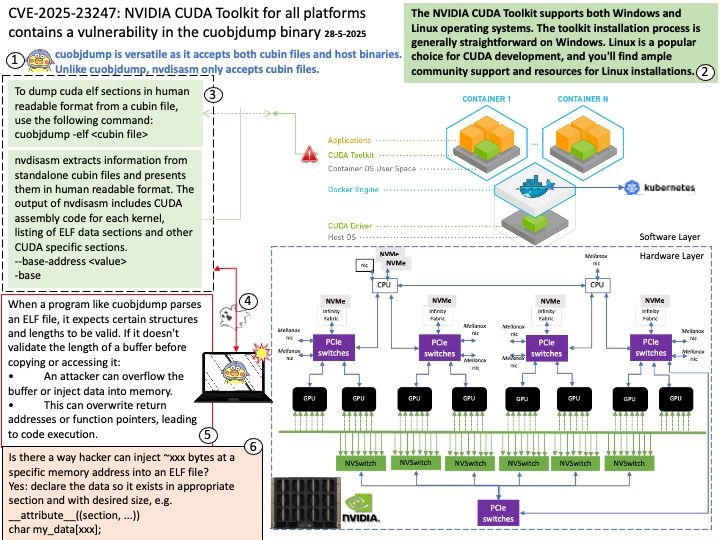
Preface: In NVIDIA CUDA, cuobjdump and nvdisasm are two binary utilities used for examining and disassembling CUDA binaries (cubin files).

cuobjdump

  • Purpose: It can disassemble CUDA binaries and extract PTX (Parallel Thread Execution) code from host binaries, executables, object files, static libraries, and external fatbinary files.
  • Usage: cuobjdump is versatile as it accepts both cubin files and host binaries.
  • Features: It provides basic disassembly and extraction capabilities but lacks advanced display options and control flow analysis.

nvdisasm

  • Purpose: It is specifically designed to disassemble cubin files.
  • Usage: Unlike cuobjdump, nvdisasm only accepts cubin files.
  • Features: It offers richer output options, including advanced display options and control flow analysis.

These tools are essential for developers who need to inspect and debug the compiled CUDA code.

Background: Parallel processing is a method in computing of running two or more processors (CPUs) to handle separate parts of an overall task. Breaking up different parts of a task among multiple processors will help reduce the amount of time to run a program. GPUs render images more quickly than a CPU because of its parallel processing architecture, which allows it to perform multiple calculations across streams of data simultaneously. The CPU is the brain of the operation, responsible for giving instructions to the rest of the system, including the GPU(s).

NVIDIA CUDA provides a simple C/C++ based interface. The CUDA compiler leverages parallelism built into the CUDA programming model as it compiles your program into code.
CUDA is a parallel computing platform and programming interface model created by Nvidia for the development of software which is used by parallel processors. It serves as an alternative to running simulations on traditional CPUs.

Vulnerability details:

The following two design flaws are associated with these CVEs:

CVE‑2024‑53870, CVE‑2024‑53871, CVE‑2024‑53872, CVE‑2024‑53873, CVE‑2024‑53874, CVE‑2024‑53875, CVE‑2024‑53876, CVE‑2024‑53877, CVE‑2024‑53878 and CVE‑2024‑53879

NVIDIA CUDA toolkit for Linux and Windows contains a vulnerability in the cuobjdump binary, where a user could cause a crash by passing a malformed ELF file to cuobjdump. A successful exploit of this vulnerability might lead to a partial denial of service.

NVIDIA CUDA toolkit for all platforms contains a vulnerability in the nvdisasm binary, where a user could cause an out-of-bounds read by passing a malformed ELF file to nvdisasm. A successful exploit of this vulnerability might lead to a partial denial of service.

Official announcement: Please refer to the vendor announcement for details – https://nvidia.custhelp.com/app/answers/detail/a_id/5594

CVE-2024-57258 – Integer overflows in memory allocation in Das U-Boot  (19-02-2025)

Preface: U-Boot is both a first-stage and second-stage bootloader. It is loaded by the system’s ROM (e.g. on-chip ROM of an ARM CPU) from a supported boot device, such as an SD card, SATA drive, NOR flash (e.g. using SPI or I²C), or NAND flash.

Background: Das U-Boot is an open source, primary boot loader used in embedded devices to package the instructions to boot the device’s operating system kernel. U-Boot uses commands similar to the BASH shell to manipulate environment variables. U-Boot supports TFTP (Trivial FTP), a stripped down FTP. So that user authentication is not required for downloading images into the board’s RAM

LK is the abbreviation of Little Kernel. LK is commonly used as bootloader in the Android system of Qualcomm platform. It is an open source project. LK is the boot part of the whole system, so it is not independent. However, LK currently only supports arm and x86 architectures. The notable feature of LK is that it implements a simple thread mechanism. And deeply customized and used with Qualcomm’s processors.

Vulnerability details: Integer overflows in memory allocation in Das U-Boot before 2025.01-rc1 occur for a crafted squashfs filesystem via sbrk, via request2size, or because ptrdiff_t is mishandled on x86_64.

Remark: An integer overflow is a type of software vulnerability that occurs when a variable, such as an integer, exceeds its assigned memory space. This can result in unexpected behavior or security issues, such as allowing an attacker to execute arbitrary code.

Official announcement: Please refer to the link for details – https://nvd.nist.gov/vuln/detail/CVE-2024-57258

nodejs: GOAWAY HTTP/2 frames cause memory leak outside heap (CVE-2025-23085) 17-02-2025

Preface: If artificial intelligence could create the world. Do you know how his creation differs from Genesis? Artificial intelligence focuses on efficiency, and everything needs to be fast.

But God is concerned with the balance of nature. Therefore, the development of everything is not rapid.

Background: HTTP/2 enables full request and response multiplexing. In practice, this means a connection made to a web server from your browser can be used to send multiple requests and receive multiple responses. This eliminates some of the time it takes to establish a new connection for each request.

The GOAWAY frame in HTTP/2 (type=0x7) is used to initiate the shutdown of a connection or to signal serious error conditions. When a server sends a GOAWAY frame, it tells the client to stop creating new streams on the connection. However, it allows the server to finish processing any streams that were already in progress. This mechanism is useful for administrative actions, such as server maintenance, as it allows for a graceful shutdown without abruptly terminating ongoing request.

Vulnerability details: A memory leak could occur when a remote peer abruptly closes the socket without sending a GOAWAY notification. Additionally, if an invalid header was detected by nghttp2, causing the connection to be terminated by the peer, the same leak was triggered. This flaw could lead to increased memory consumption and potential denial of service under certain conditions. This vulnerability affects HTTP/2 Server users on Node.js v18.x, v20.x, v22.x and v23.x.

Official announcement: Please refer to the link for details – https://access.redhat.com/errata/RHSA-2025:1613

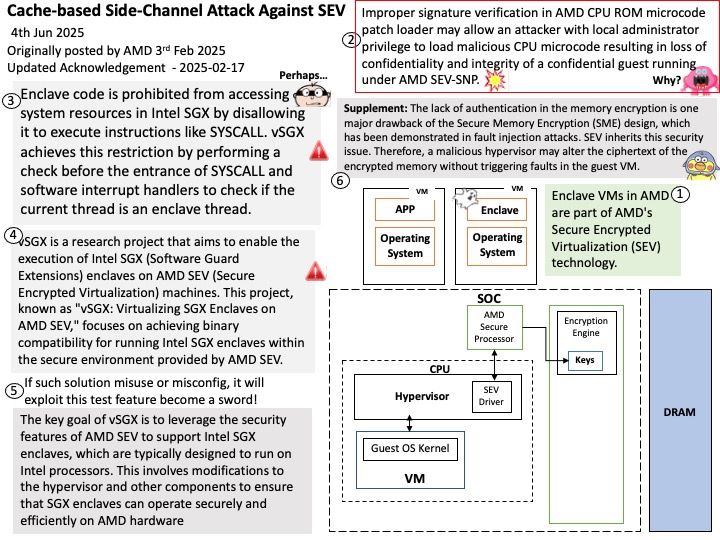
Cache-based Side-Channel Attack Against SEV (18th Feb 2024)

Originally posted by AMD 3rd Feb 2025

Updated Acknowledgement – 2025-02-17

Preface: FIPS 186-5 removes DSA as an approved digital signature algorithm “due to a lack of use by industry and based on academic analyses that observed that implementations of DSA may be vulnerable to attacks if domain parameters are not properly generated.

February 3, 2023 – NIST published Federal Information Processing Standard (FIPS) 186-5, Digital Signature Standard (DSS), along with NIST Special Publication (SP) 800-186, Recommendations for Discrete Logarithm-based Cryptography: Elliptic Curve Domain Parameters.  

Background: The SEV feature relies on elliptic-curve cryptography for its secure key generation, which runs when a VM is launched. The VM initiates the elliptic-curve algorithm by providing points along its NIST (National Institute of Standards and Technology) curve and relaying the data based on the private key of the machine.

Vulnerability details: AMD has received a report from researchers at National Taiwan University detailing cache-based side-channel attacks against Secure Encrypted Virtualization (SEV).

Remedy: AMD recommends software developers employ existing best practices for prime and probe attacks (including constant-time algorithms) and avoid secret-dependent data accesses where appropriate.  AMD also recommends following previously published guidance regarding Spectre type attacks (refer to the link in the reference section below), as it believes the previous guidance remains applicable to mitigate these vulnerabilities.

Supplement: The lack of authentication in the memory encryption is one major drawback of the Secure Memory Encryption (SME) design, which has been demonstrated in fault injection attacks. SEV inherits this security issue. Therefore, a malicious hypervisor may alter the ciphertext of the encrypted memory without triggering faults in the guest VM.

Office announcement: Please refer to the link for details – https://www.amd.com/en/resources/product-security/bulletin/amd-sb-3010.html
CVE-2024-0112 – about NVIDIA Jetson AGX Orin™ and NVIDIA IGX Orin software  (17th Feb 2025)

The original security advisory was issued on February 11, 2025.

Preface: NVIDIA IGX Orin software is used by a variety of organizations, particularly those in industrial and medical environments. This platform is designed to support AI applications at the edge, providing high performance, advanced functional safety, and security.

Some specific use cases include:

  • Industrial Automation: Companies use IGX Orin to enhance manufacturing processes with AI-driven automation and predictive maintenance.
  • Healthcare: Medical institutions leverage IGX Orin for AI-powered diagnostics, medical imaging, and patient monitoring.
  • Robotics: Robotics companies utilize IGX Orin for developing intelligent robots that can operate safely alongside humans.

The platform’s versatility and robust support make it suitable for any organization looking to deploy AI solutions in demanding environments.

Background: The NVIDIA IGX Orin Developer Kit runs the Holopack 2.0 Developer Preview software. Holopack is a comprehensive solution for end-to-end GPU accelerated AI application development and testing. Holopack supports two GPU modes:

iGPU – Holopack deploys drivers and libraries to support NVIDIA Ampere sets on NVIDIA IGX Orin modules into the GPU.

dGPU – Holopack deploys drivers and libraries to support optional NVIDIA RTX A6000 connected to PCIe slot Discrete GPU.

Its high-performance, low-power computing for deep learning, and computer vision makes Jetson the ideal platform for compute-intensive projects. The Jetson platform includes a variety of Jetson modules with NVIDIA JetPack™ SDK.

Vulnerability details: NVIDIA Jetson AGX Orin™ and NVIDIA IGX Orin software contain a vulnerability where an attacker can cause an improper input validation issue by escalating certain permissions to a limited degree. A successful exploit of this vulnerability might lead to code execution, denial of service, data corruption, information disclosure, or escalation of privilege.

Official announcement: Please refer to the vendor announcement for details – https://nvidia.custhelp.com/app/answers/detail/a_id/5611

CVE‑2024‑53880: NVIDIA Triton Inference Server contains a vulnerability in the model loading API (14th Feb 2025)

Original release date: February 11, 2025

Preface: The NVIDIA Triton Inference Server API supports both HTTP/REST and GRPC protocols. These protocols allow clients to communicate with the Triton server for various tasks such as model inferencing, checking server and model health, and managing model metadata and statistics.

Background: NVIDIA Triton™ Inference Server, part of the NVIDIA AI platform and available with NVIDIA AI Enterprise, is open-source software that standardizes AI model deployment and execution across every workload.

The Asynchronous Server Gateway Interface (ASGI) is a calling convention for web servers to forward requests to asynchronous-capable Python frameworks, and applications. It is built as a successor to the Web Server Gateway Interface (WSGI).

Vulnerability details: NVIDIA Triton Inference Server contains a vulnerability in the model loading API, where a user could cause an integer overflow or wraparound error by loading a model with an extra-large file size that overflows an internal variable. A successful exploit of this vulnerability might lead to denial of service.

Official announcement: Please refer to the vendor announcement for details – https://nvidia.custhelp.com/app/answers/detail/a_id/5612

CVE-2025-23359 – NVIDIA Container Toolkit for Linux contains a Time-of-Check Time-of-Use (TOCTOU) vulnerability (11th Feb 2025)

Preface: In software development, time-of-check to time-of-use (TOCTOU, TOCTTOU or TOC/TOU) is a class of software bugs caused by a race condition involving the checking of the state of a part of a system (such as a security credential) and the use of the results of that check.

Background: The NVIDIA container stack is architected so that it can be targeted to support any container runtime in the ecosystem. The components of the stack include:

The NVIDIA Container Runtime (nvidia-container-runtime)

The NVIDIA Container Runtime Hook (nvidia-container-toolkit / nvidia-container-runtime-hook)

The NVIDIA Container Library and CLI (libnvidia-container1, nvidia-container-cli)

The components of the NVIDIA container stack are packaged as the NVIDIA Container Toolkit.

The NVIDIA Container Toolkit is a key component in enabling Docker containers to leverage the raw power of NVIDIA GPUs. This toolkit allows for the integration of GPU resources into your Docker containers.

Remark: The Podman command can be used with remote services using the –remote flag. Connections can be made using local unix domain sockets, ssh

Vulnerability details: NVIDIA Container Toolkit for Linux contains a Time-of-Check Time-of-Use (TOCTOU) vulnerability when used with default configuration, where a crafted container image could gain access to the host file system. A successful exploit of this vulnerability might lead to code execution, denial of service, escalation of privileges, information disclosure, and data tampering.

Official announcement: Please refer to the vendor announcement for detail – https://nvidia.custhelp.com/app/answers/detail/a_id/5616

CVE-2024-21924 – AMD SMM Callout Vulnerability (11th Feb 2025)

Preface: The SmmMemLib[.]c library is part of the EDK II (EFI Development Kit II) project, which is an open-source implementation of the UEFI (Unified Extensible Firmware Interface) and PI (Platform Initialization) specifications. This library is specifically used for memory management within System Management Mode (SMM).

Background: The AMD Ryzen processors do not specifically use the SmmMemLib[.]c library. Instead, AMD provides a set of optimized libraries known as the AMD Optimizing CPU Libraries (AOCL), which are designed for high-performance computing and scientific applications. These libraries include various components like AOCL-BLAS, AOCL-LAPACK, AOCL-FFTW, and more. AMD Optimizing CPU Libraries (AOCL) are a set of numerical libraries optimized for AMD “Zen”-based processors, including EPYCTM , RyzenTM ThreadripperTM , and RyzenTM .

Vulnerability details: Analysis by AMD is that a ring 0 attacker could modify boot service tables to point to their own code, potentially resulting in arbitrary code execution. AMD has released mitigations to address this vulnerability. SMM callout vulnerability within the AmdPlatformRasSspSmm driver could allow a ring 0 attacker to modify boot services handlers, potentially resulting in arbitrary code execution.

Official announcement: Please refer to link for details –
https://www.amd.com/en/resources/product-security/bulletin/amd-sb-7028.html

CVE-2025-21684: A Linux GPIO (General Purpose Input/Output) driver design weakness (11th Feb 2025)

Preface: In the concept of Industry 4.0, the Internet of Things (IoT) shall be used for the development of so-called smart products.

Background: The GPIO driver provides an interface for user-space applications and kernel modules to access and control the GPIO pins. It abstracts the hardware details, making it easier for developers to write code that interacts with the GPIOs without needing to know the specifics of the underlying hardware.

GPIO pins on hardware are often used in automation. They can be programmed to control various devices and systems, such as:

•       Home automation: Controlling lights, fans, and other appliances.

•       Industrial automation: Managing machinery, sensors, and actuators in manufacturing processes.

•       Robotics: Operating motors, servos, and sensors to control robot movements and actions.

•       IoT (Internet of Things): Connecting and controlling smart devices and sensors.

SCADA (Supervisory Control and Data Acquisition) systems can use GPIO pins. SCADA systems are designed to monitor and control industrial processes and infrastructure, and they often interface with various sensors and actuators. GPIO pins can be used in SCADA systems to:

•       Read digital inputs: Such as switches, sensors, and other binary devices.

•       Control digital outputs: Like relays, LEDs, and other on/off devices.

•       Interface with analog inputs/outputs: Through additional circuitry or modules that convert analog signals to digital and vice versa.

For example, GPIO pins can be used to monitor the status of a machine, control the operation of a valve, or read data from a temperature sensor.

Vulnerability details: Linux Kernel Vulnerability in Xilinx GPIO Locking Mechanism.

Official Announcement – please see the link for details – https://nvd.nist.gov/vuln/detail/CVE-2025-21684

Cache-based Side-Channel Attack Against SEV (10th Feb 2024)

Originally posted by AMD 3rd Feb 2025

Preface: FIPS 186-5 removes DSA as an approved digital signature algorithm “due to a lack of use by industry and based on academic analyses that observed that implementations of DSA may be vulnerable to attacks if domain parameters are not properly generated.

February 3, 2023 – NIST published Federal Information Processing Standard (FIPS) 186-5, Digital Signature Standard (DSS), along with NIST Special Publication (SP) 800-186, Recommendations for Discrete Logarithm-based Cryptography: Elliptic Curve Domain Parameters.  

Background: The SEV feature relies on elliptic-curve cryptography for its secure key generation, which runs when a VM is launched. The VM initiates the elliptic-curve algorithm by providing points along its NIST (National Institute of Standards and Technology) curve and relaying the data based on the private key of the machine.

Vulnerability details: AMD has received a report from researchers at National Taiwan University detailing cache-based side-channel attacks against Secure Encrypted Virtualization (SEV).

Remedy: AMD recommends software developers employ existing best practices for prime and probe attacks (including constant-time algorithms) and avoid secret-dependent data accesses where appropriate.  AMD also recommends following previously published guidance regarding Spectre type attacks (refer to the link in the reference section below), as it believes the previous guidance remains applicable to mitigate these vulnerabilities.

Office announcement: Please refer to the link for details – https://www.amd.com/en/resources/product-security/bulletin/amd-sb-3010.html
antihackingonline.com