Category Archives: IoT

CVE-2024-36138: Bypass incomplete fix of CVE-2024-27980 (10 Jul 2024)

Preface: Node. js has two types of threads: one Event Loop and k Workers. The Event Loop is responsible for JavaScript callbacks and non-blocking I/O, and a Worker executes tasks corresponding to C++ code that completes an asynchronous request, including blocking I/O and CPU-intensive work.

Background: Why do we use child process in Node.js?

Node Child Process – Node is a tool that uses JavaScript and has many useful parts to it. Normally, it does work with one thread at a time, which means it can handle tasks without waiting. However, when there’s a lot of work to be done, we use the child_process module to create additional threads.

The child_process.spawn() method spawns the child process asynchronously, without blocking the Node.js event loop. The child_process.spawnSync() function provides equivalent functionality in a synchronous manner that blocks the event loop until the spawned process either exits or is terminated.

Vulnerability details: The CVE-2024-27980 was identified as an incomplete fix for the BatBadBut vulnerability. This vulnerability arises from improper handling of batch files with all possible extensions on Windows via child_process.spawn / child_process.spawnSync. A malicious command line argument can inject arbitrary commands and achieve code execution even if the shell option is not enabled.

This vulnerability affects all users of child_process.spawn and child_process.spawnSync on Windows in all active release lines.

Impact: This vulnerability affects all Windows users in active release lines: 22.x, 20.x, 18.x

Official announcement: For detail, please refer to link – https://nodejs.org/en/blog/vulnerability/july-2024-security-releases

CVE-2024-6563: About  Renesas arm-trusted-firmware (9 Jul 2024)

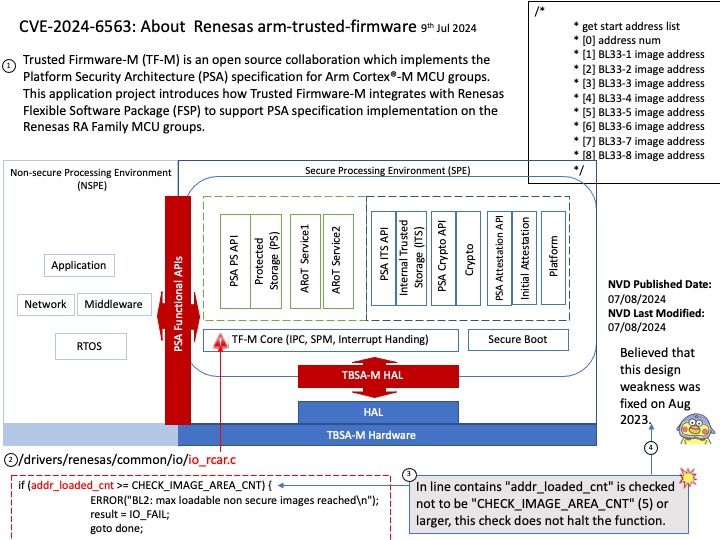
Preface: Trusted Firmware-M (TF-M) defines several common profiles, such as Profile Small, Profile Medium, Profile Medium ARoT-less and Profile Large, to provide different levels of security to adapt to different device functions and applications. Use cases on top of firmware.

Background: The capabilities and resources of different IoT devices can vary significantly. Some IoT devices may have very limited memory resources. Programs on these devices should maintain a small memory footprint and basic functionality.

Trusted Firmware-M (TF-M) defines several general profiles, such as Profile Small, Profile Medium, Profile Medium ARoT-less and Profile Large, to provide different levels of security to fit diverse device capabilities and use cases applied on the top of the base configuration.

Ref: Trusted Firmware-M (TF-M) is an open source collaboration which implements the Platform Security Architecture (PSA) specification for Arm Cortex®-M MCU groups. This application project introduces how Trusted Firmware-M integrates with Renesas Flexible Software Package (FSP) to support PSA specification implementation on the Renesas RA Family MCU groups.

Vulnerability details: Buffer Copy without Checking Size of Input (‘Classic Buffer Overflow’) vulnerability in Renesas arm-trusted-firmware allows Local Execution of Code. This vulnerability is associated with program files https://github.Com/renesas-rcar/arm-trusted-firmware/blob/rcar_gen3_v2.5/drivers/renesas/common/io/i… https://github.Com/renesas-rcar/arm-trusted-firmware/blob/rcar_gen3_v2.5/drivers/renesas/common/io/io_rcar[.]C . In line 313 “addr_loaded_cnt” is checked not to be “CHECK_IMAGE_AREA_CNT” (5) or larger, this check does not halt the function. Immediately after (line 317) there will be an overflow in the buffer and the value of “dst” will be written to the area immediately after the buffer, which is “addr_loaded_cnt”. This will allow an attacker to freely control the value of “addr_loaded_cnt” and thus control the destination of the write immediately after (line 318). The write in line 318 will then be fully controlled by said attacker, with whichever address and whichever value (“len”) they desire.

Official announcement: For detail, please refer to link – https://nvd.nist.gov/vuln/detail/CVE-2024-6563

CVE-2024-20081: Out-of-bounds write in gnss, response by Mediatek security advisory. (2nd July 2024)

Preface: GPS traditionally refers to the North American Global Positioning System, or satellite positioning system. GNSS is the term for the international multi-constellation satellite system. Therefore, GNSS typically includes GPS, GLONASS, Baidu, Galileo, and any other constellation system.

Background: GNSS positioning modules or chips, as the core component of In-vehicle Infotainment systems, provide position, speed, and time information. GNSS position and speed measurements are integral, especially with respect to moving map navigation.

GNSS are used in all forms of transportation: space stations, aviation, maritime, rail, road and mass transit. Positioning, navigation and timing (PNT) play a critical role in telecommunications, land surveying, law enforcement, emergency response, precision agriculture, mining, finance, scientific research…etc.

Vulnerability details: In gnss service, there is a possible escalation of privilege due to improper certificate validation. This could lead to remote escalation of privilege with no additional execution privileges needed. User interaction is not needed for exploitation. Patch ID: ALPS08720039; Issue ID: MSV-1424.

Official announcement: For detail, please refer to link –

https://corp.mediatek.com/product-security-bulletin/July-2024

About CVE-2024-38952 on PX4-Autopilot v1.14.3 (27 June 2024)

Preface: The PX4 is a professional autopilot. Developed by world-class developers from industry and academia and supported by an active worldwide community, it powers a variety of vehicles from racing and cargo drones to ground vehicles and submersibles.

Background:  What is needed to control a drone using PX4 flight controller?

-A computer with Internet Access.

-Linux operating system (I am using Ubuntu 14.04 LTS, you can use the operating system you want, but since I am also doing source code development, Linux will make my days a lot easier).

-A PX4 autopilot (Pixhawk, Pixfalcon, HK Pilot 32, Pixracer) with micro usb cable.

-Your drone.

-A pair of telemetry modules (optional).

Vulnerability details: PX4-Autopilot v1[.]14[.]3 was discovered to contain a buffer overflow via the topic_name parameter at /logger/logged_topics[.]cpp.

Official announcement: For detail, please refer to link –

https://nvd.nist.gov/vuln/detail/cve-2024-38952

CVE-2024-38663: blk-cgroup – fix list corruption from resetting io stat (25-June-2024)

Preface: Android uses cgroups to control and account for system resources such as CPU and memory usage and allocation, with support for Linux kernel cgroups v1 and cgroups v2.

Background: New IO stats are stored in the percpu iostat_cpu within blkcg_gq (blkg). There are multiple blkg’s (one for each block device) attached to each blkcg. The rstat code keeps track of which cpu has IO stats updated, but it doesn’t know which blkg has the updated stats. If there are many block devices in a system, the cost of iterating all the blkg’s to flush out the IO stats can be high. To reduce such overhead, a set of percpu lockless lists (lhead) per blkcg are used to track the set of recently updated iostat_cpu’s since the last flush. An iostat_cpu will be put onto the lockless list on the update side [blk_cgroup_bio_start()] if not there yet and then removed when being flushed [blkcg_rstat_flush()].

References to blkg are gotten and then put back in the process to protect against blkg removal.

Vulnerability details: blk-cgroup: fix list corruption from resetting io stat. Since commit 3b8cc6298724 (“blk-cgroup: Optimize blkcg_rstat_flush()”), each iostat instance is added to blkcg percpu list, so blkcg_reset_stats() can’t reset the stat instance by memset(), otherwise the llist may be corrupted.

Fix the issue by only resetting the counter part.

Official announcement: For detail, please refer to link – https://nvd.nist.gov/vuln/detail/CVE-2024-38663

CVE-2024-21478 – Automotive manufacturer staying alert! (18 June 2024)

Preface: For example, if your app defines a fence for headphones, it gets callbacks when the headphones are plugged in and when they’re unplugged.

Background: Automotive infotainment is an in-car system that combines entertainment such as radio and music playing with driving information, including navigation, ADAS, and vehicle settings.

The SA8255P delivers next-generation Qualcomm Snapdragon automotive infotainment SoC. Developed with SEooC targeting ASIL B use cases, the SAM8255P empowers automakers with scalable solutions that are connected, smart, and aware.

Vulnerability details: NULL Pointer Dereference in Graphics,

transient DOS when setting up a fence callback to free a KGSL memory entry object during DMA.

Affected Chipsets: QAM8255P, QAM8650P, QAM8775P, QAMSRV1H, QAMSRV1M, SA8255P, SA8650P, SA8770P, SA8775P, SA9000P, SRV1H, SRV1M.

Official announcement: For detail, please refer to link – https://docs.qualcomm.com/product/publicresources/securitybulletin/june-2024-bulletin.html

CVE-2024-4610: Arm was recently aware of this vulnerability being exploited in the wild (17 June 2024)

Arm has released limited details about the vulnerability. Do you think the following is similar to CVE-2024-4610?

Preface: Arm was recently aware of reports of this vulnerability being exploited in the wild, but this exploit was a local attack. Perhaps, cybercriminals should help via email phishing or SMS functionality. Therefore, it attracted the attention of manufacturers.

Background: The Mali Bifrost architecture – implemented by the Mali-G3x, Mali-G5x, and Mali-G7x family of products, is the successor to the Midgard architecture and the predecessor of the Valhall architecture.

The Android and Linux version of the Mali GPUs Device Driver provide low-level access to the Mali GPUs that are part of the Bifrost family.

There are many ways to communicate with IPC, such as: Shared Memory, Message Queue, PIPE, FIFO, Unix Socket, etc. A process cannot access another process’s memory. However, the kernel has control over all processes and therefore can expose an interface that enables IPC. In Binder, this interface is the /dev/binder device, which is implemented by the Binder kernel driver.

Ref: A Mutex is a Mutually exclusive flag. It acts as a gate keeper to a section of code allowing one thread in and blocking access to all others.

Vulnerability details: Use After Free vulnerability in Arm Ltd Bifrost GPU Kernel Driver, Arm Ltd Valhall GPU Kernel Driver allows a local non-privileged user to make improper GPU memory processing operations to gain access to already freed memory.

This issue affects Bifrost GPU Kernel Driver: from r34p0 through r40p0; Valhall GPU Kernel Driver: from r34p0 through r40p0.

Official announcement: For detail, please refer to link – https://nvd.nist.gov/vuln/detail/CVE-2024-4610

CVE-2023-20597: AGESA™ firmware versions previously provided did not sufficiently mitigate CVE-2023-20594. Release 2nd round of remedy.(13-June-2024)

Preface: June 2024 Update – After additional analysis, AMD believes that the Client AGESA™ firmware versions previously provided did not sufficiently mitigate CVE-2023-20594. This security bulletin has been updated with new Client AGESA™ firmware versions that contain updated mitigations.

Background: The DXE drivers are responsible for initializing the processor, chipset, and platform components as well as providing software abstractions for system services, console devices, and boot devices.

Vulnerability details:

CVE-2023-20594Improper initialization of variables in the DXE driver may allow a privileged user to leak sensitive information via local access.
CWE-665 Improper Initialization

CVE-2023-20597 Improper initialization of variables in the DXE driver may allow a privileged user to leak sensitive information via local access.
CWE-665 Improper Initialization

Published Date: Sep 20, 2023
Last updated date: Jun 11, 2024

Official announcement: For detail, please refer to link –
https://www.amd.com/en/resources/product-security/bulletin/amd-sb-4007.html

CVE-2024-31335 GPU – PowerVR: Wrong order of operations in DevmemIntUnmapPMR2 may lead to temporarily dangling PTEs.AI accelerators called Neural Network Accelerator (NNA) staying alert! (7 June 2024)

Official Posted: 31st May 2024

Preface: PowerVR not limited 2D and 3D rendering, and for video encoding, decoding, associated image processing. It also develops AI accelerators called Neural Network Accelerator (NNA). The IMG Series4 is a revolutionary neural network accelerator (NNA) for the automotive industry that enables ADAS and autonomous driving.

PowerVR accelerators are not manufactured by PowerVR, but instead their IP blocks of integrated circuit designs and patents are licensed to other companies.

Remark: An IP block is a reusable unit of logic, cell, or chip layout design and can be used as building block for various chip- and logic designs. By making this technology available NXP is opening up the opportunity for chip designers to leverage our building blocks in a wide assortment of on-chip solutions.

Background: What is DDK? To build the Android kernel and other kernel artifacts (modules, boot images, etc.), they provide a framework called “Kleaf”. For Android 14+, Kleaf is strongly recommended. One part of Kleaf is the Driver Development Kit (DDK) which is used to build external modules.

Vulnerability details: CVE-2024-31335 – GPU – PowerVR: Wrong order of operations in DevmemIntUnmapPMR2 may lead to temporarily dangling PTEs.

Software installed and run as a non-privileged user may conduct improper GPU system calls to trigger use-after-free kernel exceptions.

Official announcement: For detail, please refer to link –

https://www.imaginationtech.com/gpu-driver-vulnerabilities/#may24

CVE-2024-1086 : A use-after-free vulnerability in the Linux kernel’s netfilter. The IoT world remins vigilant. 4 June 2024

Preface: By default, OpenWrt builds the kernel with a useful set of netfilter capabilities for a robust router. NAT. REJECT. REDIRECT. CONNTRACK. LOG.

OpenWrt is a Linux distribution suitable for embedded devices. Currently, many embedded hardware platforms on the market use OpenWrt as their basis, such as routers, network gateways or industrial use computer

Background: Netfilter is a framework provided by the Linux kernel that allows various networking-related operations to be implemented in the form of customized handlers. Netfilter offers various functions and operations for packet filtering, network address translation, and port translation, which provide the functionality required for directing packets through a network and prohibiting packets from reaching sensitive locations within a network.

Netfilter represents a set of hooks inside the Linux kernel, allowing specific kernel modules to register callback functions with the kernel’s networking stack. Those functions, usually applied to the traffic in the form of filtering and modification rules, are called for every packet that traverses the respective hook within the networking stack.

Vulnerability details: CVE-2024-1086 A use-after-free vulnerability in the Linux kernel’s netfilter: nf_tables component can be exploited to achieve local privilege escalation. The nft_verdict_init() function allows positive values as drop error within the hook verdict, and hence the nf_hook_slow() function can cause a double free vulnerability when NF_DROP is issued with a drop error which resembles NF_ACCEPT. We recommend upgrading past commit f342de4e2f33e0e39165d8639387aa6c19dff660.

Official announcement: For detail, please refer to link – https://cve.mitre.org/cgi-bin/cvename.cgi?name=CVE-2024-1086